Robbie Thain
Founder, CEO

Connect product sampling to retail sell-through with retailer alignment, clear shopper actions, and reporting that separates observed sales from estimated impact.
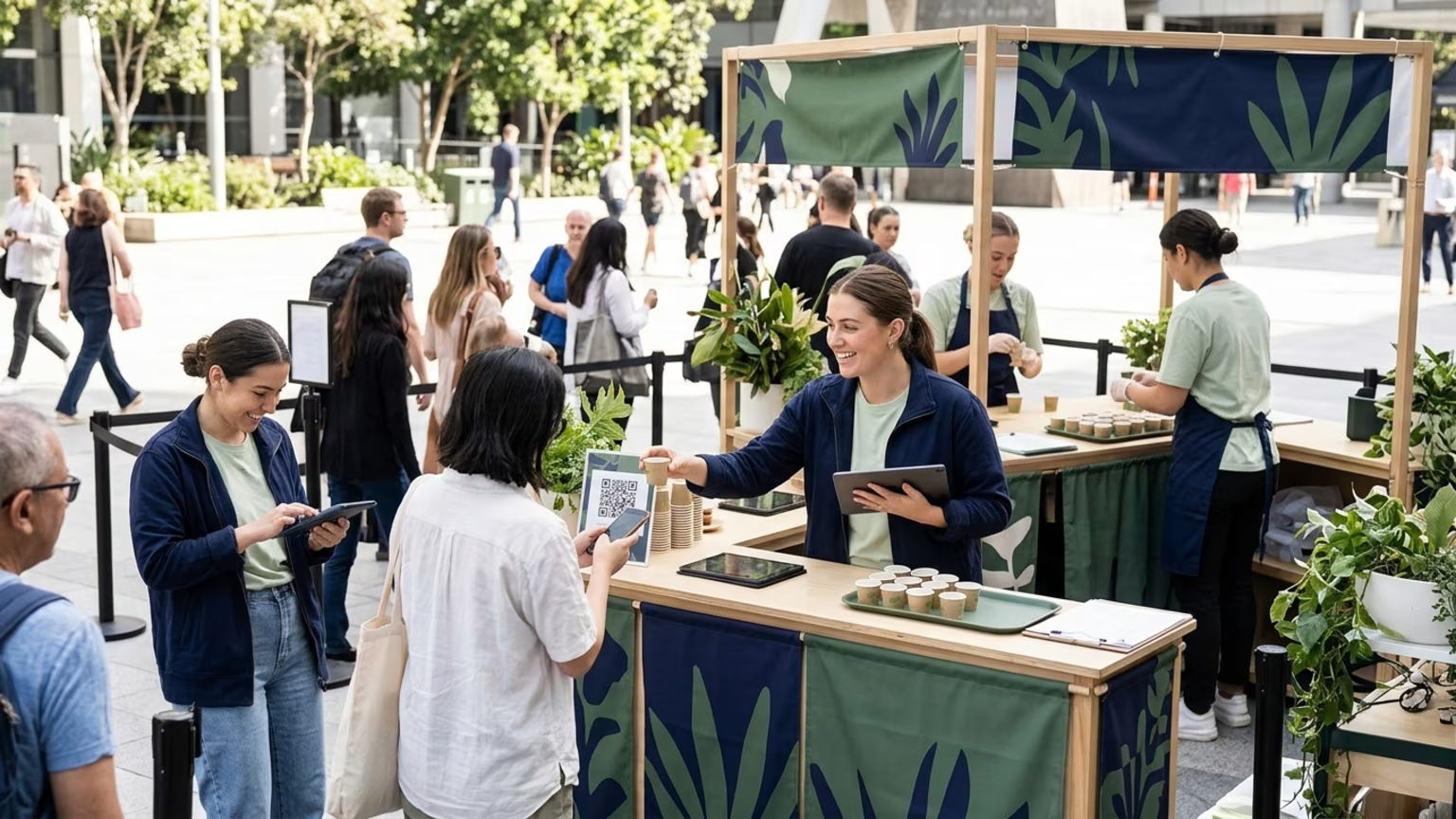
Your empty sample cartons are not a sales result. Neither is the crowd around the truck. Treating either one as proof of retail sell-through gives the activation credit before the commercial work has been demonstrated.
That is our hot take: a sampling program should earn its creative ambition through execution. The product needs a useful encounter with the right audience. The brand also needs a defensible account of what happened after the handoff.
This is not an argument against memorable experiences. It is an argument against letting a memorable experience become the entire business case. For a marketing leader defending Return on Investment, the question is not whether the activation looked successful. It is whether the program produced outcomes worth funding again.
The mainstream mistake is treating sampling as a production brief rather than a commercial program. The vehicle gets approved. The experience gets rendered. The report gets a place for photos and total attendance.
Meanwhile, the connection to retail remains a sentence about driving awareness and purchase intent. Which stores matter? Which product should shoppers buy? What information will show whether anything changed?
Those are not reporting details to settle after the activation. In our view, they belong in the original commercial brief. Without them, a polished experience can become a beautiful dumpster fire: plenty of visible activity with no agreed way to evaluate its business value.
For the CMO, that is the anxiety behind a substantial event commitment. The budget is real. The logistics are demanding. Yet the final presentation may offer a crowded footprint and no qualified pipeline.
An impression count cannot answer a question about purchases. A photo library cannot answer a question about retailer meetings. Those outputs may have value, but they should not be used to answer a different question.
The problem is not aesthetics. The problem is allowing aesthetics to stand in for an operating plan. We believe creative work deserves a stronger brief than “make people stop.”
At Makai, our alternative starts with a simple belief: a welcoming product conversation and disciplined execution belong together. Aloha-style warmth should make participation feel human. Operational rigor should give that participation a commercial purpose.
A friendly ambassador is not a substitute for product availability. A detailed reporting plan is not a substitute for a useful conversation. Our position is that neither side should have to compensate for the absence of the other.
We specialize in retail demos and product sampling programs, alongside roadshows that bring brands face to face with their audiences. These programs are designed to drive trial and build consumer relationships while accelerating retail velocity across locations. Our retail demonstrations use trained brand ambassadors for real conversations and product trials.
We have been connecting brands with people through live experiences and retail programs since 1995. That history informs our preference for execution that can support a business discussion after the event equipment is packed away. Makai's integrated services extend from permitting to CRM reporting.
Our four-week, multi-market Costco sampling program for Pulmuone's PlantSpired line offers a concrete example. The program delivered more than 65,000 samples and recorded an 18 percent sold-to-sale rate. It gives us a first-party example of structured retail sampling connecting trial with purchase.
The editorial lesson is not that every program should copy that format. It is that sampling deserves a purchase-oriented business case, not just a distribution target. Warmth is how the interaction should feel; operational discipline is how the program should hold together.
Start by deciding what commercial question the activation needs to answer. A consumer roadshow and a trade show presence should not inherit the same definition of success simply because both involve handing out product.
For consumer sampling, the question might concern product trial and subsequent retail action. For a buyer-facing activation, it might concern qualified conversations and retail meetings booked. These are different outcomes and deserve separate reporting.
The recent consumer research gives useful context. In OAAA-commissioned Harris Poll research, 51% of respondents said product samples or trials would draw them to a live marketing event. Among attendees, 40% said they made a purchase after attending a live marketing event.
The same research found that 30% said they looked for a product in stores after a memorable live brand experience. Another 27% said they later purchased the product. These findings make the path beyond the event worth examining.
Here is the evidence boundary: OAAA reports survey responses rather than independently verified transactions. Its release does not describe a control group or individual matching between sample recipients and purchases. Event codes can capture some purchases while missing others; aggregate point-of-sale comparisons do not identify which sampled individuals bought. Neither this survey nor the practical approaches below establishes a universal causal attribution method.
A practitioner discussion of live-event attribution provides a useful distinction: an event-related purchase is not necessarily an incremental purchase. Our practical recommendation is to make that distinction visible in the brief and the readout.
Retail coordination should establish what the program is trying to influence before product reaches the field. The practical planning questions include:
These are practitioner recommendations rather than a retailer-approved universal workflow. Their purpose is to connect the activation plan with information the retail partner can actually provide.
Our view is that a program should promise only the analysis its available data can support. If store-level sales are unavailable, the brief should not promise a store-level sales conclusion. That is a scope decision to make before launch.
A sample introduces the product. The next action should explain what an interested shopper can do with that interest.
An event-specific offer or code can create a trackable response. A QR destination can provide another response signal. Neither needs to become an elaborate technology project to have a defined role in the measurement plan.
The useful question is what each action represents. A scan is a scan. A redemption is a redemption. A captured purchase belongs in its own category.
That distinction also matters when connecting event responses with retail follow-through. For lead-generating programs, capture and CRM tagging should support the intended follow-up rather than leave an undifferentiated contact list. Consumer purchase activity and qualified retailer opportunities should remain separate.
A useful reporting structure gives each result an honest label:
Record activation locations and dates on dimensions compatible with the sales data. Review the same stores and periods. Where feasible, use a matched comparison group and explain how the estimate was produced.
Our Little Debbie Share a Smile Tour illustrates why categories matter. We ran the activation across 21 markets using a branded truck and trailer alongside Cupcake Smart Cars. The tour distributed 224,534 cupcakes and generated more than 2.4 million brand impressions.
We also captured 9,500 photos and 340 videos while earning coverage from three local television stations. Those figures describe different outputs. Distribution belongs in one reporting category; exposure and content belong in others.
Our editorial position is that these results deserve recognition on their own terms. They do not need to be renamed as sales to sound useful. The same discipline should guide how live-event results are connected with retail performance.
The core takeaway is that sampling should be judged as an executed commercial program rather than a beautiful object. Demand a clear retail objective and a useful human interaction. Then demand reporting that separates what was distributed from what was observed and what was estimated.
A strong creative idea still matters. But it earns its place by serving the product encounter and the business question. The most attractive activation is not automatically the most accountable one, and accountability should never be left for the recap deck.
Visual ambition still needs a route from product trial to qualified follow-up; Makai's retail demonstrations center on trained brand ambassadors and shopper conversations. Weak post-event follow-up and disconnected CRM routing are problems Makai addresses through experiential campaigns and trade show activations designed to connect brief interactions with qualified leads for premium CPG brands.

30 Years Experiential & Retail Activation Partner for CPG & Beverage Brands | Multi-Market Demos, Roadshows & Costco/Club Programs That Actually Sell


