Robbie Thain
Founder, CEO

Stop treating sampling crowds as sales proof. Connect human engagement with baselines, purchase data, repeat behavior, and clear reporting limits.
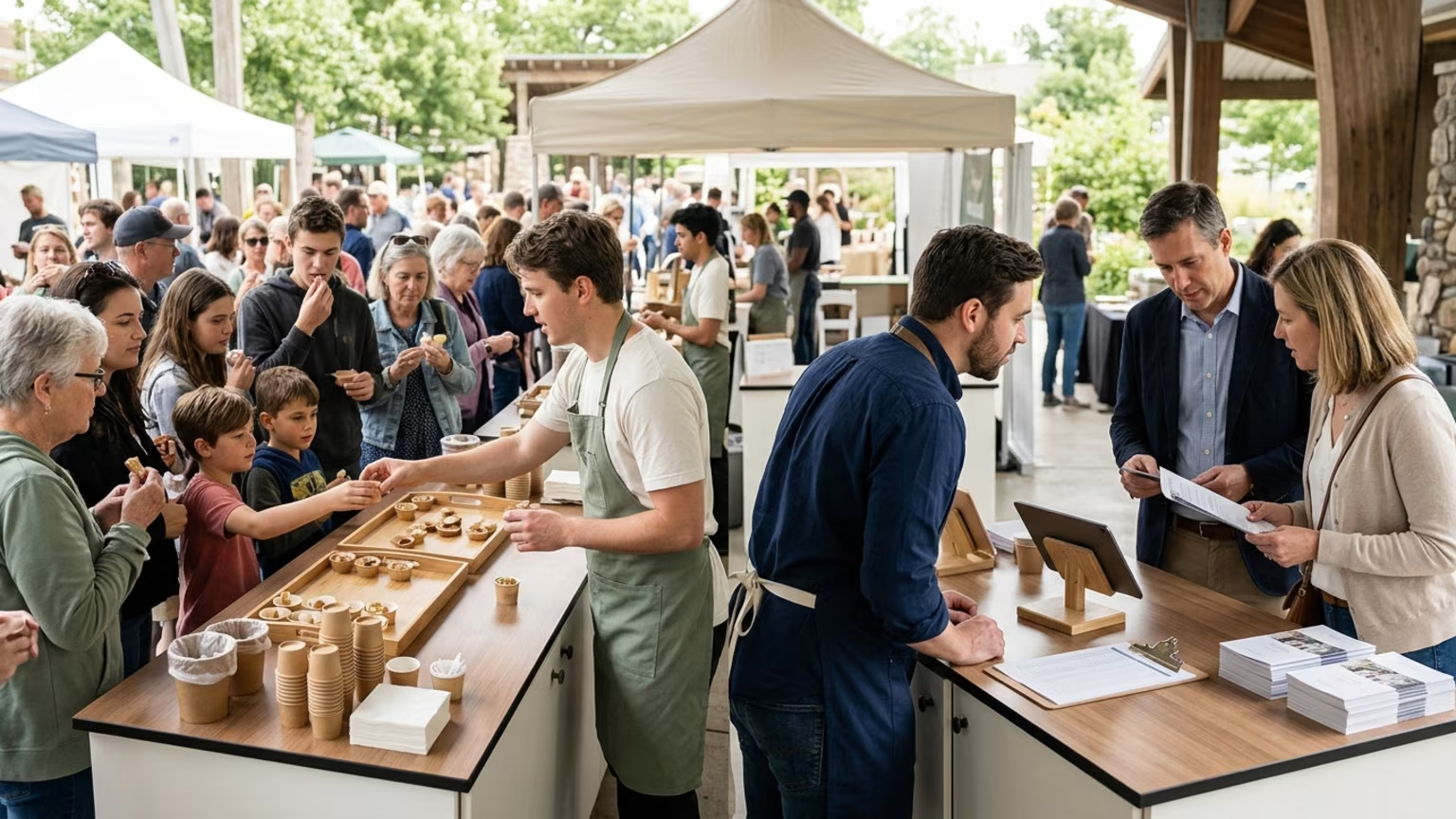
Your sampling crowd is not your sales pipeline. A line around a beautiful booth shows that people stopped. It does not establish that the right people tried the product or that the experience created a purchase.
The sacred cow worth retiring is the belief that a bigger spectacle makes a stronger commercial case. We believe creative work earns its budget when it supports a useful human interaction and a measurable next step.
That is not an argument for dull experiences. It is an argument against asking aesthetics to do the job of execution. If the recap celebrates the crowd but cannot explain what happened after the sample changed hands, the commercial question remains unanswered.
The CMO's nightmare is a six-figure activation followed by a gorgeous recap and no qualified pipeline. Our objection is not to the ambition. It is to a plan that resolves the visual details while leaving the commercial handoff unfinished.
Consider the operational questions hiding behind the rendering. Who should receive the sample? What conversation should accompany it? What counts as a qualified lead or a completed purchase?
When those questions stay vague, the report has little choice but to lean on whatever was easiest to count. Attendance becomes the headline. Samples become the victory. The next budget discussion becomes an argument about whether those numbers meant anything.
A Return on Investment (ROI) conversation needs more than proof that the activation happened. It needs an agreed business outcome and evidence appropriate to that outcome. Otherwise, the team is defending production quality when leadership is asking about commercial value.
Our view: this is where a beautiful activation becomes a beautiful dumpster fire. The display may be doing its job. The operating plan has not defined what happens next.
At Makai, we believe warmth and discipline belong in the same experience. Aloha-style hospitality means treating the person across the sampling counter as a person rather than a tally mark. Operational discipline means giving that interaction a clear purpose and a measurable commercial next step.
Our retail demonstrations put trained brand ambassadors into real conversations and product trials. Our integrated services extend from permitting to CRM reporting. That combination reflects our positioning: human connection supported by the execution needed to pursue measurable sales pipeline.
We create experiential programs that connect emotion with action. Our work blends creativity with strategy and data. We also craft experiences that engage all five senses because a product should be felt and experienced rather than merely displayed.
But sensory creativity is not a substitute for accountability. We believe the strongest experience makes room for both: a welcoming interaction for the shopper and a clear business question for the brand team. Neither should have to disappear to make room for the other.
We managed a four-week, multi-market Costco sampling program for Pulmuone's PlantSpired line. The program delivered more than 65,000 samples and recorded an 18 percent sold-to-sale rate. The useful editorial lesson is the pairing of a distribution measure with a purchase-related measure rather than presenting distribution alone.
We also integrate QR codes and mobile technology into retail experiences and events, as well as tours. For us, those tools should connect physical participation with a useful next action. Technology should serve the conversation and its intended outcome rather than become another attraction competing with the product.
Start with the commercial question rather than the reporting dashboard. Is the activation intended to generate product trial among target shoppers? Is the priority purchase or retailer confidence? At a trade show, is the desired outcome a qualified retail meeting?
Choose the primary outcome before execution. Then keep the supporting stages visible without treating them as interchangeable:
Samples distributed to target buyers and retail meetings booked are tangible outcomes worth reporting. They still answer different questions. A consumer trial and a retailer meeting should not be combined into a single impressive-looking total.
A retail-activation practitioner guide recommends comparing activation-period point-of-sale results with a matched baseline. It advises aligning the day of week and hours where possible. It also describes matched control stores and historical same-period comparisons, along with pre-activation periods, as possible approaches.
The practical implication is to agree on the comparison before reviewing the outcome. Where feasible, assess activated stores or markets against similar locations without the activation. If the comparison is historical, identify that choice at the outset rather than presenting it later as equivalent to a concurrent control.
This is the difference between asking whether sales happened and asking whether performance changed relative to a useful reference. Our discussion of connecting activation reporting with sales evidence develops that distinction further.
The same practitioner guide recommends using the activation window for point-of-sale comparisons. It describes repeat purchase as a later cohort outcome measured through loyalty-program or CRM data.
Those are different reporting jobs. An immediate sales readout should answer the purchase question for its stated period. A repeat-purchase readout should follow the defined customer group through a window aligned with the product's purchase cycle.
Agree in advance on the sales data and customer records needed for each question. Also agree on what constitutes a qualified lead or a repeat purchase. A reporting deadline should not silently become the definition of customer behavior.
The practitioner guide recommends point-of-sale data for sales comparisons. It also describes codes or receipts for traceable purchases and loyalty or CRM cohorts for repeat-purchase measurement.
That gives teams a practical way to separate the evidence. Use participation records to describe engagement. Use transaction evidence to describe purchases. Use identifiable customer cohorts to assess whether those customers bought again.
The data plan belongs beside the experience plan rather than behind it. Deciding what customer information is needed also shapes the capture experience. Our guide to planning useful event data collection addresses that operational connection.
A vendor-published report summarizing sampling research distinguishes accelerated purchases from genuinely additional purchases and purchases that replace others. It argues that a comparison group is needed to isolate incremental gain. It also reports that sampling effectiveness varied among brands within the same category.
Keep the limits together in one place: state whether the comparison was matched or historical and whether purchases could be linked to exposed consumers. Identify unavailable data and distinguish self-reported attitudes from observed transactions. Without a suitable comparison, describe tracked purchases as attributed or associated outcomes rather than proven incremental sales.
Neither the practitioner guidance nor the vendor research summary establishes a universal conversion benchmark. Our Pulmuone figures belong to that program rather than serving as a forecast for another brand. Purchase intent should remain an attitude measure rather than being relabeled as a completed sale.
That disclosure gives leadership a usable interpretation of the result. It should not bury the finding or turn every sentence into a hedge. State the result clearly, explain its boundary, then identify the next business decision it supports.
We provide clear reporting on reach and trials, as well as leads and sales. Our measurement approach tracks awareness alongside engagement and conversion. The purpose is to turn brand moments into actionable data that guides campaign optimization.
For a leadership recap, we favor a direct narrative: the intended outcome, the observed result, the comparison used and the decision ahead. Supporting activity counts belong underneath that story. They explain delivery without taking the place of the business result.
A report should leave the team better able to judge the activation. More charts are not automatically more clarity. The standard is whether the evidence supports a sensible next decision.
The core takeaway is simple: demand execution before applauding aesthetics. Creative work deserves attention when it helps the right people experience the product and take a meaningful next step. Warm human engagement and disciplined measurement are not competing priorities. Together, they give an activation a commercial purpose and give leadership a defensible account of what happened.
Brand managers are accountable for connecting retail sampling with purchases; under Makai's retail demonstration service, trained brand ambassadors conduct the shopper interaction. Makai supports in-store sales through product trial and direct dialogue for food and beverage teams running regional or national campaigns.

30 Years Experiential & Retail Activation Partner for CPG & Beverage Brands | Multi-Market Demos, Roadshows & Costco/Club Programs That Actually Sell


