Robbie Thain
Founder, CEO

Honest Kids’ reported zoo confessional linked family play with lunchbox-note packaging. Makai examines the staffing, space and measurement implications.

On October 12, 2026, EventMarketer reported that Honest Kids (the organic juice brand) had run a back-to-school pop-up confessional at Chicago’s Lincoln Park Zoo in August. The activation connected a playful family interaction with limited-edition packaging designed to carry lunchbox notes.
For CPG and beverage leaders, the useful detail is that connection. A seasonal product feature became the basis for an experience people could participate in. The operational question is how to preserve that connection while making the physical encounter serve a measurable business purpose.
According to EventMarketer, the reported activation had three connected elements:
The confessional was not a product-review exercise. Children were talking about their parents rather than evaluating the juice. That distinction matters when describing the campaign internally or deciding which results a similar program should capture.
The creative connection ran through the family relationship. Parents could put a personal message on the packaging. Children could offer their own perspective through the live interaction. The product sat within that exchange rather than becoming the subject of every conversation.
Our reading is that the occasion gave the idea its structure. Back-to-school was connected to a specific product use case, not just a seasonal headline attached to a giveaway. That is a useful design principle for marketers deciding whether a pop-up concept belongs with their product.
EventMarketer’s brief account does not provide attendance, sampling volume, cost or sales impact. It also does not establish retail conversion or changes in brand perception. Treat this as a reported design example rather than a documented performance case.
For us, aloha and operational discipline belong together. A welcoming interaction should feel easy for the participant. Behind it, the brand still needs a clear reason for being there and a clear definition of what progress looks like.
We believe the strongest part of this concept is its relevance to the buying occasion. The packaging feature and the activity both concerned the relationship between parents and children. That gives a marketing team a coherent idea to evaluate before moving into production.
Makai designs consumer events around interaction, emotion and engagement. We also specialize in retail demos and product sampling programs that bring brands face to face with their audiences. Those formats are designed to drive trial and build consumer relationships while supporting retail velocity across multiple locations.
That positioning shapes our reaction to the Honest Kids example. Participation deserves attention, but it should not replace the product’s role. A playful encounter and a useful product conversation can belong in the same experience without making every participant deliver a testimonial.
For broader context, Chief Marketer reported in September 2026 on Spiro’s research conducted with The Harris Poll. The survey of 2,015 U.S. adults found that two in five shoppers purchased at real-world marketing events. Among reported effects after a memorable retailer event, 30% searched for more information, 30% later looked for the product in stores and 30% viewed the product or retailer more positively.
Those are respondents’ reported behaviors around real-world marketing events generally. They do not measure the Honest Kids activation or establish that participation caused a purchase.
For a marketing leader, the value of that research is the range of outcomes it identifies. Product interest and later store activity are different from participation at the event. A useful measurement brief keeps those outcomes distinct rather than combining them into a vague claim of engagement.
That is also why field reporting tied to specific outcomes belongs alongside the creative brief. Return on Investment requires a commercial frame. The interaction tells the team what happened in the space; separate measurement must address what happened afterward.
The Honest Kids example does not introduce a new rule for field marketing. It presents a different execution problem from a straightforward sample handoff: the activity has its own subject, while the product has its own purpose. Our operational view is that both need to remain legible throughout the experience.
For a comparable activation, the staffing brief should account for the invitation to participate and the introduction to the product. The participant should understand the activity without losing sight of the brand behind it. That is a planning priority, not a claim about how Honest Kids staffed its event.
Makai’s retail demonstrations use trained brand ambassadors for product trials and real conversations. That first-party capability is relevant because a sample and a conversation perform different jobs. The sample provides a direct product encounter; the conversation gives the brand room to explain its relevance.
Our stance is not that every family interaction needs a lengthy pitch. It is that the creative activity should leave room for product understanding. Otherwise, the team risks designing a memorable game with a weak connection to the item it is there to promote.
This is the practical tension behind coordinating creative and field execution. The activity and the ambassador brief should support the same purpose rather than competing for the participant’s attention.
A physical venue gives an activation a setting. It does not resolve how the interaction and sampling will fit together. In a comparable brief, we would evaluate the footprint as a place for both participation and product contact rather than treating the creative feature as the whole experience.
Makai’s integrated services extend from permitting to CRM reporting. From our perspective, that scope connects the right to operate in a location with the work required to make the experience commercially useful. Site permissions and operating requirements belong in the planning discussion rather than being treated as a separate creative afterthought.
Our Glanbia engagement offers a first-party example of coordinated physical execution. At Natural Products Expo West 2025, we designed and managed a 40 by 20 foot trade show environment that brought think!, Isopure, Optimum Nutrition and Amazing Grass into one space. We handled concept, operations, staffing and breakdown.
More than 14,000 recorded product samples were distributed across the activation stations. For this discussion, the useful lesson is the scope of responsibility around the footprint. A physical concept involves more than its central attraction: the surrounding operations are part of the experience’s delivery.
A zoo pop-up and a multi-brand trade show environment are different formats. The shared planning issue is how the product encounter fits into the overall space without becoming disconnected from the idea that attracted the visitor.
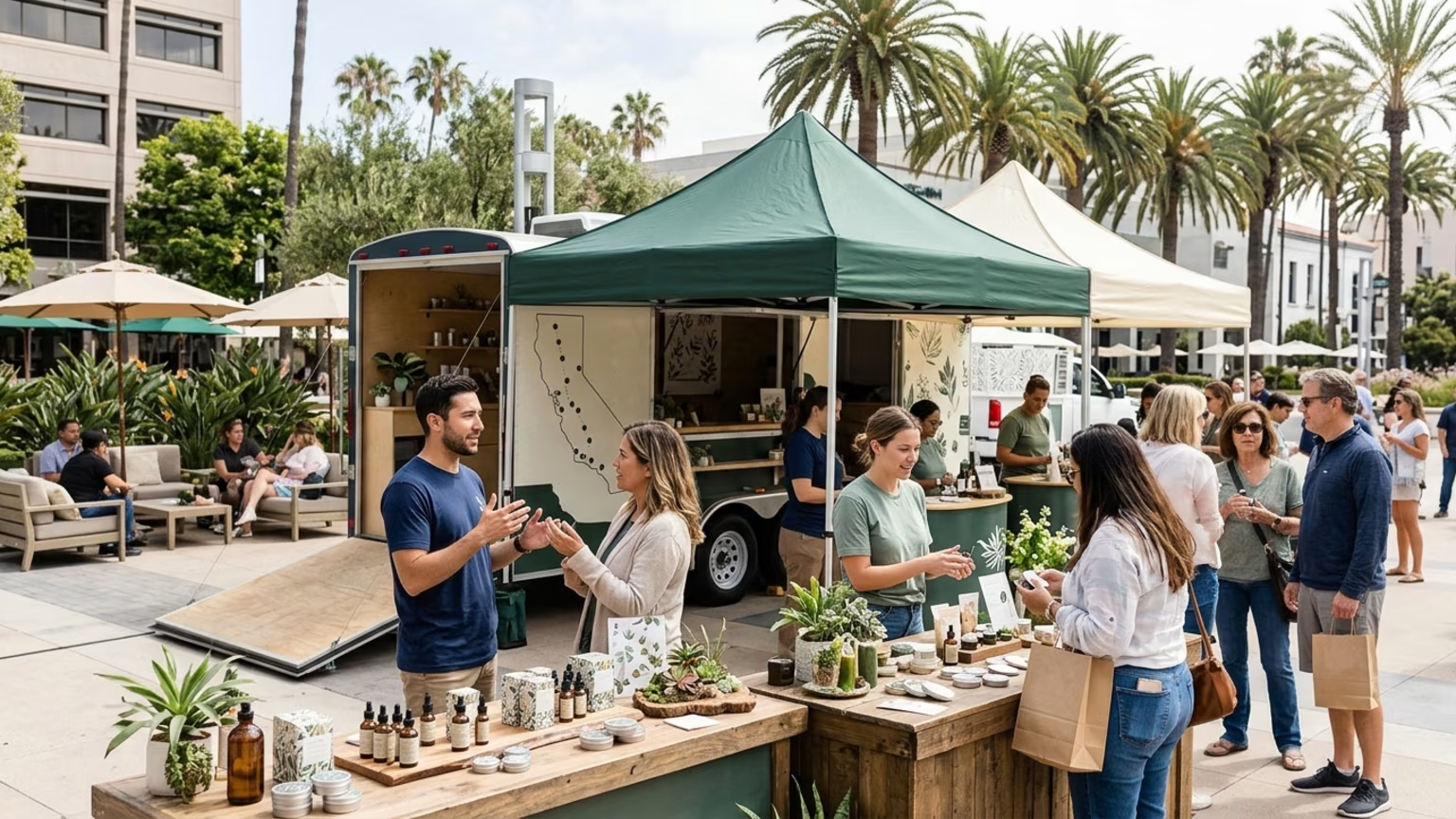
Our Little Debbie Share a Smile Tour shows why distinct measures matter. We ran the program as a 21-market mobile activation using a branded truck, trailer and Cupcake Smart Cars. Across the tour, we distributed 224,534 cupcakes and generated more than 2.4 million brand impressions.
Those figures describe different outputs. Product distribution is not the same measure as impressions. Neither should be renamed as qualified pipeline simply because the campaign took place face to face.
The same discipline belongs in a family-facing pop-up brief. Participation describes the creative interaction. Sampling describes the product contact. Retail interest and qualified leads belong in their own measurement categories when those outcomes are part of the objective.
For us, a useful operational brief connects those categories without pretending they are interchangeable. This keeps a strong creative idea from carrying a performance claim that the reporting cannot support. It also gives the marketing team a clearer basis for evaluating the next activation.
The reported Honest Kids concept linked a family interaction to a seasonal packaging feature. For Makai, the lesson is to retain that clarity as the idea moves into staffing and physical execution. Measurement then needs to match the business objective rather than borrow credibility from a lively scene.
For the CMO or VP planning the next seasonal activation, what will connect the equivalent of that Lincoln Park Zoo confessional to measurable product trial and qualified pipeline before the creative concept is approved?
A family pop-up can make the seasonal story tangible, but the live interaction still needs a clear connection to the product and a defined purpose for the brand. Makai designs consumer events that bring brands and people together through interaction, emotion and engagement.

30 Years Experiential & Retail Activation Partner for CPG & Beverage Brands | Multi-Market Demos, Roadshows & Costco/Club Programs That Actually Sell