Robbie Thain
Founder, CEO

BOS Ice Tea transformed Johannesburg’s Rosebank district into a participatory BOS Studio. Learn how interactive street pop-ups compare to passive billboards.
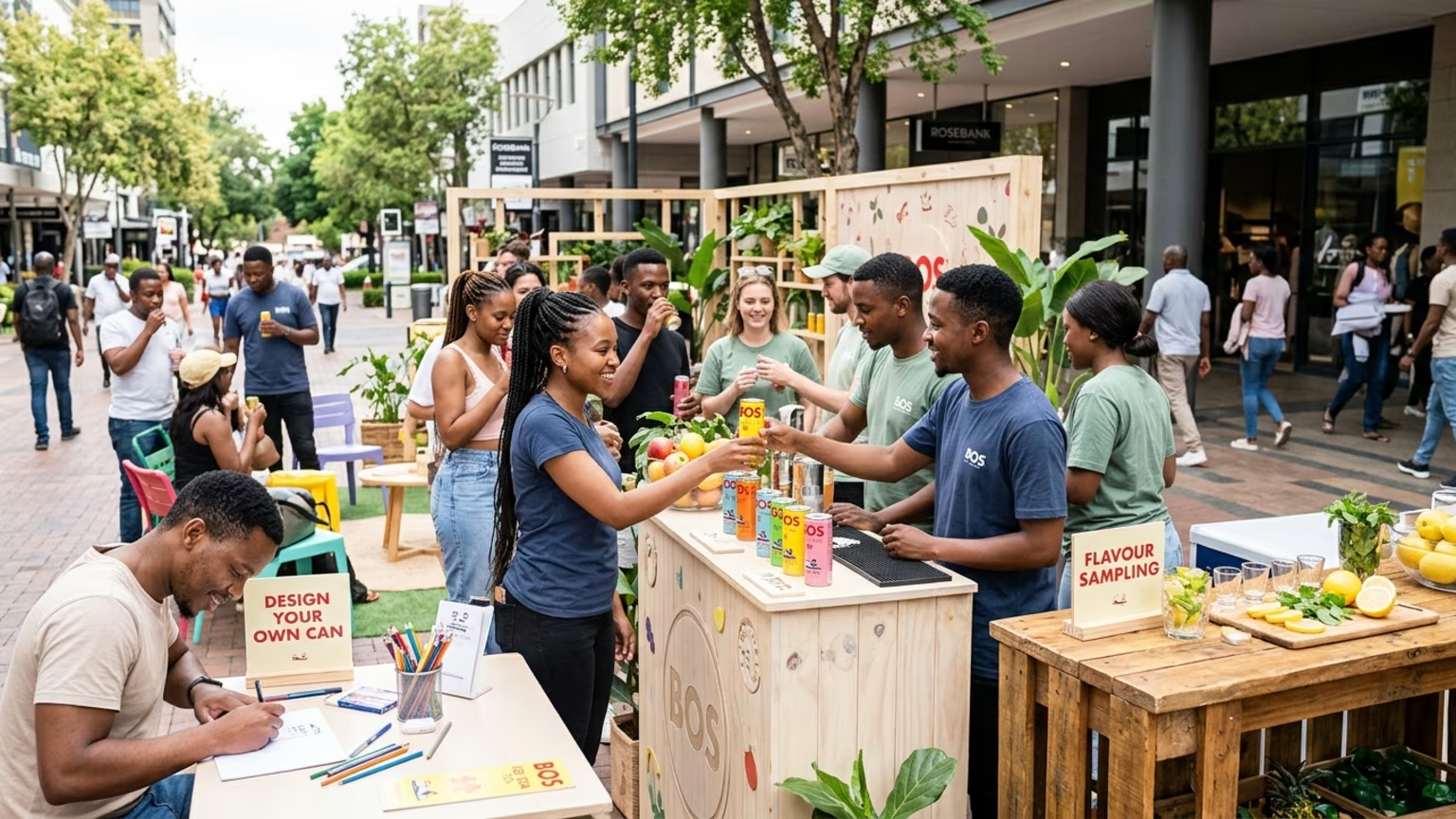
A blank wall on a busy sidewalk sits ready for public contribution, flanked by paint stations and an unexpected soundtrack. For BOS Ice Tea, the strategic choice came down to buying passive billboard space or building a physical environment that requires the public to step inside. The contrast between these two approaches shapes the modern marketing landscape.
Conventional advertising relies heavily on presenting a finished brand display for the public to observe. The core mechanic focuses on visibility, high-volume media placements and repeated messaging. Brands pay for foot traffic exposure, trusting that these ambient impressions will eventually drive product consideration. There is minimal expectation of immediate, physical consumer engagement at the point of display.
Logistically, this approach requires very little active management once the campaign is live. The primary constraints are securing prime real estate and managing the upfront creative production. There is no need for on-site staffing, crowd control or complex permit negotiations. The asset simply exists in the physical environment.
However, consumer responsiveness to marketing focused solely on visibility is shifting. A recent Business Standard analysis argues that FMCG brands must evaluate demand across online discovery, quick commerce and offline purchasing. The analysis notes that these channels influence one another, requiring a broader view beyond the final transaction point. Simply existing on a wall may no longer provide enough friction to capture attention in a crowded retail corridor.
The alternative approach replaces passive media with active environments that invite the public to participate. A clear example is BOS Ice Tea running its BOS Studio in Johannesburg’s Rosebank district from August 28 to 30. According to Bizcommunity, the project replaces conventional advertising displays with paint, music, blank walls and public participation. The activation invites people to step off the street and contribute directly to the installation.
Rather than presenting a static display, the space evolves as visitors incorporate their work into a collective portrait of Johannesburg. William Battersby, BOS Ice Tea’s CEO, noted that the brand wanted to create an unexpected opportunity for people to share their creativity. He added that the activation gives people a place to switch off, pick up a brush and create without overthinking. There are no formal classes or workshops.
Visitors are simply encouraged to create freely without worrying about technical correctness. This format completely changes the logistical footprint of the campaign. An open-ended painting experience requires careful staffing, material replenishment and tight weather planning. The operational complexity is much higher, but the physical interaction creates a branded environment that can generate significant dwell time.
This evolving artwork creates a natural content opportunity because the installation changes as more people participate. The resulting artwork is intended to become a collective portrait of Johannesburg, giving visitors a tangible role in the experience. Building high-impact activations effectively requires a team that understands the nuances of live event management. Brand protection guidelines and queue management must function quietly in the background so visitors can focus entirely on their artistic contributions.
Static billboards and conventional displays remain highly effective when the primary goal is sheer scale and ambient awareness. A conventional placement dominates when a brand needs to communicate a simple message to millions of commuters without requiring any operational overhead. If the objective is broad national targeting without the need for immediate consumer action, passive media delivers a reliable baseline.
This approach also wins when budgets are strictly allocated to pure media reach rather than localized engagement. It is the unarguable winner for maintaining an always-on brand presence in high-traffic transit hubs. Brands do not have to worry about the unpredictable nature of live crowds. There are no material resets required, and safety controls are limited to basic structural compliance.
Participatory environments excel when a brand needs to generate dwell time, encourage content creation and build deeper audience connections. BOS Ice Tea’s CEO described Johannesburg as a city that is at its best when it is creating. By tapping into local cultural relevance, a brand can turn a standard streetscape into a true destination. This format creates a physical reason to stop rather than walk past.
This localized approach aligns closely with industry guidance on audience segmentation. Circana advises smaller CPG brands to target at the consumer, market, banner and store-tier levels rather than treating the market as a single national audience. When brands need localized relevance, an interactive pop-up allows them to connect with a specific community. To ensure success, this targeted setup requires aligning field staff and event labor to manage the live interactions effectively.
A Brand Manager in the CPG space shared: "Makai transformed our test-drive activation into an emotional brand journey. They connected technology, lifestyle, and experience seamlessly, and turned casual visitors into loyal fans." We successfully integrated multiple experience layers to convert casual participants into committed brand advocates. This level of emotional connection is exactly where active participation dominates passive displays.
This strategy is critical during product launches or brand revitalization efforts. When a brand needs to prove its value through physical interaction, a participatory system creates a memorable exchange. It is the necessary approach when turning raw consumer attention into measurable pipeline is the core campaign objective.
The final verdict between these two tactics comes down to the operational model and the underlying measurement architecture. While the BOS Studio concept is highly engaging, the Bizcommunity report does not identify an agency partner, disclose the activation budget or publish attendance and Return on Investment figures. Participation alone does not automatically prove commercial effectiveness. A busy activation can produce impressive photographs without demonstrating incremental revenue.
One industry commentary recommends tracking dwell time, completed interactions, leads and assisted sales alongside reach. Brands must transition from measuring sheer exposure to evaluating the depth of interaction. To evaluate these campaigns properly, experiential leaders should prioritize tracking field pop-up analytics that connect back to the bottom line.
To maximize value, experiential marketers must connect the physical activation to nearby retail locations and measurable commercial actions. The physical experience should not end at the venue. The source emphasizes paint, music, blank walls and collective artwork, but it does not explain how prominently BOS Ice Tea products appear within the experience. This creates a potential brand-linkage risk if the creative concept overshadows the actual beverage.
If an interactive pop-up generates significant on-site engagement but lacks evidence of downstream purchase, the business value remains questionable. The activation should therefore be connected to nearby retail, product trial or matched-market analysis wherever operationally practical. By blending creative freedom with tight operational controls, brands can ensure that live engagement translates into trackable results. The true operator advantage lies in building a participation system that captures attention while driving downstream retail success.
Replacing passive out-of-home advertising with highly participatory street activations requires intense operational control to ensure creative freedom does not devolve into logistical chaos. Makai solves the challenge of navigating complex event logistics, permits, and staffing by assuming full execution control. We deploy our Brand Activations capability to create high energy activations that turn awareness into participation and drive measurable consumer response.

30 Years Experiential & Retail Activation Partner for CPG & Beverage Brands | Multi-Market Demos, Roadshows & Costco/Club Programs That Actually Sell