Robbie Thain
Founder, CEO

Project Worldwide APAC CEO Ben Taylor argues experiential marketing must move away from predetermined menus and venues to focus entirely on business outcomes.

On September 21, 2026, Branding in Asia published an interview with Ben Taylor detailing how experiential marketing is structurally changing. Taylor, who serves as CEO of Project Worldwide APAC, argued that the industry must move away from predetermined venues and attendee counts. His central directive is that marketers must design live experiences around specific business outcomes rather than isolated tactical gimmicks. The executive presented audience insight, localization, and purposeful technology as the foundation for modern brand connection.
Historically, experiential marketing operated as an afterthought built around a rigid schedule and an arbitrary attendee count. Taylor refers to this outdated approach as a focus on “menus and venues” rather than defined business objectives. Now, the baseline standard requires teams to define desired outcomes during the drawing-board stage. This ensures that key performance indicators are integrated into the experience from the very beginning.
The new framework revolves around a clear starting question: what do you want the audience to think, feel, and do? Taylor identifies three explicit measurement pillars for these activations. These pillars are brand sentiment, audience engagement, and business results. By working backward from the intended audience response, agencies can dictate the appropriate format required to hit those goals.
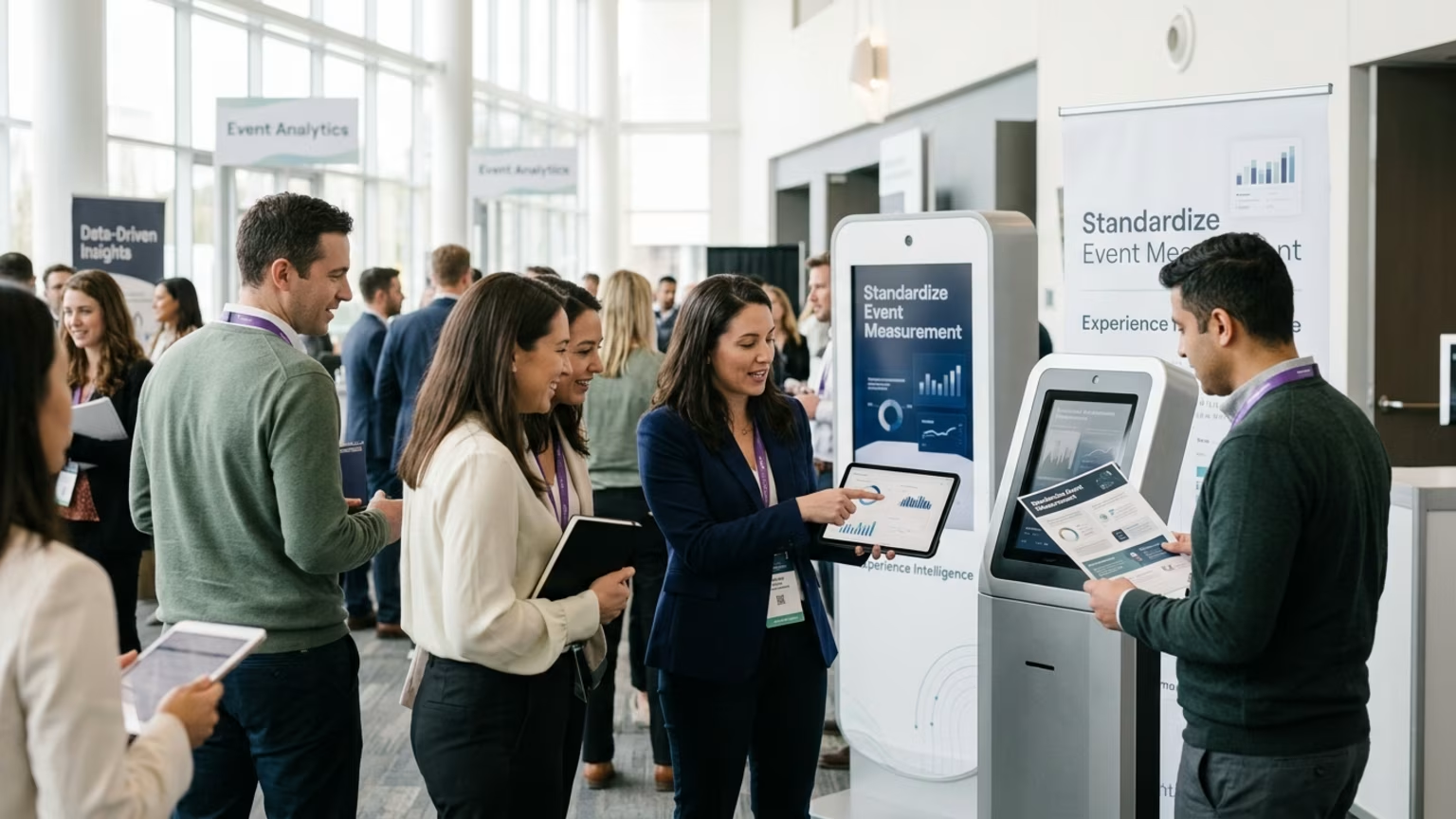
Agencies and internal marketing teams must prove their strategic value to secure long-term budget commitments. According to Taylor, experiential marketing historically suffered from an attribution problem because it was valued intuitively rather than analytically. To overcome this hurdle, Project Worldwide invested in a standardized measurement methodology intended to scale globally. While the interview does not disclose the underlying formula, the agency applied this framework directly to a major enterprise client.
By mapping one program directly to the client CMO’s specific business KPIs, the agency secured massive organizational trust. Taylor notes that the agency retained the client, became its Agency of Record, and won its entire multi-market experiential portfolio. This case illustrates exactly why operational teams must connect their physical footprint to executive-level business goals. When experiential operations align with the broader marketing strategy, the entire program gains vital executive protection.
We believe this shift toward measurable business impact is completely necessary for physical marketing operations. Across our history, we have delivered more than 1,000 campaigns in all 50 states for more than 200 brands. That track record has given us experience across different products, audiences, and market conditions. When you manage live experiential marketing campaigns for premium CPG brands, you have to prioritize actual revenue generation.
A beautiful booth design means nothing if the consumer interaction fails to drive purchase behavior. We create hands-on brand moments that connect emotionally and turn customers into ambassadors. However, our process relies on blending creativity with strict data capture to ensure every interaction drives measurable results. If a beverage brand wants to increase retail market share, the field strategy must aggressively support that exact metric.
When you build measurement into the architecture of an event, the downstream operational requirements completely change. Field marketing directors can no longer rely on unscripted street interactions or vague post-event summaries. Brand activation services must now include precise data-capture protocols at the point of interaction. Staffing models must shift from hiring generic promotional models to deploying trained ambassadors who understand data routing.
This structural shift dramatically impacts booth flow and physical footprint design. Instead of maximizing pure volume, operators must curate spaces that facilitate qualified conversations and clean CRM handoffs. If your primary objective is a specific business result, the physical layout must funnel participants toward that action. This requires strict coordination between storage, logistics, and front-line execution teams.
Furthermore, technology integration becomes a highly disciplined functional requirement rather than a flashy distraction. Project Worldwide currently uses computer vision to read audience emotions in real time while maintaining strict data-privacy requirements. According to the interview, this system indicates whether guests appear inquisitive, surprised, or disengaged. We know that any technology deployed in the field must directly support data collection without breaking the human connection.
The transition to outcome-based planning changes how leadership evaluates the timeline for Return on Investment. When an agency maps a program directly to business goals, they must account for the specific commercial environment. The interview contrasts these environments directly to show why standardized metrics fail across different business models. A major enterprise buyer might represent a potential contract worth millions of dollars, requiring a much longer sales cycle.
Meanwhile, a consumer product might sell for less than $100 and be purchased several times per year. This massive economic gap proves that attendance numbers cannot serve as a universal benchmark for success. We have seen these distinct behavioral patterns play out repeatedly across our national and regional event coverage. When our crews manage execution and track reach metrics, we establish upfront agreements on how the audience interacts with the product category.
Immediate engagement numbers provide early performance indicators for fast-moving retail goods. However, converting an enterprise lead into a closed-won contract requires patience and highly disciplined data routing. Marketers who expect instant revenue from B2B trade shows often abandon successful campaigns before the sales cycle finishes. By treating retail and enterprise activations as entirely separate behavior systems, brands protect their marketing budgets from mismatched expectations.
Judging an event strictly by physical attendance is an outdated metric that ignores lead quality. Taylor points to Salesforce Dreamforce to illustrate this structural evolution. A decade ago, physical attendance at some Dreamforce events exceeded 100,000 people. Today, the physical audience has shifted to approximately 40,000 or 50,000 highly curated and senior decision-makers.
While the physical footprint shrank to target higher-intent buyers, the broadcast reach expanded exponentially. The interview notes that Dreamforce acts as a content platform with over 200,000 virtual viewers and over 90 million broadcast views. This demonstrates that a smaller physical activation can generate massive reach when paired with the right digital distribution. When managing experiential marketing resources across national campaigns, targeting the right buyer outpaces raw foot traffic.
We see this same trend toward localized, high-touch formats replacing massive centralized gatherings. Taylor notes that AWS now uses 10 smaller summits across APAC rather than relying on one flagship event. Adapting execution to local markets prevents the trap of lazy regionalism where a single template is forced onto diverse audiences. For instance, the Google Next event in Tokyo adapted to local audience discipline by running five simultaneous silent breakout sessions without room dividers.
When consumer brands execute field programs, the same principles of audience fit apply. The interview cites Maybelline’s launch of Sky Tubes Tubing Mascara, which tested the product on the slopes of the Southern Alps. Whether you are planning a massive product launch or reviewing experiential marketing case studies, the physical environment must directly support the intended consumer behavior.
This industry transition demands a ruthless audit of how your marketing team plans live engagements. If your field reporting relies exclusively on badge scans, your strategy is missing critical revenue indicators. Instead of relying on outdated menus and venues, modern programs must function as highly measurable conversion tools. When you look at your upcoming event calendar, are your physical activations built to capture trackable business results, or are you just paying for another unmeasurable crowd?
When marketing teams prioritize massive venue crowds over upfront performance planning, measuring actual business impact becomes nearly impossible. To solve inefficient post event follow up and CRM routing, Makai architects live experiences entirely around measurable pipeline outcomes. Through our Retail Demonstrations capability, trained brand ambassadors drive in store sales through real conversations and product trials.

30 Years Experiential & Retail Activation Partner for CPG & Beverage Brands | Multi-Market Demos, Roadshows & Costco/Club Programs That Actually Sell