Robbie Thain
Founder, CEO

Missed dock windows and damaged display freight threaten live tours unless multi-stop operating models, asset classification.
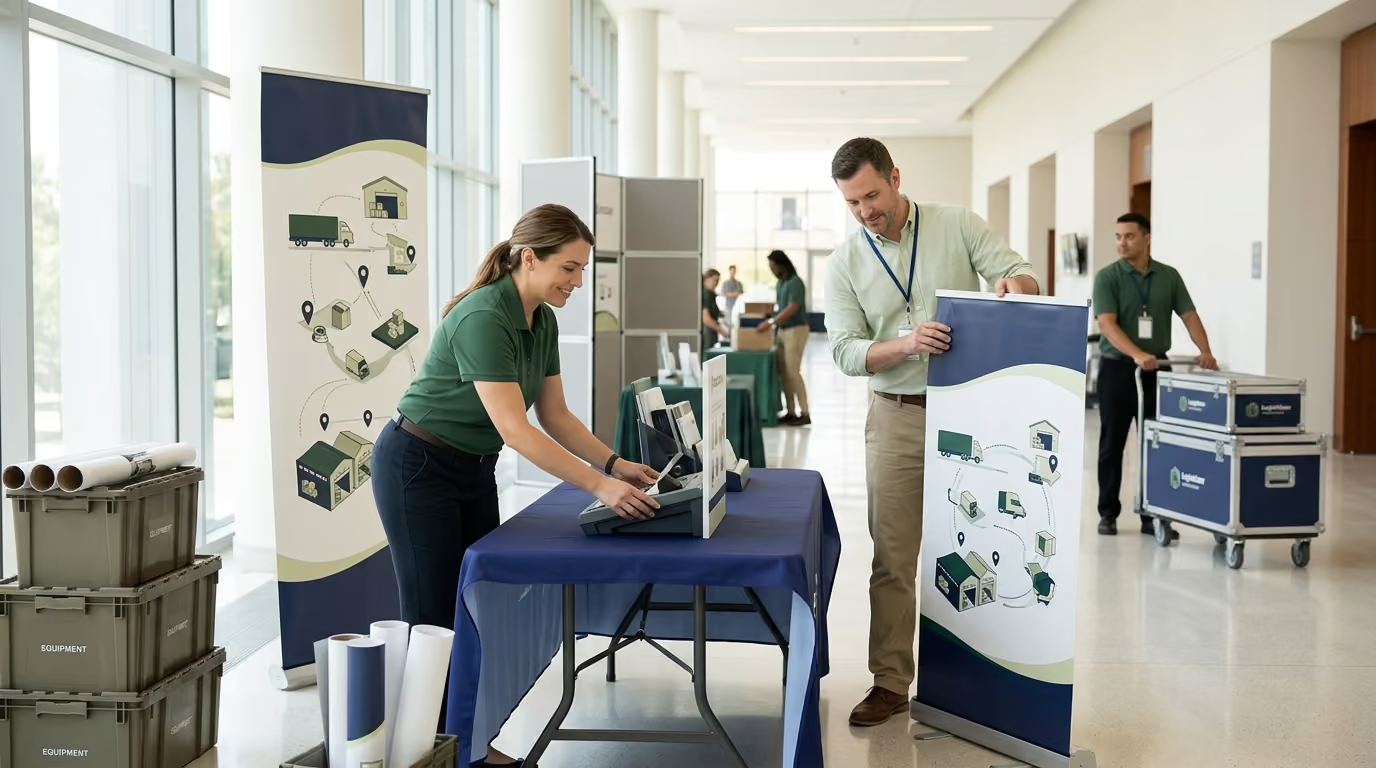
Product roadshow logistics is not standard freight distribution, nor is it a simple series of one-off trade show shipments. It is a synchronized mobile supply chain that moves physical brand architecture, technical assets, demonstration products, and field crews across a network of fixed, unmovable deadlines.
This guide provides an operational framework for brand directors, experiential marketing leads, and logistics managers who must move high-value assets between markets without schedule failures or budget overruns. Mastering these transportation dynamics ensures your live activations open on time, remain fully functional, and convert consumer attention into measurable business value.
The loading dock of a major convention center or city activation site is an unforgiving environment. A tractor-trailer carrying custom display architecture arrives at the venue marshalling yard two hours behind schedule because the carrier hit unexpected highway congestion. The driver misses the assigned receiving window. The venue general contractor cancels the dock reservation and pushes unloading to the end of the line.
Inside the hall, an expensive union installation crew stands idle at forty dollars per person per hour. The brand marketing team watches the clock tick toward the opening ceremony with an empty footprint. When the trailer finally reaches the dock, workers discover that several unsecured flight cases shifted during transit. A main interactive video wall structure is cracked, while the critical power distribution units were packed at the very front of the nose, trapped behind five tons of secondary marketing collateral.
Meanwhile, the local brand ambassadors arrive to prepare product samples. They find that the temperature-controlled consumables shipment was delivered to an unmonitored advance warehouse three days early and left sitting on an ambient dock. The product is ruined, the display structure is damaged, and the field marketing team is scrambling to find local rental equipment at four times the standard rate.
This scenario plays out across the country every week. It happens when companies treat experiential tours as basic freight movements rather than precision-timed, high-stakes deployments. When logistics fail in the field, marketing budgets burn rapidly, brand reputation suffers, and the opportunity to engage qualified prospects is lost.
An effective mobile tour requires you to view every market not as an isolated stop, but as a linked node within an ongoing distribution network. Moving freight from City A to City B to City C creates cumulative risk. Any delay, mislabeled crate, or broken component in the first market compounds across every subsequent market.
To build a reliable operating system, you must establish a centralized control tower. The control tower maintains a single version of operational truth across your master itinerary, freight tracking feeds, carrier contracts, venue manuals, and recovery plans. It ensures that forward logistics, the movement of assets to the live activation, links directly with reverse logistics, the controlled recovery and redeployment of those assets after the event closes.
Strategic network planning requires mastering field logistics and moving equipment across regional corridors. You must segment your entire inventory into distinct operational classes:
These are the indispensable physical elements required to open the activation. They include custom display structures, demonstration vehicles, proprietary product prototypes, primary audio-visual hardware, and main power distribution panels. If a Class A asset is missing or broken, the event cannot operate. These assets require dedicated transportation, continuous satellite tracking, rigid inspection protocols, and immediate escalation paths.
These include secondary furniture, standard lighting fixtures, utility tables, standard cabling, hand tools, and cleaning gear. While necessary for a polished footprint, Class B assets can be rented or purchased locally if an emergency occurs. You should maintain documented local procurement sources in every target city for fast substitution.
Consumables include product samples, printed sales slicks, branded giveaways, disposable service ware, and sanitation supplies. These items do not return to central storage; they are depleted on site. Managing Class C assets requires accurate consumption forecasting, safety stock calculations, and localized replenishment schedules rather than individual asset tracking.
This class covers lithium-ion battery banks, power generators, fuel cells, pressurized canisters, and specialized cleaning chemicals. Regulated assets require strict adherence to federal transportation standards, specialized packaging, and certified carrier handling. Mishandling Class D items can result in carrier rejection, severe regulatory fines, or catastrophic safety incidents.
Every individual asset across these four classes must have a permanent digital record. Assign each item a unique asset identification number, a defined weight and dimension profile, a replacement value, and an assigned internal owner. A bill of lading tells you how many pallets are on a truck; an asset tracking manifest tells you which crate holds the replacement power inverter. Understanding these differences helps teams avoid multi-stop roadshow breakdowns before the tour leaves the warehouse.
Selecting the wrong transportation mode is the most common cause of tour delays and blown budgets. Each mode offers distinct trade-offs between transit velocity, handling risk, tracking visibility, and financial cost.
Dedicated Full Truckload (FTL) gives your tour exclusive use of an entire trailer. The driver picks up your crates at the staging facility and drives directly to the venue dock or advance warehouse without stopping at intermediate freight terminals.
FTL is the gold standard for Class A assets, large custom footprints, and multi-city tours with tight turnarounds. It eliminates intermediate cross-dock handling, which is where over eighty percent of freight damage occurs. While FTL carries a higher baseline cost than shared modes, it provides precise pickup and delivery scheduling, higher security, and direct communication with the driver.
Less-Than-Truckload (LTL) combines your freight with shipments from other companies on a single trailer. The carrier moves your cargo through a hub-and-spoke network of regional terminals, loading and unloading the pallets multiple times along the route.
LTL can work for non-critical Class B materials and advance consumable replenishment where delivery windows are flexible. However, standard LTL transit estimates are never guaranteed. The repeated forklift touches introduce severe risk of crate punctures, dropped loads, and missed target move-in dates. Never use standard LTL for mission-critical structures or sensitive electronics on a multi-city schedule.
Air freight and dedicated ground hot-shots serve as your emergency recovery network. When a custom structural bracket breaks or an unexpected surge depletes your sample stock, air freight bypasses highway transit times to get replacements on site overnight.
However, air freight imposes strict physical and regulatory limits. Heavy exhibit crates face prohibitive dimensional weight charges. Furthermore, strict federal rules restrict the air transport of large lithium batteries and hazardous liquids, making ground hot-shots the preferred emergency option for heavy or regulated equipment.
If your roadshow centers on a branded mobile showroom, custom trailer, or fleet of demonstration vehicles, you must plan vehicle movements carefully. You have two primary choices: driving the vehicles over the road or moving them on commercial vehicle carriers.
Driving the vehicle directly offers flexibility, but it accumulates mileage, increases mechanical wear, and exposes custom vinyl wraps to highway debris. Transporting vehicles inside enclosed carriers protects high-value finishes and sensitive interior electronics from weather damage. For heavy machinery and commercial vehicles, transport carriers must comply strictly with Federal Motor Carrier Safety Administration (FMCSA) cargo securement standards under 49 CFR 393.130.
Convention centers, hotel ballrooms, sports arenas, and municipal outdoor plazas do not operate like commercial fulfillment centers. They enforce rigid, highly politicized receiving protocols that dictate exactly when, where, and how freight moves onto the floor.
The official event manual outlines two delivery pathways: the advance warehouse and direct-to-show site delivery.
The advance warehouse receives freight anywhere from twenty-one to thirty days before the event opens. The general contractor accepts your crates, stores them in a local facility, and delivers them directly to your designated footprint before exhibitor move-in begins. This method provides an exceptional scheduling buffer, protecting your team from highway transit delays. However, it introduces an extra handling cycle and incurs additional warehouse storage and transfer fees.
Direct-to-show delivery routes your trucks directly to the venue dock during a narrow, specified move-in window. This eliminates the advance warehouse handling step and works well for large single-trailer activations or fragile custom exhibits. The danger lies in timing: if your truck hits a three-hour traffic delay, it may miss its target window entirely, forcing your crew to wait until all other exhibitors have unloaded.
At major venues, commercial freight trucks cannot drive straight to the loading dock. Drivers must first report to an off-site marshalling yard.
At the marshalling yard, venue staff verify the driver delivery paperwork, check the freight destination against the master move-in schedule, and issue a queue number. The driver waits in the yard until an appropriate loading dock and forklift crew become available. Failing to budget for two to six hours of marshalling yard dwell time is a primary reason roadshow schedules collapse on move-in morning.
Drayage is the movement of freight from the venue dock to your specific booth or activation footprint, including the storage of empty crates during the show and the return movement back to the dock at move-out.
Drayage is managed exclusively by the official general service contractor and is billed based on hundredweight (CWT) increments. Understanding these costs is critical:
Understanding these dock protocols is vital when aligning your brand activation logistics playbook with union venue rules.
Reliable field operations depend on the discipline practiced inside your staging warehouse long before assets load onto a trailer. The staging facility serves as your testing ground, quality control checkpoint, and kitting center.
Standard single-use cardboard boxes and lightweight wooden pallets will not survive the rigors of a ten-city roadshow. You must invest in heavy-duty, reusable ATA flight cases, rotationally molded polyethylene containers, and custom-engineered steel-reinforced wooden crates.
Design your packaging around specific operational requirements:
Never ship an exhibit or interactive technology display to a live market without conducting a full dry run in your staging facility. Assemble the entire footprint exactly as it will stand on site. Connect all power distribution units, boot the digital interfaces, run the display software, and inspect every structural joint for mechanical fit.
Once verified, disassemble the footprint and create a formal load plan. The load plan maps the physical position and axle weight distribution of every case inside the trailer. It must follow a strict last-in, first-out sequence:
Warehouse staging and dock loading present severe physical hazards. The Occupational Safety and Health Administration (OSHA) notes that loading docks, powered industrial trucks, and material handling create high injury risks if safety protocols are ignored.
Under OSHA regulations, dockboards and dock levelers must be securely anchored to prevent slipping under load. Trailers parked at the dock must have their rear brakes firmly locked, and operators must place heavy-duty wheel chocks against the rear tires to prevent trailer creep while forklifts move inside. Staging managers must enforce strict pedestrian separation lanes, inspect all lifting rigging, and maintain accessible Safety Data Sheets for all chemicals and cleaning solvents.
Operating a modern roadshow requires absolute compliance with federal safety and transportation laws. Ignoring regulatory mandates can result in impounded trailers, substantial fines, and cancelled events.
Modern roadshows rely heavily on lithium-ion batteries to power wireless display units, handheld point-of-sale systems, lighting rigs, and mobile sampling carts. However, lithium cells are classified as Class 9 Hazardous Materials under federal law.
The Pipeline and Hazardous Materials Safety Administration (PHMSA) enforces strict requirements under 49 CFR Parts 171 through 180 governing the packaging, marking, and transport of lithium batteries:
Logistics schedules must conform to human realities and federal transportation laws. The Federal Motor Carrier Safety Administration (FMCSA) strictly limits commercial motor vehicle driver operating hours to prevent driver fatigue.
Commercial drivers are legally restricted to eleven hours of driving time within a fourteen-hour on-duty window, followed by ten consecutive hours of mandatory off-duty rest. Under the FMCSA Electronic Logging Device (ELD) mandate, commercial vehicles automatically record engine data, movement, and duty status. Dispatchers cannot alter these digital logs.
When routing a tour across multi-city corridors, never build schedules based on continuous driving or best-case map estimates. You must factor in mandatory driver rest breaks, fuel stops, mandatory pre-trip vehicle inspections, and highway congestion buffers. If a transit leg exceeds five hundred miles between consecutive evening events, you must contract a team-driver configuration or establish regional staging relays.
If your roadshow crosses international borders into Canada, Mexico, or overseas markets, you must prepare specialized customs documentation well in advance.
Under U.S. Customs and Border Protection (CBP) regulations, goods entering a foreign country temporarily for exhibition or commercial sampling can avoid standard import duties by using an ATA Carnet or Temporary Importation Under Bond (TIB). An ATA Carnet acts as a physical passport for your cargo, guaranteeing that professional equipment and display materials will be re-exported within twelve months.
Your customs master file must list every single item, its country of origin, serial number, and accurate commercial value. Consumables and giveaways must be declared separately from temporary professional equipment, as consumable items are subject to standard import duties and local food safety or agricultural inspections.
Executing a flawless tour stop requires operational discipline before, during, and after the event. The following chronological playbook outlines the exact execution sequence required for every market.
Proving the real Return on Investment (ROI) of a product roadshow requires looking beyond marketing foot traffic and lead generation numbers. Brand leadership must track operational efficiency, asset preservation, and logistics cost control to understand the true financial performance of the tour.
Leading metrics track operational readiness and predict potential failures before they impact the live event:
Lagging metrics measure the ultimate efficiency, cost-effectiveness, and asset preservation of the roadshow supply chain:
Modern corporate sustainability mandates require tracking the carbon footprint of national field tours. Logistics managers should partner with carriers enrolled in the U.S. Environmental Protection Agency (EPA) SmartWay program. SmartWay provides standardized tools to benchmark freight emissions, optimize route fuel efficiency, and eliminate empty deadhead miles across multi-stop networks.
Consider the operational deployment of a rapidly expanding functional beverage brand launching a national retail campaign across twelve major metropolitan markets. The program required deploying custom twenty-by-twenty experiential sampling structures, high-capacity commercial refrigeration display units, interactive touchscreens, and over one hundred thousand temperature-sensitive product samples to major metropolitan events and high-volume retail locations.
In our experience, managing high-volume field programs requires absolute integration between brand presentation and operational discipline. We specialize in creating retail demos, product sampling programs, and roadshows that bring brands face to face with their audiences. Each program is designed to drive trial, build consumer relationships, and accelerate retail velocity across multiple locations.
For this multi-market launch, our team engineered a unified forward and reverse logistics framework:
The tour operated on an aggressive twelve-week timeline. Several market transitions allowed only thirty-six hours between Sunday evening strike in one city and Tuesday morning move-in at the next. The product samples required constant temperature monitoring between thirty-six and forty degrees Fahrenheit, while the custom display structures included sensitive audio-visual hardware and modular aluminum framing.
Our team segmented the tour assets into standardized, color-coded deployment kits. We procured dedicated team-driver tractor-trailers to bypass standard driver hours-of-service delays, ensuring continuous non-stop transit between distant markets.
We established three regional consolidation hubs to manage consumable inventory. Temperature-controlled product samples moved via dedicated refrigerated carriers to these regional hubs, where field teams pulled fresh stock in weekly increments. This prevented product spoilage and eliminated the need to haul heavy, perishable inventory across long highway routes.
Every custom flight case was fitted with internal shock monitoring sensors and external digital identification tags. Field crews used handheld scanners at every loading dock, instantly updating our central control tower the moment a crate left the trailer and landed in the venue footprint.
By applying this disciplined logistics engine, the brand achieved exceptional results across all twelve markets:
Applying structured logistics transforms operational complexity from a constant liability into a massive competitive advantage. Teams planning similar large-scale expansions can study our framework for scaling product launch roadshows across nationwide corridors.
Activate your pre-established contingency protocol immediately. The field operations lead must photograph the damaged packaging and interior components while the freight is still on the truck to preserve insurance claim validity. Simultaneously, notify the central control tower to assess asset criticality. If a Class A component is broken, the control tower dispatches the backup unit via an emergency hot-shot courier from the nearest regional staging hub. If the item is a Class B asset, the local field team executes a local rental agreement or buys a replacement locally from your pre-approved supplier list.
Use direct market-to-market redeployment when your tour schedule has tight turnarounds (under five days between stops), the transit distance between consecutive cities is logical, and the equipment does not require major mechanical maintenance. Direct redeployment cuts freight costs and eliminates redundant warehouse touches. However, direct routing requires that your field crew execute a rigorous post-event inventory scan and condition inspection during strike. If you are cycling complex interactive electronics, running food service equipment that requires deep sanitization, or experiencing high component wear, route the assets through a regional hub for professional servicing before the next market.
No. Federal regulations enforced by the Pipeline and Hazardous Materials Safety Administration (PHMSA) and the Federal Aviation Administration strictly prohibit loose or spare lithium-ion batteries from being checked as baggage on commercial passenger flights. Furthermore, damaged, defective, or recalled lithium batteries are forbidden from all commercial air transportation, including dedicated cargo aircraft. Spare batteries must be shipped via certified ground freight carriers with appropriate hazardous material labeling, thermal insulation, and short-circuit terminal protection.
Book dedicated tour carriers at least sixty to ninety days before your first market deployment. Specialized carriers with experienced roadshow drivers, lift-gate trailers, and climate-control capabilities operate on tight schedules, especially during peak spring and autumn event seasons. Booking early allows you to negotiate consistent multi-stop lane rates, lock in dedicated driver teams who remain with your tour across all markets, and conduct driver safety reviews well ahead of dispatch.

30 Years Experiential & Retail Activation Partner for CPG & Beverage Brands | Multi-Market Demos, Roadshows & Costco/Club Programs That Actually Sell