Robbie Thain
Founder, CEO

Measurable commercial success and minimized field risks result from systematically evaluating audience value, operational throughput, legal compliance.
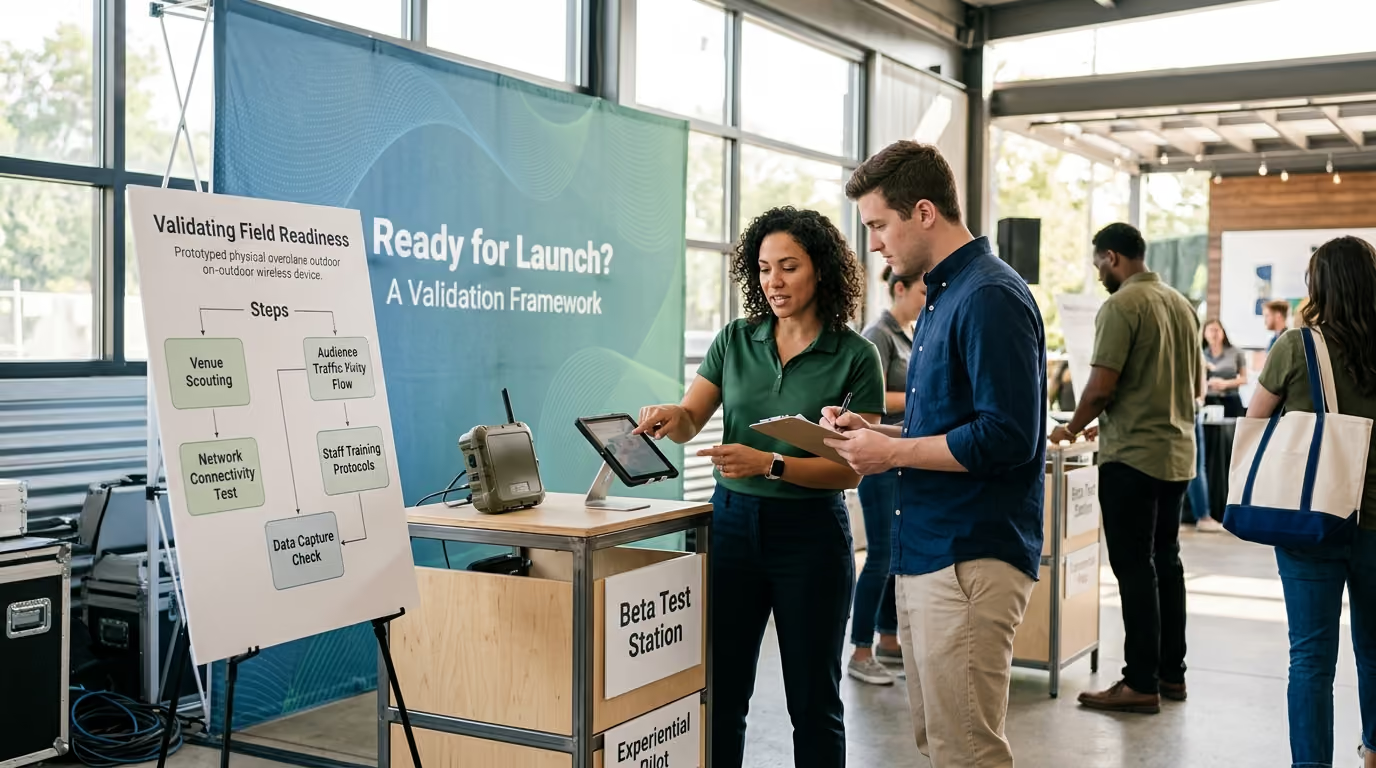
This framework establishes a stage-gate review system that evaluates audience value, behavioral impact, operational throughput, legal exposure, measurement design, and retail connectivity before brands commit capital to live field activations. Applying this rigorous evaluation process prevents costly operational failures, protects brand reputation, and guarantees every physical activation creates a measurable pathway to commercial purchase.
Most experiential marketing concepts fail not in the creative pitch, but on the pavement. Brand teams frequently fall in love with high-concept renderings, bold guerrilla stunts, and promises of viral social reach. When those concepts enter the real world without operational vetting, the result is budget waste and brand frustration.
Imagine a typical Saturday morning activation for a premium beverage brand. The customized sampling vehicle arrives at a high-traffic metro plaza thirty minutes late due to route restrictions. The event footprint blocks a municipal fire lane, prompting immediate scrutiny from local police. The generator overloads after twenty minutes, cutting power to the commercial refrigeration units and letting thousands of product samples warm past safe holding temperatures.
As crowds gather, brand ambassadors struggle with an ambiguous queue system. They hand out cold cans to anyone who walks past, including unaccompanied children, while failing to convey the core product message. Nobody tells consumers where to purchase the product locally. No retailer-specific coupons are offered, and the QR code on the vehicle wrap links to a broken website homepage.
By the end of the weekend, the brand has spent sixty thousand dollars. The campaign dashboard proudly reports thirty thousand impressions and five thousand samples handed out. Yet local retail scan data shows zero sales lift in nearby grocery accounts, and the brand is left with a municipal citation.
This scenario happens when organizations confuse creative ambition with operational readiness. Live activations sit at the complex intersection of field sales, retail coordination, public-space regulation, transport logistics, food safety, and behavioral measurement. A high creative score should never override a failure in operational, legal, or commercial feasibility. Evaluating these components systematically protects your investment and ensures that every live footprint drives genuine business growth.
Before spending time on detailed floor plans or vehicle fabrication, you must determine whether experiential activation is the right channel for your business challenge. Physical activations carry higher fixed costs per contact than digital media. They are justified only when physical interaction solves a barrier that screen-based media cannot address.
A live activation is strategically defensible when the product benefit requires sensory validation. Taste, scent, texture, physical ergonomics, or complex mechanical demonstrations benefit immediately from live trial. When a consumer tastes a food product or tests a performance tool, their uncertainty drops instantly.
Conversely, an activation is indefensible when the brand creates an expensive spectacle that has no logical connection to the product truth. If a consumer enjoys an immersive photo booth but learns nothing about the brand, the budget has funded entertainment rather than marketing.
To pass the initial strategic screen, your team must complete one clear governing statement:
"For [specific target audience] in [specific physical context], this activation will trigger [specific commercial behavior] because the live experience proves [specific product truth], and the participant can act through [specific purchase pathway]."
If your team cannot complete this sentence without using vague language like "drive awareness" or "spark engagement," the concept must be stopped.
Once strategic eligibility is confirmed, you must evaluate the five core forms of audience value. An activation must deliver real value to the participant, not just to the brand.
The experience solves an immediate problem or removes a purchasing barrier. This includes product sampling that replaces risk, technical demonstrations that show ease of use, or practical services that assist the consumer on site.
The activation offers genuine entertainment, playfulness, surprise, or aesthetic enjoyment. Consumers participate willingly because the interaction is rewarding in the moment.
The activation creates a natural context for shared human connection. It gives participants something interesting to discuss, experience with friends, or document organically.
The consumer gains credible, useful knowledge about the category, ingredients, application techniques, or nutritional benefits without feeling subjected to a hard sales pitch.
The consumer receives a concrete physical sample, exclusive promotional discount, or tangible gift.
The strongest field activations combine several value types into a cohesive moment. However, relying purely on incentive value is a dangerous trap. Giving away premium merchandise will draw large crowds, but those crowds may care only about the free gift. True feasibility requires that participants value the brand experience itself.
To validate audience value before building a full tour, deploy low-cost intercept pilots. Use storyboards, rapid physical prototypes, and small pop-up carts to test messaging, queue interest, and comprehension in real environments. Measure whether consumers understand the value proposition within five seconds of approaching the footprint.
A successful mobile sampling tour or street activation must guide consumers along an explicit behavioral chain. Attention must convert into commercial action. If any link in this chain breaks, the activation fails to generate economic return.
Every transition on this ladder represents a potential drop-off point. Feasibility planning requires designing mechanisms that pull the consumer from one step to the next without friction.
The most vulnerable point in the entire ladder is the transition from product experience to retail purchase. Brands often assume that a positive interaction will automatically lead to a future store visit. Research from the Event Marketing Institute in their EventTrack study indicates that 85 percent of consumers report a high likelihood to purchase after participating in live events. However, stated intent rarely matches actual behavior unless an immediate, convenient purchasing bridge is provided.
To build an effective retail bridge, your concept must satisfy ten foundational requirements:
First, identify the exact retail doors carrying the product within a two-mile radius of the activation site. Second, confirm shelf availability and inventory depth with those retailers prior to deployment. Third, establish clear signage or digital directions pointing consumers to those specific stores.
Fourth, provide a trackable, retailer-specific incentive, such as a high-value digital coupon loaded directly to a mobile wallet. Fifth, ensure the local retail price point aligns with consumer expectations set during the activation. Sixth, coordinate with store managers so they anticipate increased customer inquiries.
Seventh, secure property permissions if activating on or adjacent to commercial retail property. Eighth, synchronize field timing with retailer promotional circulars or endcap placements. Ninth, deploy digital geofencing around the activation zone to serve store-locator ads to participants. Tenth, implement receipt-validation or loyalty-scan mechanisms to measure verified purchases post-event.
Integrating retail access directly into the field design transforms an isolated brand stunt into a powerful sales driver. Reviewing our guide on designing an experiential activation readiness plan will help your team connect field engagement directly to retail accounts.
A brilliant creative concept is useless if it cannot survive the physical realities of the field. Operational feasibility converts an abstract design into a reliable, repeatable field machine. It requires rigorous modeling of spatial flow, supply chain mechanics, and human capacity.
You must analyze every mobile footprint as a continuous production line. The primary operational constraint is throughput capacity. If an interactive demonstration takes five minutes per person and your footprint has two stations, your theoretical capacity is twenty-four people per hour. If your activation targets six hundred interactions per day, that operating model is mathematically impossible.
Theoretical capacity calculates the maximum possible volume under ideal conditions. To find realistic capacity, you must calculate effective capacity. Effective capacity accounts for real-world friction, including staff rest breaks, restocking cycles, inclement weather, and crowd arrival patterns.
Utilization rates fluctuate heavily throughout an activation day. A street footprint may sit underutilized at ten in the morning, then face severe congestion at noon. Your operational model must be stress-tested against peak volume rather than daily averages. When crowds surge, long lines cause queue abandonment, frustrating consumers and reducing brand affinity.
In our experience, operational success depends on establishing clear staffing ratios, standardized training protocols, and dedicated logistics support. We run experiential and engagement programs coast to coast with local crews, smart logistics, and permit expertise that let us launch fast and maintain quality consistency in every region, from major metros to smaller markets. Our nationwide infrastructure enables us to activate brands wherever their audiences are located.
To ensure field stability, every activation must establish a Minimum Viable Field Version. This is a stripped-down operational configuration that preserves core product trial if primary equipment fails.
If a custom vehicle suffers an engine breakdown, the crew must be trained to deploy a compact, branded cart system within sixty minutes. If an interactive touchscreen interface crashes, brand ambassadors must switch instantly to a hands-on physical demonstration. If primary power fails, the team must have backup battery banks ready to run essential refrigeration.
Documenting fallback protocols prevents minor mechanical disruptions from turning into total operational shutdowns. For comprehensive contingency planning tools, study our logistics playbook for live brand activations to prepare your teams for unexpected field conditions.
Physical activations interact with public spaces, commercial real estate, local municipal codes, and consumer safety laws. Overlooking legal compliance during the planning stage exposes your organization to fines, shutdowns, and severe reputational damage.
Advertising compliance applies to real-world interactions just as strictly as broadcast media. The Federal Trade Commission (FTC) enforces clear guidelines regarding endorsements and consumer representations. Under the FTC Guides Concerning the Use of Endorsements and Testimonials in Advertising, any material connection between a brand and an endorser must be clearly disclosed.
When brand ambassadors talk to consumers on the street, they cannot present themselves as independent, unbiased product enthusiasts. They must clearly identify their affiliation with the brand. Ambassador scripts must provide accurate, substantiated product claims without exaggeration. If brand ambassadors distribute free products in exchange for social media posts or online reviews, participants must be instructed to include clear disclosures like #Ad or #Sponsored.
Data privacy represents another major regulatory hurdle. Activations frequently collect consumer contact details through sweepstakes, digital photo booths, or product sample registrations. The FTC emphasizes the principle of data minimization, which requires businesses to collect only the personal information reasonably necessary for a specific transaction.
If your activation occurs in spaces frequented by families, you must account for the Children's Online Privacy Protection Act (COPPA). COPPA establishes strict requirements for operators collecting personal information online from children under thirteen years of age. You must not collect digital contact details, photographs, or identifiers from children under thirteen without verifiable parental consent.
Food and beverage activations introduce complex safety and sanitation responsibilities. You must follow the Food and Drug Administration (FDA) Food Code standards regarding temporary food establishments. Perishable products must be held strictly below forty-one degrees Fahrenheit or above one hundred thirty-five degrees Fahrenheit to prevent foodborne illness.
Local health departments require specific operational approvals before sampling begins. Staff must have access to certified handwashing stations, sanitizing supplies, and hair restraints. Allergen warnings must be displayed prominently across the footprint to protect consumers from major food allergens.
Physical accessibility is a non-negotiable legal and moral mandate. Under the Americans with Disabilities Act (ADA) Standards for Accessible Design, temporary structures and event spaces must comply with federal accessibility standards. Your activation footprint must feature level, barrier-free access routes at least thirty-six inches wide.
Service counters must offer a lowered section no higher than thirty-six inches from the ground to accommodate wheelchair users. Experiential elements, games, and sampling stations must provide equal enjoyment and alternative participation options for individuals with visual, auditory, or mobility impairments.
Public-space guerrilla programs face additional legal exposure regarding municipal permitting. Operating on public sidewalks, parks, or transit plazas requires explicit municipal permits, comprehensive general liability insurance certificates, and property owner sign-offs. Unpermitted guerrilla activations risk immediate shutdown by law enforcement, property confiscation, and trespassing citations. To build a solid safety net across all physical touchpoints, examine our framework for experiential marketing risk management.
To prevent flawed concepts from advancing into production, your organization must institute a disciplined stage-gate scoring system. The framework evaluates seven critical dimensions, weighting each based on its potential to impact operational success and commercial return.
Each dimension is scored on an objective scale from one to five. A score of one indicates an unacceptable failure or fundamental operational flaw. A score of two reflects major unresolved challenges. A score of three represents a plausible hypothesis that requires validation through pilot testing. A score of four indicates strong operational documentation with manageable risk. A score of five reflects a proven, fully repeatable model.
Rigid gating rules protect the organization from emotional decision-making. Regardless of an activation's overall average score, specific fatal flaws will immediately halt production planning:
Any concept that receives a score of one in Operational Feasibility, Legal Exposure, or Audience Value is immediately stopped. Creative brilliance can never compensate for unsafe, illegal, or unexecutable field plans.
A score below three in Retailer Connection prevents the brand from setting sales-lift or volume objectives. The activation may only proceed if reclassified as a pure brand-building exercise with adjusted financial expectations.
A score below three in Measurement Architecture prevents the marketing team from claiming Return on Investment (ROI) to leadership. If you cannot measure the result cleanly, you cannot claim commercial attribution.
The stage-gate review produces one of four binding operational decisions:
Every project must maintain a formal Feasibility Dossier. This living document houses site permits, throughput calculations, ambassador scripts, food safety logs, and measurement protocols. It ensures complete operational alignment before a single dollar of field capital is spent.
Executing this feasibility model requires a structured sequence of cross-functional reviews. The following step-by-step playbook guides your team from initial concept review through live market deployment.
For specialized operational insights on field team management, review our resource on field contingency planning for street activations to support your phase deployment.
Measuring experiential marketing performance requires moving past superficial vanity metrics. Counting foot traffic or unverified social impressions provides zero insight into business growth. A mature measurement framework tracks a balanced hierarchy of leading and lagging indicators.
Leading metrics capture operational execution in real time. They tell you whether the field machine is functioning according to design. Lagging metrics capture downstream commercial behavior. They reveal whether the activation generated profitable business outcomes.
To establish true financial accountability, calculate performance across six core economic formulas:
Divide total campaign expenditure by the verified number of completed product trials. This isolates the true cost of putting the product into the consumer's hands, filtering out passive passersby.
Divide total campaign expenditure by the number of participants who match your exact target demographic criteria. This reveals whether your footprint attracted high-value prospective buyers or untargeted crowds.
Divide the number of redeemed digital coupons or promotional vouchers by the total number of incentives distributed on site. This measures how effectively the live experience converted initial interest into store visits.
Divide the total number of verified first-time buyers in the activation trade area by the total number of completed product trials. This measures the persuasive power of your live product demonstration.
Subtract total activation expenditure from the incremental gross margin generated in exposed markets, then divide by total activation expenditure. Always use gross margin rather than top-line revenue to avoid overstating economic returns.
Divide total activation expenditure by the unit contribution margin of the product. This reveals the precise number of incremental units the brand must sell to cover campaign costs.
To isolate incrementality, deploy a difference-in-differences measurement model. Select matched control markets that mirror your activation markets in demographic profile, historical sales volume, and retail distribution depth.
Run your mobile tour across the active test markets while maintaining standard marketing support across control markets. Comparing retail scan data across both groups before, during, and after activation isolates the true sales lift driven by your field experience. To build an advanced attribution framework, study our guide on measuring ROI beyond booth scans.
Examining real-world execution highlights how the feasibility framework functions under competitive market conditions. Consider the case of a fast-growing ready-to-drink organic cold brew brand preparing a multi-city mobile tour.
The brand's initial concept involved a customized mobile coffee lounge featuring acoustic musical performances, lounge seating, and an interactive digital art installation. The creative team projected massive social media reach and strong brand affinity.
When the concept underwent the Feasibility Framework review, the cross-functional committee uncovered critical vulnerabilities across multiple gates:
Under Gate 3 (Operational Feasibility), the review revealed that the acoustic lounge created an average dwell time of twelve minutes per person. Theoretical capacity was limited to thirty participants per hour, yielding an unsustainable Cost Per Completed Trial of forty-two dollars.
Under Gate 4 (Legal and Safety), the local health review identified severe risks regarding bulk dairy storage and sanitation in high summer temperatures. Under Gate 5 (Retailer Connection), the plan revealed no integration with regional grocery chains stocking the product.
The concept was issued an immediate Stop and Redesign mandate. The team restructured the activation into an agile mobile sampling and retail conversion footprint:
The redesigned model replaced the complex lounge build with two high-speed, dual-station sampling bars. The brand served pre-portioned, sealed three-ounce cold brew cans, eliminating open dairy handling and health department permitting delays. Average interaction time dropped from twelve minutes to forty-five seconds, increasing throughput to one hundred eighty participants per hour.
The team established an airtight retail bridge. Every participant received an immediate digital coupon delivered via Apple Wallet or Google Pay, redeemable exclusively at grocery stores within one mile of the footprint. Product inventory was coordinated with local store managers two weeks prior to the tour's arrival.
Over a twelve-week deployment across eight regional markets, the restructured tour delivered remarkable results:
By applying rigorous feasibility screening before committing production funds, the brand avoided an expensive operational disaster. It turned an unvetted creative idea into a disciplined, scalable commercial engine. To explore how our team designs and executes high-converting physical activations, review our full brand activation services or contact our field marketing team to evaluate your upcoming campaign.
Field execution rewards operational discipline, so validate every dimension of your physical activation framework before spending your marketing budget.

30 Years Experiential & Retail Activation Partner for CPG & Beverage Brands | Multi-Market Demos, Roadshows & Costco/Club Programs That Actually Sell