Robbie Thain
Founder, CEO

Learn how to connect your next experiential marketing activation to tangible pipeline, retail sell-through, and measurable business growth.

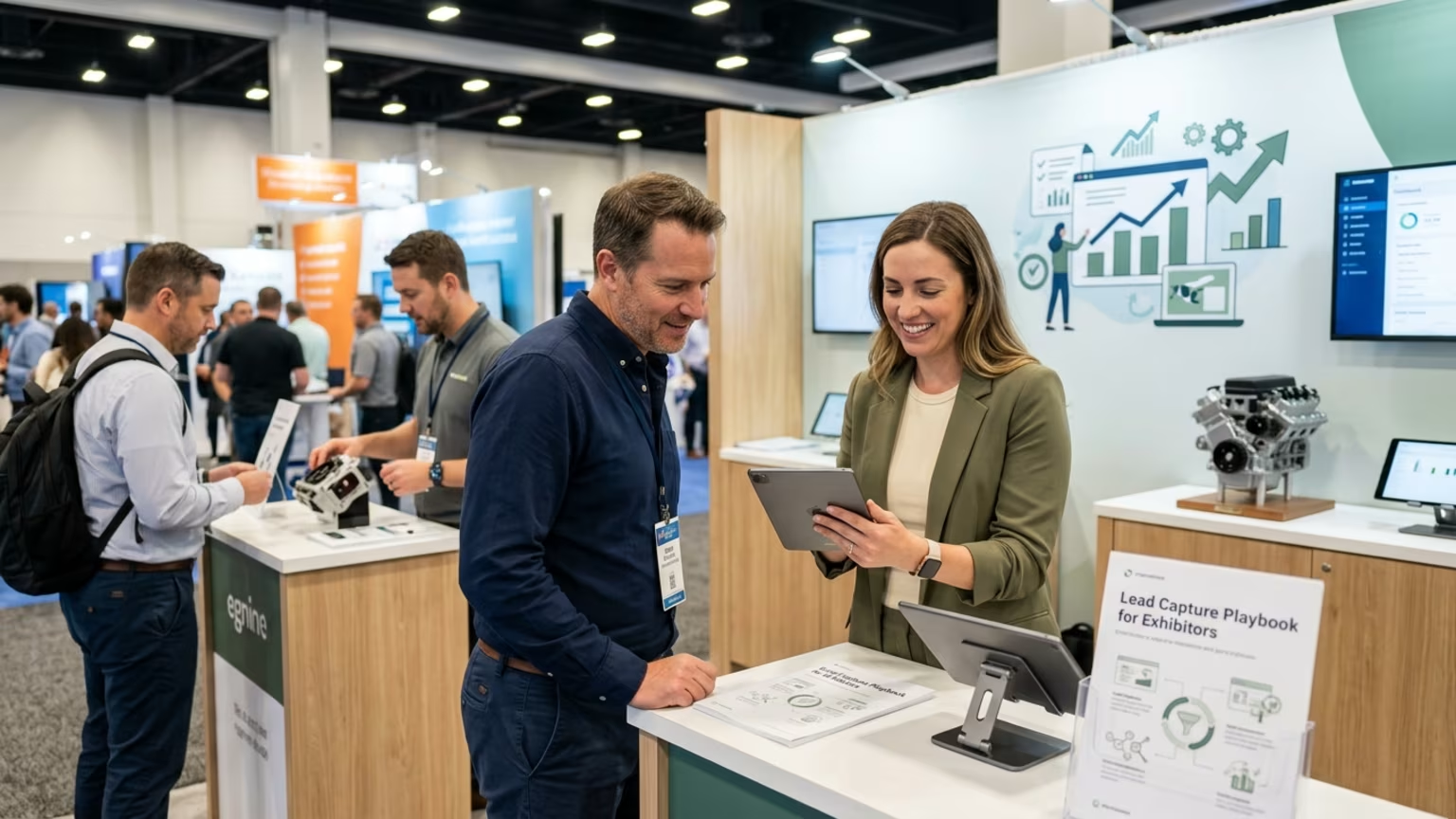
A marketing director stands in a crowded trade show aisle holding a tablet full of badge scans. The booth is packed, the team is exhausted, and the display looks incredible. But when the CFO asks for the revenue attribution next week, that list of names will be entirely useless.
Stop measuring success by how many people walked past your logo. Counting badge scans and QR hits does not prove Return on Investment. It only proves people have a pulse and a hand. Your giant interactive virtual reality booth at the expo is bleeding you dry if it cannot produce a qualified pipeline.
Marketers are spending significant money on these experiences. A 2026 Content Marketing Institute survey summary reported that 78% of B2B marketers allocate budget to experiential marketing. This is not pocket change for these organizations. Among those respondents, 40% said experiential represented 1% to 10% of their marketing spend. Furthermore, 26% allocated 11% to 30% of their budgets to these live environments.
Even larger investments exist among the most aggressive brands. The same survey showed that 13% of respondents allocated 31% to 50% of their marketing budget to experiential, and 4% allocated more than half. Yet, the way teams evaluate this spending is often a beautiful dumpster fire. The Content Marketing Institute survey summary indicates that attendance and participation remain the dominant measurement approach among B2B marketers. In fact, 70% of respondents measured experiential impact through engagement indicators such as attendance and participation.
This creates massive anxiety for the modern marketing executive. Revenue or ROI calculations were cited by only 46% of marketers. Meanwhile, customer feedback was cited by 46%, content performance by 39%, and brand impact by 34%. You cannot hand a board of directors a report on customer smiles and expect them to approve next year's field budget.
The lack of rigorous reporting is staggering. The survey summary reported that 27% of respondents had not measured experiential impact, and another 27% were unsure whether they had. CMOs lose sleep over this exact gap in their data. They know they need to solve the live event measurement gap, but their teams keep delivering vanity metrics instead of actionable business intelligence.
There is a better way to operate in the field. At makai, we approach every project with warm, human authenticity paired with brutal operational discipline. We create experiential marketing programs built to connect emotion with action. Our process blends creativity, strategy, and data to ensure every brand interaction drives measurable results. We craft experiences that engage all five senses, helping people not just see brands, but feel them, turning moments into meaningful business outcomes.
We believe that a hospitable, engaging presence must be backed by a relentless focus on conversion. Your brand activation services should never stop at looking pretty on a show floor. A successful program requires defining the exact commercial target before the creative team ever touches a rendering. A practitioner oriented event measurement guide recommends choosing the measurement metric before the event even runs.
This operator mentality changes how you view a crowd. You stop seeing a mass of attendees and start seeing individual paths to retail sell through or direct purchase. You demand evidence that your warm conversations are leading to actual trial and adoption.
To build a real measurement framework, you must stop treating all metrics as equal. You need a hierarchy that separates casual observers from highly qualified buyers. This shift in thinking separates amateur event planners from serious business operators. You must track the user journey through five distinct levels of value.
The first two levels of measurement cover basic exposure and engagement. These metrics tell you if people showed up and if they interacted. However, they are not proof of business value on their own. They simply describe your opportunity to make a sale.
Many teams celebrate a crowded aisle without asking if those people are actual buyers. A crowded booth can easily mask a poorly targeted campaign. If your staff is busy talking to people who will never purchase your product, your event is failing. You must set strict definitions for what counts as success at this stage.
For awareness led programs, industry guidance notes that cost per meaningful engagement can be a relevant efficiency metric. This is only true provided the brand defines what counts as a meaningful engagement rather than using raw footfall. Do not let a casual glance count as a brand interaction.
The third level is where your operational discipline pays off. Did the activation generate an identifiable and commercially relevant response? You need to know if the attendee fits your ideal customer profile and has actual buying power. Your field staff must be trained to separate a casual conversation from a true lead.
This requires specific mechanisms for consumer and retail focused brands. For product trial or retail programs, the same guidance states that possible measures include sample to sale tracking, offer or QR code redemption, and retail sales lift in the activation trade area. You must track the journey from the booth to the cash register. A QR code scan means nothing if the consumer does not immediately convert or join your loyalty database.
This level separates the top performing agencies from the rest of the industry. The fourth level focuses entirely on measurable business results and incremental commercial impact. For B2B events and trade shows, booth meetings should be entered into the CRM and tracked through opportunity creation, pipeline progression, and closed revenue rather than reported only as scans or conversations.
Do not accept a spreadsheet of names as a final deliverable. When you tie experiences directly to pipeline, the financial impact becomes obvious. The Content Marketing Institute survey summary reported that among marketers who had measured experiential touchpoints, 16% said the sales process was significantly shorter. Additionally, 35% of those marketers said the sales process was somewhat shorter.
To prove that your activation caused a spike in sales, you need to establish a baseline. You must compare the results of your exposed audience against a control group. This step is critical for determining actual incrementality rather than just assumed attribution. Without a control market, you are merely guessing at your true financial impact.
If your brand launches a retail tour, compare the sales in participating stores against similar locations that did not host the event. This isolates the actual revenue generated by your field presence. True measurement eliminates the guesswork and provides hard evidence for your finance team.
Fragmented staffing and inconsistent data capture will ruin your measurement system before the analysis even begins. You cannot measure pipeline if your team forgets to scan badges or fails to record the context of a conversation. Operational quality dictates measurement quality. Your field teams must use standardized data fields across all markets and event days.
If your brand ambassadors are not trained to log intent properly, your Return on Investment calculations will always be inaccurate. True operators ensure that every interaction is cataloged with precision. You must separate raw volume from actual qualified interactions at the source. This discipline prevents your database from filling up with useless contacts.
The final level evaluates whether the experience improved the economics of the customer or the partner over time. You should look at repeat purchase rates, customer lifetime value, and long term retailer confidence. Brands must demand this level of experiential marketing impact from their campaigns. Securing end cap space at a major grocer is a direct result of proving your brand can draw a loyal crowd.
The industry is putting serious financial weight behind these live environments. A separate industry forecast cited by National Experiential estimated global experiential spending at $138.94 billion in 2025, with projected growth of 10.3% in 2026. You cannot justify that level of global investment without proving long term commercial value.
The era of the purely decorative trade show activation is over. Brands can no longer afford to fund beautiful spaces that fail to generate measurable pipeline. Your marketing team must demand strict data capture protocols and flawless field execution from the very beginning. A culture of operational excellence is the only way to turn live interactions into undeniable revenue.
Every dollar spent on an event must be traceable to a specific commercial target. You must reject the idea that attendance alone justifies your budget. Stop settling for engagement metrics when your leadership team expects a direct line to retail lift and closed deals.
Before you sketch a single booth design, write down the one measurable business outcome this activation must achieve, and build your entire tracking process around that single goal.

30 Years Experiential & Retail Activation Partner for CPG & Beverage Brands | Multi-Market Demos, Roadshows & Costco/Club Programs That Actually Sell