Robbie Thain
Founder, CEO

Campus marketing calendars align seasonal brand activations with academic milestones, student lifecycles, and high-impact moments from orientation.
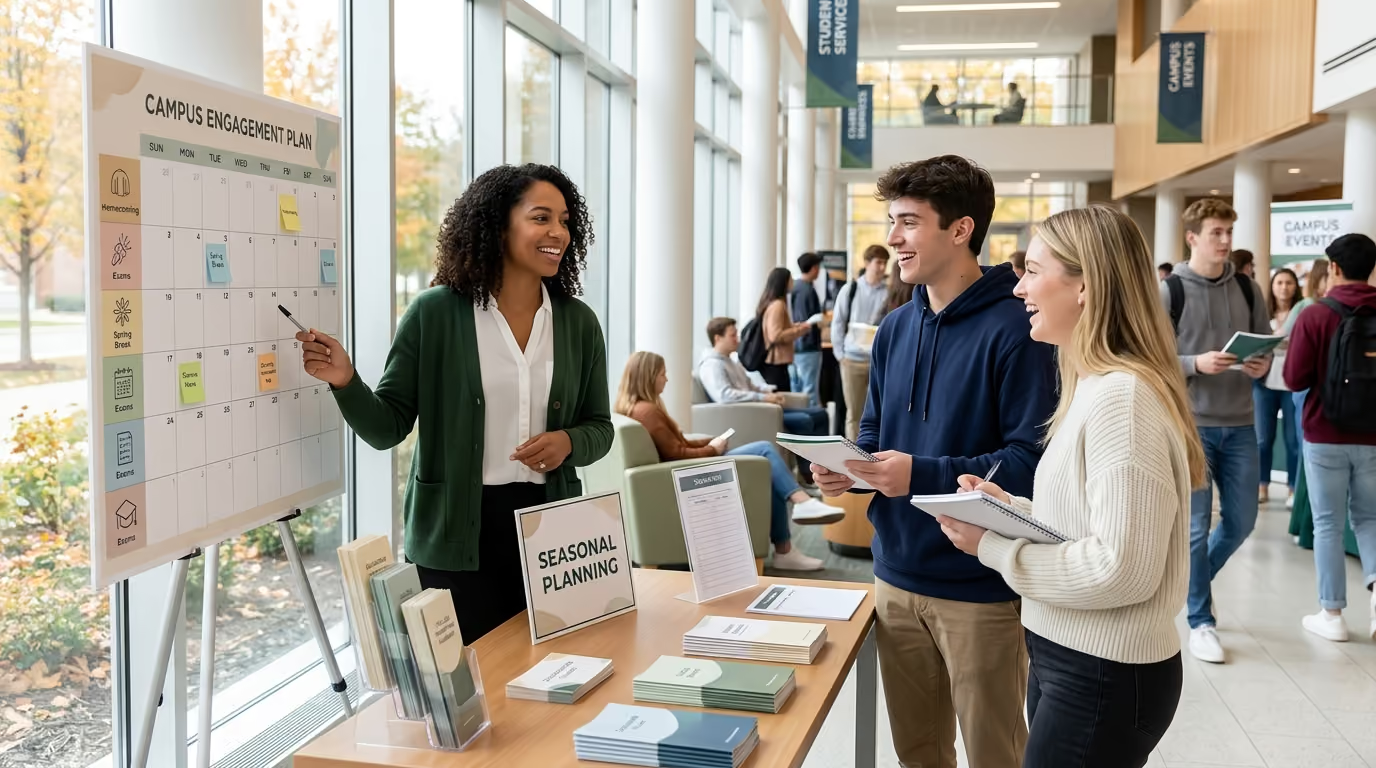
A college marketing calendar is not a schedule of athletic games and orientation dates. It is an operational architecture that aligns brand investment with student psychological states, academic milestones, and campus logistics throughout the year. Mastering this framework allows brands to maximize student engagement and build sustained trial without exhausting ambassador teams or operational budgets.
The reality on the ground during the first week of the fall semester is often total chaos. Brand ambassadors stand behind folding tables loaded with generic swag while thousands of exhausted freshmen haul mini-fridges up dormitory stairwells. Campus administrators issue warnings over unpermitted sampling, competitor street teams crowd the same sidewalk corner, and half the ambassador cohort fails to show up because of class registration conflicts. Without a structured calendar, field teams burn eighty percent of their annual budget in ten frantic days, generating zero qualified follow-ups and leaving the brand absent for the remaining eight months of the school year.
A collegiate marketing calendar is a specialized operational system that synchronizes field marketing activations with the operational rhythm of higher education. Unlike standard consumer calendars that revolve around major commercial holidays, campus marketing is governed entirely by institutional schedules. A retail brand may focus heavily on holiday shopping in December, but December on a college campus is a period of intense academic pressure followed by complete physical desertion.
Standard consumer campaigns assume a relatively stable lifestyle across quarters. College students experience sharp psychological shifts every four to six weeks. Their availability, financial liquidity, stress levels, and openness to new products fluctuate rapidly based on academic deadlines. Operating a campus program requires a deep understanding of these distinct student lifecycle stages:
Campus structures also dictate marketing viability. Quarter-system institutions move at an accelerated pace compared to semester-system universities. Commuter campuses feature high vehicle traffic and minimal weekend activity, while residential campuses maintain high pedestrian density seven days a week. When teams build a framework for selecting target college campuses, they must align their operational cadence with these institutional variations rather than applying a blanket national schedule.
A common failure mode in campus marketing is treating every campus gathering as a major activation opportunity. When brands attempt to maintain peak operational intensity across club fairs, football games, parent weekends, and social mixers, student ambassadors experience rapid burnout. Field marketing directors must classify campus events into three distinct operational tiers.
Anchor moments represent the foundational pillars of the academic year. These events receive the largest share of budget, central logistics support, field supervision, and formal measurement. Examples include:
Anchor moments demand dedicated event footprints, rigorous pre-event training, substantial inventory, and comprehensive follow-up mechanisms. A brand should execute only two to three anchor activations per campus per semester.
Support moments reinforce brand presence between major milestones without demanding complex field logistics. These activations rely on modular execution kits, small ambassador pods, and targeted student organization partnerships. Examples include:
Support activations use standardized playbooks that an ambassador can execute in two hours with minimal central oversight.
Maintenance moments maintain continuous peer-to-peer engagement at near-zero incremental operational cost. These activities keep the brand relevant between physical activations. Examples include:
To maintain discipline, field leaders should follow a 70/20/10 resource allocation model. Seventy percent of the campus budget and labor should fund proven anchor moments. Twenty percent should support modular support activations, while ten percent remains in reserve for unexpected cultural moments or local campus opportunities. Applying structured event capacity planning and headcount ensures field teams stay focused on high-yield windows without exceeding their staffing limits.
The fall semester represents the most critical acquisition window of the academic year. Incoming students are forming purchasing habits that can persist for four years. However, execution during this window requires extreme operational discipline.
Field teams must complete program foundations before students arrive on campus. June and July must be dedicated to recruiting, screening, and onboarding campus ambassadors. Waiting until August guarantees late permits, rushed shipping, and untrained field reps.
During the summer, field managers must secure required institutional permits, finalize vendor delivery windows, and map physical distribution routes. Ambassadors should complete compliance modules covering Federal Trade Commission endorsement guides, campus solicitation rules, and brand messaging standards.
Freshman move-in is an intense physical environment. Students and their parents are carrying heavy boxes, navigating unfamiliar buildings, and dealing with summer heat. Activations that demand lengthy app registrations or long surveys will fail.
The move-in strategy must focus entirely on practical utility. Ambassadors should distribute cold beverages, hydration packets, moving supplies, or pre-packaged snack kits. Interactions should last under thirty seconds. The primary goal is delivering immediate relief, creating positive sentiment, and placing a scannable conversion point directly into the student's residence.
Once unpacking concludes, students transition into social discovery mode. Welcome week brings high foot traffic, club fairs, and social gatherings. Brands should shift their focus from pure utility to interactive discovery.
Instead of running a standalone booth that competes with dozens of campus clubs, partner directly with student organizations. Providing product inventory to official campus mixers, outdoor movie nights, or residence hall events builds organic credibility. Research published in the Higher Education Social Media Engagement Report shows student engagement peaks during these opening weeks as students document their new routines. Field teams should equip ambassadors to capture authentic peer interactions during these social milestones.
By late September, campus life settles into a predictable rhythm. Students have established their class schedules, gym routines, and dining habits. This period is ideal for repeatable micro-activations.
Ambassadors should deploy portable sampling kits to academic buildings, commuter transit stops, and study lounges. Rather than hosting massive events, run consistent weekly touchpoints. For example, an energy drink or healthy snack brand can establish a recurring morning study lounge drop every Tuesday. This consistency embeds the product into weekly student behavior.
Midterms arrive between October and early November, fundamentally changing the campus climate. Social event attendance drops as library occupancy surges. A national survey by Studiosity found that fifty-one percent of postsecondary students identify the fear of failing as a top driver of stress.
Activations during midterms must demonstrate empathy and operational restraint. Loud music, intrusive street teams, and aggressive sales pitches damage brand perception during exam weeks. Brands should deploy quiet study kits, digital delivery vouchers, desk drops, and silent library partnerships. Focus on products that deliver sustained energy, nutrition, mental clarity, or practical convenience.
Athletic traditions generate massive emotional energy, institutional pride, and concentrated physical density. However, these events present distinct operational risks that require strict risk management.
Homecoming combines active students, returning alumni, faculty, and local families. This multi-generational audience creates great brand visibility, but field teams must navigate strict university trademark rules and exclusive athletic sponsorships.
Field teams should never use protected university trademarks, mascots, or official athletic marks on promotional collateral without formal commercial licenses. Focus activations around the perimeter of official game zones, student tailgates, and off-campus community events. Hydration stations, charging lounges, and photo utility experiences perform well during homecoming because they serve both alumni and undergraduate crowds.
Major athletic rivalry games produce extreme emotional investment. Brands should build a multi-week activation ladder rather than relying solely on a three-hour game-day footprint:
Field teams must plan for unpredictable logistics around stadium perimeters. Local municipal permits often supersede university permissions on public roads. Establishing rigorous contingency planning for field logistics protects operations against sudden security zone expansions, road closures, or bad weather.
The second half of the academic year requires a tailored operational strategy. Replicating the fall playbook during spring semester inevitably leads to diminished results.
Thanksgiving, winter break, and spring break temporarily dissolve the physical campus audience. National data from the National Student Clearinghouse Research Center indicates over eighteen million students are enrolled across American postsecondary institutions, representing diverse geographic and residential backgrounds.
Field managers must avoid assuming all students travel home during breaks. International students, graduate researchers, and student workers often remain on campus. Field programs should pause physical campus footprints five days before break starts, shifting resources toward digital engagement, retail locator campaigns, and ambassador administrative reviews.
The spring semester begins in January under entirely different physical conditions. Cold weather across northern campuses pushes student foot traffic entirely indoors, restricting outdoor sampling footprints.
Furthermore, returning students already know the campus layout and social landscape. The spring focus must shift toward new transfer students, spring sports, career preparation, and personal wellness goals. Indoor residence hall activations, fitness center partnerships, and career fair sponsorships deliver superior engagement compared to outdoor quads during winter months.
Spring break planning requires clear segmentation. A portion of the student body travels to resort destinations, while others work seasonal jobs, study, or rest at home.
Brands should avoid heavy on-campus activations during spring break week. Instead, focus on pre-break travel readiness kits and post-break recovery campaigns. When students return in late March, launch a back-to-routine campaign that reactivates ambassador networks for the final stretch of the school year.
Final exams in May represent the highest stress period of the academic year. Campus administrations actively enforce quiet hours across dorms and academic quadrangles. Commercial intrusions are swiftly removed by campus security.
Field programs must adopt a pure helpfulness model:
Ambassadors are students first. Forcing student reps to work extensive promotional shifts during exam week leads to poor field execution, high turnover, and severe ambassador resentment.
Commencement is a celebratory milestone involving graduating seniors, multi-generational families, faculty, and institutional leaders. It requires a distinct tone focused on achievement, nostalgia, and transition.
Graduation marketing should avoid aggressive hard-sell tactics. The objective is securing long-term brand affinity as students enter the professional workforce. High-performing graduation activations include:
Measurement windows for graduation campaigns must extend well beyond the event day. Unlike move-in activations where conversion can occur within forty-eight hours, commencement conversions often take thirty to ninety days as graduates relocate, secure housing, and establish new professional purchasing routines.
Executing a high-performing campus activation requires strict backward planning. A twelve-week operational timeline prevents supply chain bottlenecks and administrative delays.
Field programs operating across dozens of universities cannot design bespoke physical footprints for every location. Operations teams must build standardized, modular campus kits that pack into a single shipping container:
Campus brand ambassadors frequently share promotional content on personal social channels. The Federal Trade Commission strictly requires clear and conspicuous disclosures whenever a material connection exists between a brand and an endorser.
Ambassadors must explicitly disclose paid relationships, free products, or incentives in every social post. Disclosures such as #ad, #paidpartnership, or clear spoken statements must appear before the fold and remain visible across all device types. Field managers must monitor ambassador feeds and immediately correct non-compliant posts.
Evaluating a campus marketing campaign solely by crowd size or sample counts produces misleading conclusions. Field marketing leaders must implement a multi-tiered field marketing KPI framework that connects real-world engagement to hard pipeline and sales lift.
Activity metrics track operational execution and labor efficiency:
Engagement metrics measure the depth of student interaction:
Outcome metrics track actual financial return and customer acquisition. When calculating overall Return on Investment (ROI) in field activations, teams must analyze downstream conversion data over an extended timeframe:
Industry practice demonstrates that point-of-sale scan lift in campus adjacent retail should be evaluated across a four-week post-activation window. This captures delayed habit adoption that single-day attribution models miss completely.
A fast-growing ready-to-drink beverage brand faced severe operational hurdles while expanding into twenty-five major university markets. Their initial campaign suffered from inconsistent ambassador attendance, unpermitted quad sampling that resulted in campus citations, and massive product waste caused by unchilled inventory.
Our team restructured their entire collegiate operation around a disciplined seasonal framework. We eliminated scattered one-off events and focused resources entirely on three structured windows: move-in hydration hubs, mid-semester intramural partnerships, and library finals desk drops. We established centralized cold-chain storage hubs within ten miles of each campus, routing pre-chilled product directly to ambassadors on precise execution schedules.
We also designed modular sampling backpacks and self-contained mobile kits. This allowed ambassadors to operate compliantly in high-traffic public transit corridors without requiring fixed booth permits. Custom digital discount codes mapped directly to local convenience stores surrounding each campus, enabling precise multi-week retail attribution.
The campaign delivered a three hundred percent increase in verified student trial, reduced product loss to under two percent, and drove a twenty-four percent sustained retail sales lift in target campus retail stores over the four-week post-event window. A VP of Marketing in the CPG beverage category told us: "Robbie, your leadership and vision turned our campaign into something truly special. The Makai team brought our new drink to life with energy, creativity, and flawless execution. Thanks to you, our brand isn't just tasted, it's remembered."
Quarter-system institutions operate on ten-week academic terms, compressing orientation, midterms, and finals into rapid cycles. Marketers must deploy anchor activations within the first ten days of the quarter. Support activations must occur between weeks three and six, while finals protocols must activate by week nine. Semester-based timelines will consistently miss key academic windows on quarter-system campuses.
Commuter students spend minimal time on campus quads outside class hours. Field teams must shift focus from residence halls to high-density transit nodes, commuter parking structures, student union dining hubs, and early morning arrival corridors. Activations should emphasize grab-and-go convenience, portable nutrition, and digital offers that students can redeem near their homes or workplaces.
Establish a formal academic blackout policy at the beginning of the semester. Reduce promotional quotas during midterm periods and completely pause physical shifts forty-eight hours before final exams. Transition ambassadors to passive digital tasks, schedule content in advance, and maintain flexible shift swapping to ensure student reps never have to choose between their employment and academic success.
Every physical event requires a documented secondary plan. Secure approved indoor contingency spaces during the initial university permitting phase. If extreme weather, security incidents, or campus protests disrupt an outdoor activation, field teams should immediately scale down to mobile sampling kits, pivot to campus-adjacent retail partner locations, or shift resources toward digital ambassador promotions.

30 Years Experiential & Retail Activation Partner for CPG & Beverage Brands | Multi-Market Demos, Roadshows & Costco/Club Programs That Actually Sell