Robbie Thain
Founder, CEO

Discover how marketing operators use centralized logistics and real-time data to turn street activations into measurable retail pipeline and verifiable revenue.
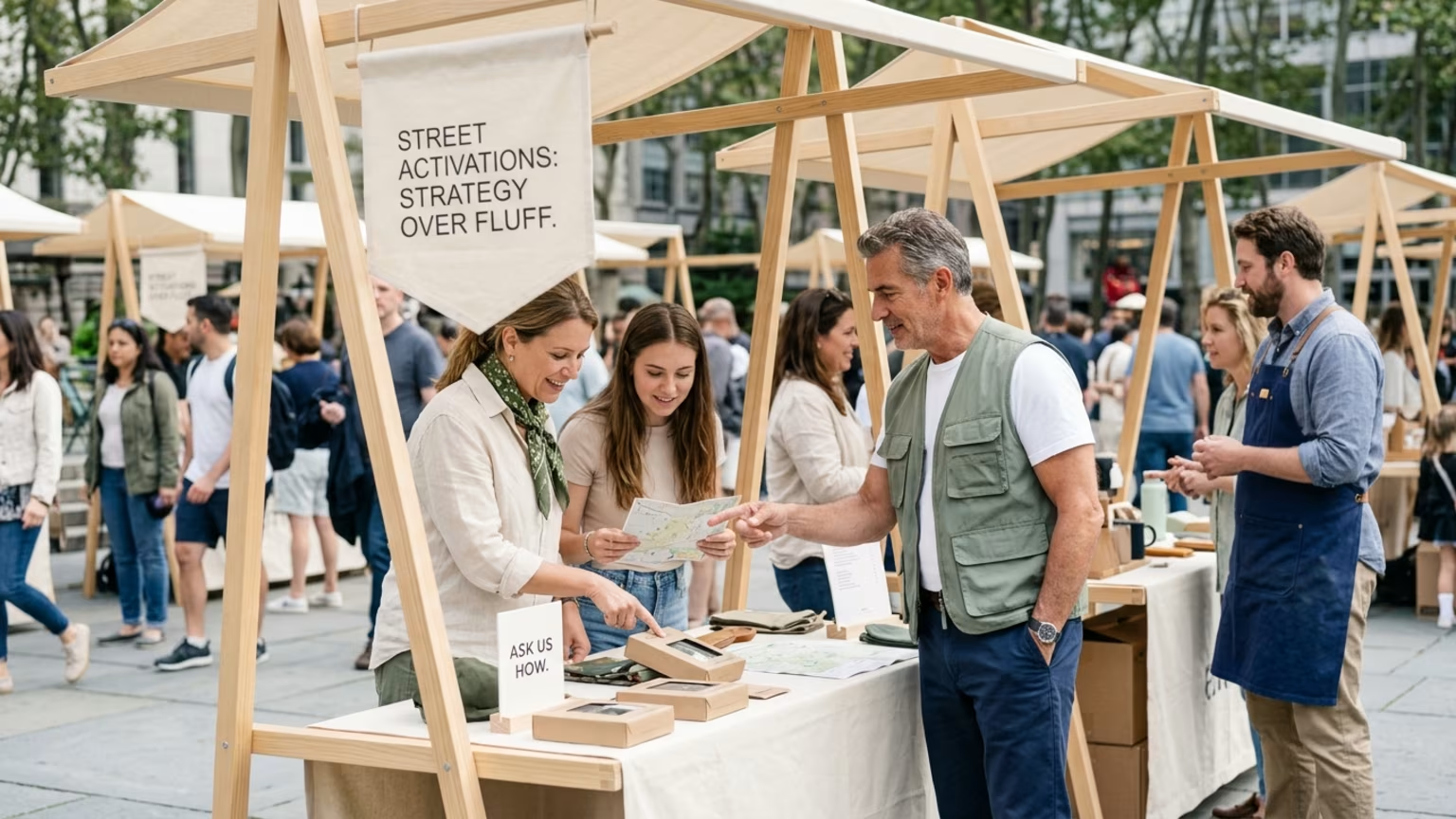
According to data from Guac Digital, experiential marketing in 2026 delivers an average 5.8x Return on Investment (ROI), significantly outperforming the 2.8x return typically seen in digital channels. Additionally, the global experiential industry is now valued at $128.35 billion. This massive capital shift proves that high-impact experiential marketing is not superficial brand theater, but a high-stakes operational discipline focused on measurable retail outcomes and long-term customer lifetime value. It requires moving beyond simple product sampling to turn physical spaces into highly precise conversion engines. True engagement marketing is the meticulous process of engineering offline interactions to generate undeniable retail pipeline.
Enterprise marketers now allocate roughly 29% of their total budgets to experiential channels. This represents a massive increase from the 14% they spent in 2019. This sudden influx of capital demands a strategy that prioritizes concrete retail sell-through over fluffy awareness metrics. Brands can no longer afford to fund empty brand theater that lacks a clear and measurable conversion path. Every dollar spent on the street must eventually find its way back to the cash register.
Marketing leads in the consumer packaged goods and beverage sectors are heavily demanding this new operational approach. For these operators, the strategy relies on centralized logistics, standardized staffing, and real-time data to build lasting brand trust. Industry practitioners emphasize that managing the chaos of field marketing requires a centralized strategy paired with localized execution. Success should never be measured by the raw number of events hosted, but by their direct role in accelerating existing retail opportunities.
The physical world of consumer goods requires campaigns that translate directly into measurable pipeline rather than fleeting social media impressions. A major shifting trend in the industry moves away from simple sampling toward identity marketing. In this refined model, the product acts as a tool for consumers to step into a new version of themselves. A shopper might engage with a physical activation to feel like a wellness insider or an outdoors enthusiast for the afternoon.
This subtle psychological shift turns passive audiences into active, paying participants. Analysis from AnyRoad suggests that customers who form an emotional connection to a brand through live experiences can have a 306% higher lifetime value. Furthermore, these emotionally connected shoppers are 71% more likely to recommend the product to their friends and family. This exceptional level of loyalty is what ultimately separates actionable physical strategies from vanity brand theater.
However, many field marketing teams still fall into the dangerous busy but faint trap. Events often look highly successful simply because they are crowded with enthusiastic foot traffic. Yet, if these activations lack a clear reason to engage beyond a quick photo opportunity, they will fail to drive long-term behavior change. A crowded parking lot means absolutely nothing if those brief interactions do not result in sustained retail momentum.
Experts at The IPM suggest that for an experience to travel beyond its physical location, it must be thoughtfully designed as a content engine. This engine must be deeply rooted in an authentic brand story and a highly relevant cultural agenda. By bridging the gap between street activations and retail velocity, brands can ensure their physical footprints actually generate measurable revenue. Engaging the public in the physical world requires discipline, tactical restraint, and a relentless focus on the final sale.
Executing a precision-driven campaign across multiple regions requires significantly more than just good creative intentions. It demands a rigorous infrastructure that eliminates operational guesswork and enforces strict consistency across all markets. There are three fundamental components required to manifest this strategic vision in the physical world. Without these pillars, even the most beautiful creative concept will collapse under the weight of poor execution.
Brands are rapidly moving away from fragmented local agencies in favor of centralized storage and deployment systems. This critical operational shift ensures every physical asset arrives on schedule, in perfect condition, and ready for deployment. It actively prevents the last-minute scrambles that inevitably inflate budgets and cause immense stress for local field teams. When bulletproof field logistics for street activations are prioritized, the entire supply chain becomes a massive competitive advantage.
At makai, we have been connecting brands with people through live experiences, retail programs, and national activations since 1995. Over three decades, our team has built a track record of creating meaningful brand moments across the country by heavily investing in logistical control. In our experience, the true success of a complex roadshow is decided in the warehouse long before the first tent is ever pitched. You cannot build a premium consumer experience on top of a chaotic, disorganized supply chain.
Senior marketing leaders must enforce strict training and vetting protocols for all field teams representing their products. These frontline brand ambassadors cannot be treated as casual gig workers if you expect them to drive real conversions. They must be deeply trained in specific sales-conversion messaging that adheres closely to strict company playbooks. A beautiful booth is completely useless if the staff inside it cannot articulate the core value proposition of the product.
When brands overhaul event staffing and training, they effectively transform temporary workers into powerful extensions of the corporate sales team. These highly trained ambassadors learn exactly how to read a consumer and deliver the specific narrative needed to close a trial. This standardized approach guarantees that the brand sounds exactly the same in a California parking lot as it does in a Texas grocery store. Consistency builds trust, and trust drives retail sales.
A highly common failure point in experiential marketing is inconsistent data collection across different local activation sites. One market might rely on paper clipboards while another uses a digital application to track consumer interactions. This dangerous data fragmentation often renders post-campaign analysis entirely unreliable for corporate leadership teams. You cannot optimize a campaign if you cannot trust the numbers coming out of the field.
To combat this exact problem, leading platforms like InEvent and AnyRoad now provide real-time dashboards that accurately track the full funnel. They closely follow the consumer journey from the initial physical impression straight through to the final revenue action. This unprecedented visibility allows marketing leads to optimize tactical engagement mid-activation rather than waiting weeks for a disappointing post-mortem report. Real-time data turns physical marketing into a precise, highly adaptable science.
Establishing clear, undeniable metrics is the only reliable way to protect marketing budgets from skeptical finance departments. Research published by Elation Digital indicates that only 23% of marketers currently feel confident in their ability to quantify the emotional impact of their live activations. However, 52% of business leaders still believe events offer the highest ROI. This massive confidence gap forces operators to adopt a much more rigorous, mathematically sound framework for tracking overall success.
To prove clear results to a Chief Financial Officer, brands should strategically commission a small pre-activation brand-tracker study to measure baseline awareness and intent. They can then run the exact same consumer survey four to six weeks post-activation to mathematically isolate the resulting delta. This highly straightforward approach provides concrete evidence of consumer sentiment shifts that executive leadership can actually trust. It replaces vague feelings of success with hard, auditable evidence of market penetration.
Furthermore, smart operators leverage critical trigger moments to significantly amplify their local retail support efforts. Activations should be precisely timed with major retail expansions or high-profile product launches to heavily boost product velocity within activation markets. This concentrated local lift can then be effectively presented to retail buyers to secure much better shelf placement in future fiscal quarters. Timing a street activation to support a new retail rollout is one of the most effective ways to guarantee a measurable return.
When supported by a strong Return on Investment guide, well-executed experiential campaigns typically yield an impressive return between 3:1 and 5:1. In fact, nearly half of all participating brands report results in this highly profitable range when using a disciplined measurement framework. By carefully measuring trial conversions, sell-through rates, and retail lift, operators can finally prove that physical experiences belong at the absolute center of the revenue strategy.
The true power of physical engagement lies not in the temporary visual spectacle, but in the permanent operational systems that reliably turn a single human interaction into lasting retail velocity.

30 Years Experiential & Retail Activation Partner for CPG & Beverage Brands | Multi-Market Demos, Roadshows & Costco/Club Programs That Actually Sell