Robbie Thain
Founder, CEO

Safeway’s centennial sampling plan offers CPG marketers a practical lens on staffing, store flow and measuring product trial separately from promotion entries.
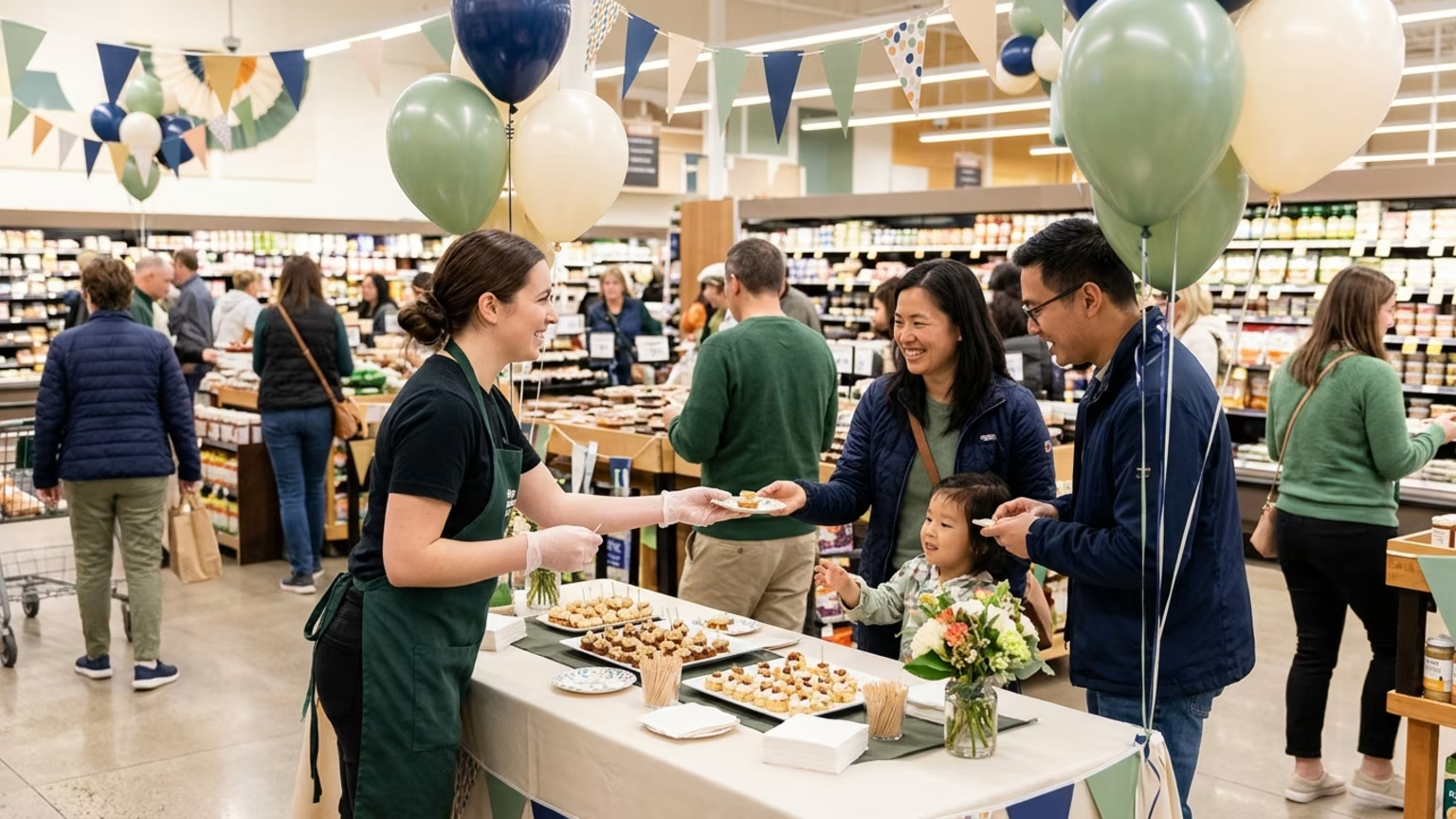
On November 2, 2026, Mass Market Retailers reported that grocery retailer Safeway planned a public centennial celebration featuring food sampling throughout its Dublin store. The announced event was scheduled for November 5, 2026, from noon to 2 p.m. at 4440 Tassajara Road in Dublin, California. Sampling was part of a broader program that combined a retailer milestone with entertainment and community activities.
According to Mass Market Retailers, the celebration was billed as marking 100 years of Safeway service in Northern California. The announced format placed food samples throughout the store alongside giveaways and live performances. Community activities were also part of the program.
The report listed a Safeway Spin Wheel promotion offering shoppers a chance to win a free bag of groceries. A sweepstakes award ceremony was scheduled for 1:30 p.m. These elements made the announced format broader than a standalone product demonstration.
Mass Market Retailers also reported more than 55,000 entries in the anniversary promotion. That figure describes promotion entries. It is not a count of event attendees or shoppers who accepted samples.
The available coverage describes plans rather than verified execution. Although the scheduled date has passed, it provides no reported turnout or sampling sales results. It also leaves participating brands and products unspecified, along with station locations and staffing, sample volume and immediate purchase availability. The useful analysis is therefore about activation design rather than demonstrated performance.
At Makai, we see the value in putting product trial inside an occasion that already gives people a reason to engage with the retailer. But the occasion and the product conversation need to work together. A celebration is not a substitute for a clear sampling objective.
Our retail demonstrations bring trained brand ambassadors into stores for real conversations and product trials designed to support sales. We also specialize in sampling programs and roadshows that bring brands face to face with their audiences. That makes the relationship between the welcome and the operating plan central to how we think about this announcement.
Our stance is aloha with accountability. Respect the retailer’s occasion and make the interaction welcoming. Then define the commercial response the brand hopes to measure. Warmth belongs in the experience; discipline belongs in the brief.
For food and beverage teams, the strategic question is not simply whether milestone traffic creates an opportunity to hand out samples. It is whether the brand has a meaningful role within that occasion. Product trial should contribute to the shopper experience rather than compete with everything else happening around it.
We believe a retail purchase and a qualified sales lead should remain distinct outcomes. Both can matter to a broader marketing program. Neither should be replaced by a generic interaction total when leadership evaluates Return on Investment.
The operational issue is scope. “Throughout the store” describes where sampling was planned, but it is not an execution brief. Our view is that comparable activations need clear ownership across staffing and shopper flow, with measurement defined before execution.
A practical staffing brief should distinguish the sampling interaction from the surrounding celebration. Product explanations and shopper questions need clear ownership. Coordination with the retailer needs ownership too.
This does not mean adding people by default. It means defining the work before deciding how to cover it. A broad promise of storewide presence should not stand in for a clear understanding of what each ambassador is there to accomplish.
For us, the ambassador’s value is the real conversation around the trial. The staffing discussion should protect that purpose rather than treat every available person as interchangeable event support.
Planning product availability alongside field coverage also keeps the staffing conversation connected to the materials behind the experience. The goal is a coordinated program rather than separate plans for people and product.
Safeway’s announced program combined distributed sampling with a timed ceremony and other activities, according to Mass Market Retailers. For comparable events, we believe that combination belongs in one shared operating brief.
The planning task is to define how a product interaction fits within the retailer’s broader program. A tasting area has a different purpose from a giveaway activity. Treating both as generic engagement overlooks the different conversations each is meant to support.
Store flow deserves the same attention as visual presentation. A useful layout discussion should account for the shopper’s ability to approach the experience and continue shopping afterward. It should also keep the retailer’s other activities visible rather than treating sampling as the only use of the space.
That discussion belongs alongside food safety planning for live sampling. A milestone theme does not replace the operating work behind a food demonstration. Creative planning and execution planning should support the same experience.
Our team ran a four-week Dole Whip summer sampling program across San Francisco, Boston, Tampa and Orlando. The activations distributed more than 64,000 servings. We also built the creative assets so the concept could be reused in future campaigns.
The lesson we draw from that work is about separating the reusable idea from the location-specific operating brief. A recognizable concept can carry across a program. The plan for an individual activation still needs to reflect its setting and purpose.
For a retailer milestone, we believe that distinction matters. The brand idea should be coherent without making the anniversary feel like a backdrop for an unrelated promotion. Reuse is valuable when it preserves the concept while leaving room for the occasion.
The serving count answers a volume question. The reusable assets address a repeatability question. Commercial impact needs its own evidence rather than being inferred from either of those facts.
The research-supported measurement approach separates participation from purchasing. Relevant measures include:
These measures answer different questions. Samples offered describe distribution activity. Samples accepted describe participation. Purchasing measures address a different part of the commercial picture.
A practical next step is to define those terms before execution so the recap does not have to reconstruct what participation meant. Our view is that the reporting brief should identify the intended outcome and the evidence needed to describe it honestly.
That is also why the anniversary promotion’s entry total belongs in its own category. Promotion participation should not be carried into a sampling report as though it represented product trials or purchases.
Teams working through this distinction can use a framework for measuring sampling beyond headcount. The objective is not a longer dashboard. It is a cleaner connection between the activity funded and the outcome reported.
Mass Market Retailers described community programming as part of Safeway’s anniversary plan. For comparable retailer events, our position is that brand participation should respect the occasion rather than try to take it over.
That means aligning the sampling presence with the retailer’s execution requirements and the purpose of the gathering. The brand can still have a clear commercial objective. A welcoming experience and accountable reporting do not need to compete.
The next useful move is to bring retailer context and measurement into the same operating conversation. The sampling objective should be clear before the program is judged by the energy around it. Creative ambition deserves an execution brief that can support it.
Aloha in the welcome. Discipline in the field.
As a CMO or VP of Marketing, what evidence would you require in the operating plan before treating your next retailer milestone as a credible product-trial opportunity?
Coordinating storewide sampling falls to food and beverage brand managers; with Makai, trained brand ambassadors handle product trials and shopper conversations. For CPG teams navigating event logistics, permits and staffing, Makai’s retail demonstrations focus on in-store sales through real conversations and direct product experience.

30 Years Experiential & Retail Activation Partner for CPG & Beverage Brands | Multi-Market Demos, Roadshows & Costco/Club Programs That Actually Sell