Robbie Thain
Founder, CEO

Makai examines Roland Berger’s retail tech analysis and its implications for CPG sampling, staffing, booth flow and campaign measurement.

On November 16, 2026, Roland Berger published Beate Rosenthal’s analysis of technology and sweet packaged goods as part of its 2026 consumer-goods study. The article examines how technology is changing product selection and purchase. Its most relevant example for experiential marketers connects advertising with a shopping moment, then links that digital activation to physical-store sales.
For CPG marketing leaders, the announcement puts a familiar operational challenge inside the AI conversation: connecting what attracts a shopper with what happens when that shopper encounters the product.
Roland Berger’s analysis combines proprietary research with expert discussions across Europe, the United States and Asia. It groups the changes into technology, retail and digital commerce, and consumer media behavior. This is a strategic outlook rather than a new retail operating requirement.
The firm reports that 30% of retailers are piloting physical AI, humanoid robots or drones. It identifies inventory management and retail interaction as potential applications alongside sampling and delivery. Separately, it describes AI-powered personalization of storefronts and promotions as part of a changing purchase journey.
The clearest example concerns KitKat’s “break mode” activation for Gen Z and millennials. According to Roland Berger, synchronizing ad delivery with the shopping experience increased click-through conversion threefold and translated the digital activation into physical-store sales. That is a reported result from a specific activation, not a general performance promise for coordinated advertising.
The public page does not provide the study’s sample size or detailed methodology, and it does not define the automation pilots. For KitKat, it supplies no campaign dates, baseline or measurement definition, and no independent verification. Those gaps make the examples useful hypotheses to test rather than benchmarks for another brand’s forecast.
The analysis also argues that physical retail remains central to impulse buying and visibility. It says iconic brand equity and taste retain their value. Roland Berger cautions that technology investments may not produce immediate Return on Investment, while regional differences and concerns about privacy and trust can affect adoption.
At Makai, our reaction is aloha with a field plan: make the welcome human and the commercial objective clear. We create face-to-face experiences designed to capture attention and generate measurable sales pipeline. For us, technology earns its place when it supports that purpose rather than becoming the attraction by default.
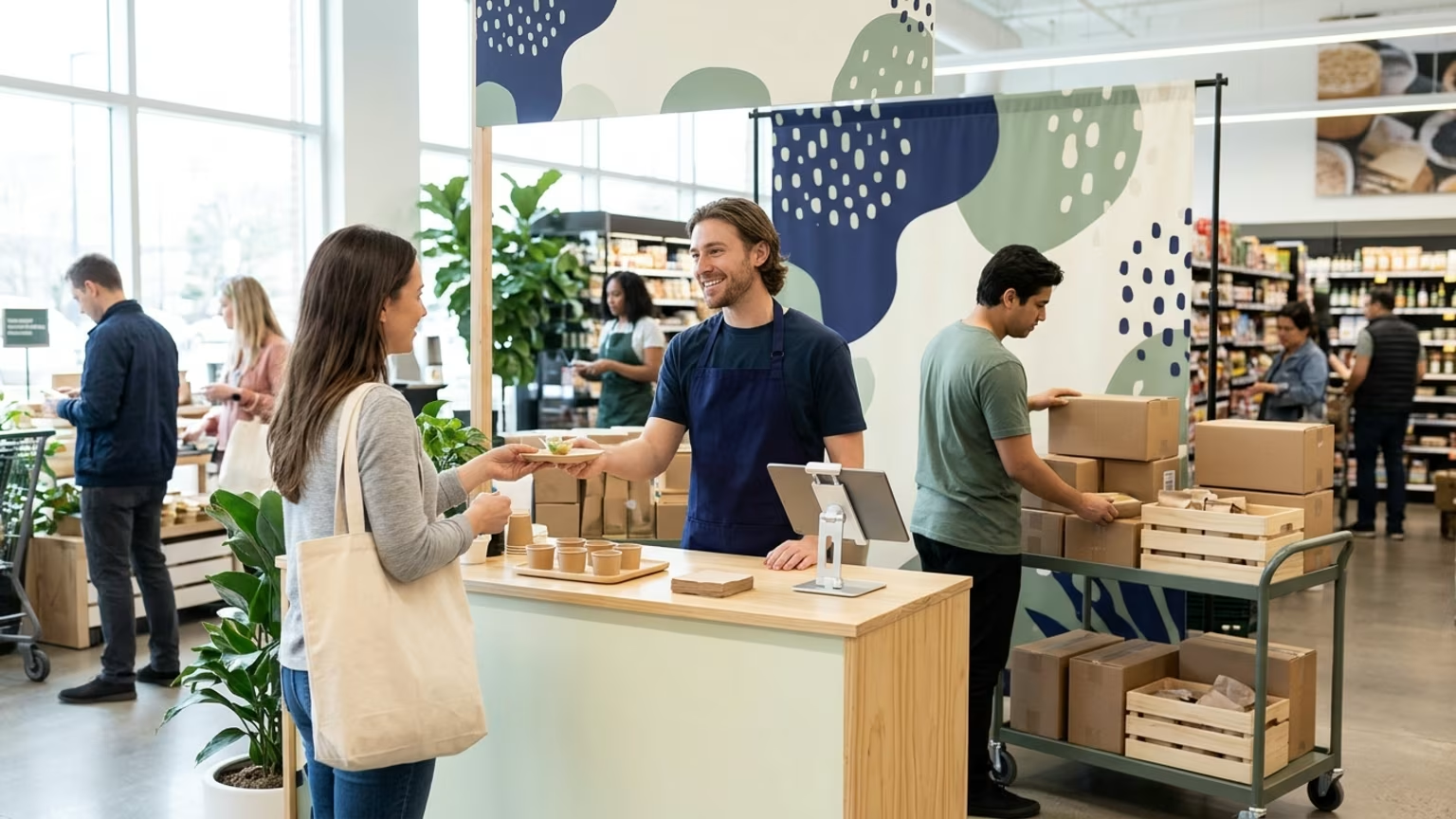
Our retail demonstrations use trained brand ambassadors to support in-store sales through real conversations and product trials. That capability matters to this discussion because a personalized recommendation and a product experience perform different jobs. We believe the strongest brief gives each a clear role instead of asking one to replace the other.
For food and beverage leaders, that puts the conversation at the sampling table on the strategic agenda. The question is not simply whether a digital message reached someone. It is whether the physical experience gives that person a useful opportunity to engage with the product and take a relevant next step.
We managed a four-week, multi-market Costco sampling program for Pulmuone’s PlantSpired line. It delivered more than 65,000 samples and recorded an 18 percent sold-to-sale rate. The lesson here is metric discipline: sample volume and the sold-to-sale rate describe different parts of performance. Neither should be relabeled as an advertising click-through result.
That distinction sits behind our focus on connecting product trial with retail sell-through. Attention has a role. Trial has a role. A useful commercial assessment keeps those roles visible without treating every positive interaction as the same outcome.
We also integrate QR codes and mobile technology across retail, event and tour experiences. This connected layer can give physical participation a digital continuation. In our view, its value rests on the connection it creates rather than the amount of technology visible in the footprint.
Roland Berger’s argument supports a closer relationship between digital touchpoints and physical execution. Our operational reading is that this connection belongs in staffing and experience design as much as in media planning. The following implications are planning judgments, not additional findings from the study.
Roland Berger identifies sampling as a possible future application of physical automation. Our view is to separate that possibility from the work a brand needs people to perform. Product conversations and consumer questions deserve an explicit place in the staffing plan.
For Makai, trained brand ambassadors are central to in-store demonstrations. A technology test should state which part of the interaction it supports and what remains a human responsibility. That gives staffing decisions a purpose beyond placing someone beside a device.
A useful brief connects the audience invitation with the product conversation and the intended commercial next step. If advertising introduces one promise while the live experience presents another, the campaign has an execution problem to resolve. Adding a digital feature does not resolve that mismatch by itself.
Trade show space needs to support attention and conversation rather than simply accommodate equipment. Makai plans and manages trade show spaces designed to attract visitors and turn conversations into customers. From that perspective, every interactive element should have a defined role in the visitor’s experience.
A QR interaction should fit the journey rather than interrupt a tasting or compete with a product explanation. Digital content and the live conversation should point toward the same intended action. This is a design principle, not an argument for adding another screen.
The same discipline belongs in adapting execution to venue realities. A store demonstration and an expo activation can share a campaign idea without needing identical footprints. Our view is that consistency should protect the brand promise while leaving room for the physical format to work.
Roland Berger discusses technology in inventory management as well as retail interaction. For field teams, our reading is straightforward: the media promise and the available product belong in the same planning discussion. Coordinated messaging has limited practical value when the planned product interaction cannot take place.
Makai’s storage and logistics services include storing sampling products and event gear. They also cover shipping, tracking and nationwide delivery coordination. Our integrated service scope extends from permitting to CRM reporting.
Those capabilities support what happens at the sampling table or booth. In our view, proposed technology should be assessed alongside those operating needs rather than given a separate brief that ignores them. Its potential does not settle questions about the intended format or its permitting scope.
Roland Berger recommends experimentation and scaling promising outcomes. Applied to live marketing, that supports a measurement plan built around a defined objective rather than a headline result borrowed from another activation.
The research brief’s practical implication is to document the baseline, sample and measurement definition before launch. Click-through conversion should remain distinct from product trials and purchases. Reporting should also distinguish a directly observed result from a broader interpretation of its influence.
For Makai, generating measurable sales pipeline is part of the purpose of face-to-face marketing. We see connecting live engagement to business impact as a design task rather than a reporting exercise saved for the end. The intended outcome should help shape the experience from the beginning.
A retail purchase and a qualified trade show lead are different commercial outcomes. The measurement plan should reflect the format instead of forcing every interaction into a single success label. That gives a marketing leader a clearer basis for deciding what deserves another test and what deserves a larger commitment.
The useful response to Roland Berger’s analysis is not to put AI into every activation. It is to connect the proposed technology with a specific consumer interaction and an operating plan that can support it. For CMOs and VPs of marketing, that makes the next brief a place to connect creative ambition with field accountability.
When your next campaign moves from an advertisement to the aisle, will the operation behind it deliver the product interaction and measurable outcome that Roland Berger’s November 16 analysis puts on the agenda?
A digitally timed shopping moment still leaves a physical task: helping a shopper engage with the product rather than only the advertisement. Makai delivers retail demonstrations where trained brand ambassadors connect with shoppers through real conversations and product trials designed to support in-store sales.

30 Years Experiential & Retail Activation Partner for CPG & Beverage Brands | Multi-Market Demos, Roadshows & Costco/Club Programs That Actually Sell