Robbie Thain
Founder, CEO

Oreo's Twist, Lick, Vote campaign lets consumers choose a new flavor for 2027. Learn how brands use retail trials and digital voting to test new products.
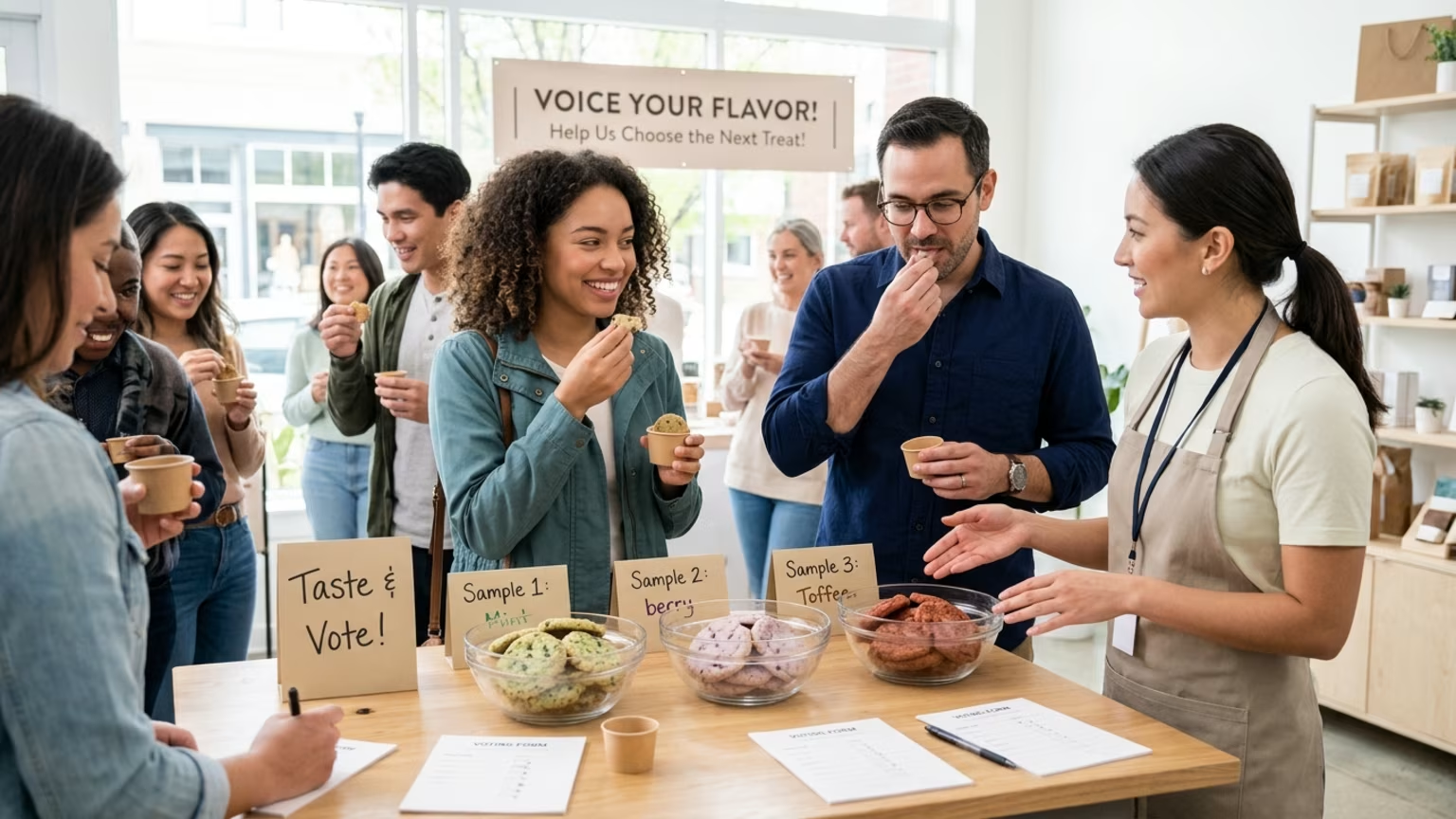
One out of three experimental cookie flavors from Oreo will survive to see a national return in 2027 based entirely on consumer votes. That single promised outcome forces buyers to engage with the product physically before making a digital choice, turning a standard product launch into an active trial. A shopper stands in aisle six, scanning a QR code on a limited edition package to cast their ballot and frame the strategic choice between launching a product blindly or turning the retail floor into a live testing environment.
The standard approach to launching a product relies heavily on closed door focus groups to predict shelf performance. Brands spend months testing concepts in highly controlled environments before making massive financial commitments. They finalize the packaging, spin up full manufacturing lines, and push millions of units into national distribution. This method treats the consumer as a passive buyer who encounters the product only after the major decisions are final.
Logistical constraints heavily define this conventional path. Companies must commit vast resources to production, trade spend, and marketing before a single real shopper makes a purchase decision. If the flavor misses the mark in a live retail environment, the brand absorbs the markdown costs and the reputational hit. There is no built in safety valve to gauge true demand across diverse retail channels.
Field teams often struggle to prove Return on Investment from these massive blind pushes. Without a direct feedback loop, sales volume becomes the only metric of success. Brands cannot easily tell if a consumer bought the item for its unique taste or simply because it was on sale. This disconnect makes it difficult to refine future product lines based on actual shopper sentiment.
The second approach brings the testing phase directly to the store floor. On Aug. 13, 2026, Oreo launched its Twist, Lick, Vote campaign to ask consumers which flavor should return in 2027. The three candidates are Banana Pudding, Deep Fried Cookies, and Chicken & Waffles. All three flavors became available for online presale beginning Aug. 17 through Oreo.com/UnwrapTheCollab and the SnackWorks TikTok Shop storefront.
Execution here looks entirely different from a standard launch. Oreo marketing director Sally Barton told ADWEEK that the company had not yet planned which flavor it would launch. This makes the consumer vote part of the product selection process rather than a simple promotional contest. Consumers taste the actual cookies, scan a package QR code, and cast their vote by Oct. 12, 2026. The physical product serves as the primary entry point to a digital action.
The flavors themselves demonstrate the value of this direct testing model. According to AllRecipes, the Banana Pudding product uses banana and vanilla flavored crème between vanilla wafer style cookies. The Deep Fried option combines fried dough and dark chocolate flavored crèmes with fried dough flavored cookies. The Chicken & Waffles product contains fried chicken and maple syrup flavored crèmes between waffle embossed cookies. Consumers must physically taste these complex combinations to form a valid opinion.
We handle every step of activation execution with precision and purpose, from initial concept through final logistics. Our comprehensive approach ensures that each program is designed to spark curiosity, drive action, and leave a lasting impression on consumers. When clients need to mitigate risk on untested concepts, we advise them to build direct feedback mechanisms into the retail experience itself.
The traditional rollout still holds undisputed ground in specific operational scenarios. It remains the unarguable winner when brands face tight budget constraints that prohibit multi product trial runs. Producing and distributing a single SKU is always leaner than running three parallel manufacturing lines for a temporary market test. Supply chain managers prefer the simplicity of a single clear directive over managing fractional inventory for multiple experimental variants.
This tactic also prevails when dealing with proven, low risk flavor profiles that do not require consumer validation. If a brand introduces a simple seasonal variation like a holiday mint, the traditional push is usually sufficient. Shoppers already understand the flavor profile, making a complex voting mechanic unnecessary and overly complicated. In these straightforward cases, a traditional retail rollout provides the fastest path to market.
Furthermore, when shelf proximity is highly constrained, securing space for three competing test items is often impossible. Retailers operate on strict planograms that do not always accommodate sprawling experiential displays. In these tight physical environments, a single strong retail presence beats a fractured multi product test. Brands looking to establish a CPG sampling strategy must respect the physical limits of their retail partners.
Conversely, consumer voting campaigns dominate when brands introduce highly polarizing or unusual concepts. Oreo clearly demonstrates this necessity with its sweet and savory Chicken & Waffles option. Assessing real demand for such a radical combination requires actual physical tasting, not just stated preference on a digital survey. A shopper must eat the cookie to know if they would ever buy a full package again.
This trial driven approach is also mandatory when brand launches require a high degree of community participation. Matt Foley, vice president at Oreo, told the press the brand was giving its community true agency to help decide the future of its product lineup. When massive crowd aggregation and earned media are the goals, asking fans to defend their favorite flavor creates natural momentum. A previous fan vote in 2025 only asked consumers to select among discontinued flavors, making this 2026 campaign a distinct evolution toward true innovation testing.
To maximize this engagement, brands must remove friction from the voting process. The official Oreo campaign page states that no purchase is necessary to vote, and participation is open to legal residents of the 50 U.S. states and Washington, D.C., who are at least 18 years old. Voting ends at 11:59 p.m. Eastern Time on Oct. 12, 2026. By keeping the barrier to entry low, the brand ensures a higher volume of actionable consumer data.
Incentives further drive this necessary interaction volume. Each eligible vote automatically enters the participant into a sweepstakes for a year's supply of original Oreo cookies. Oreo defines that prize as 10 packages of 13.29 ounces, shipped quarterly over a 12 month period. The official rules state that participation is limited to one sweepstakes entry per person, ensuring the incentive does not severely skew the fundamental flavor preference data.
Evaluating these two methods requires a strict look at operational reality. The over under on the traditional rollout is increasingly negative for highly experimental products. Putting a strange new concept directly onto shelves without a feedback mechanism invites substantial financial risk. You miss the chance to collect critical demographic data from shoppers while they hold the actual packaging in their hands.
The trial driven vote takes the over every single time. It forces the brand to measure actual tasted preference rather than abstract concepts generated in a vacuum. By committing to announce the winning flavor on Oct. 13, Oreo gives consumers a tangible, business level reason to participate. Bridging the gap between physical retail and digital feedback is how modern field marketing teams build highly reliable product pipelines.
Execution quality heavily influences what consumers experience in these physical testing environments. Brands running similar programs must predefine minimum standards for shelf placement, inventory levels, and QR visibility. A flavor that underperforms because it was poorly presented should not be treated as a pure product failure. Teams that want to avoid a scaling execution crisis must control the field conditions tightly.
The next time a shopper stands in aisle six scanning a QR code, they are not just looking at a cookie box. They are actively directing the future of a global supply chain.
Makai creates high impact experiential marketing campaigns and trade show activations that turn fleeting consumer interactions into qualified leads for premium CPG brands. We help food and beverage brand managers overcome the difficulty measuring real ROI from live events by turning physical product trials into trackable data. Request a proposal

30 Years Experiential & Retail Activation Partner for CPG & Beverage Brands | Multi-Market Demos, Roadshows & Costco/Club Programs That Actually Sell