Robbie Thain
Founder, CEO

BeyondCPG goes national to tackle the CPG scaling crisis. Learn how marketing leaders can replace generic brand awareness with measurable retail execution.
The hardest part of consumer packaged goods growth is no longer creating a brand. It is building the operational discipline to scale retail distribution and prove shelf velocity.
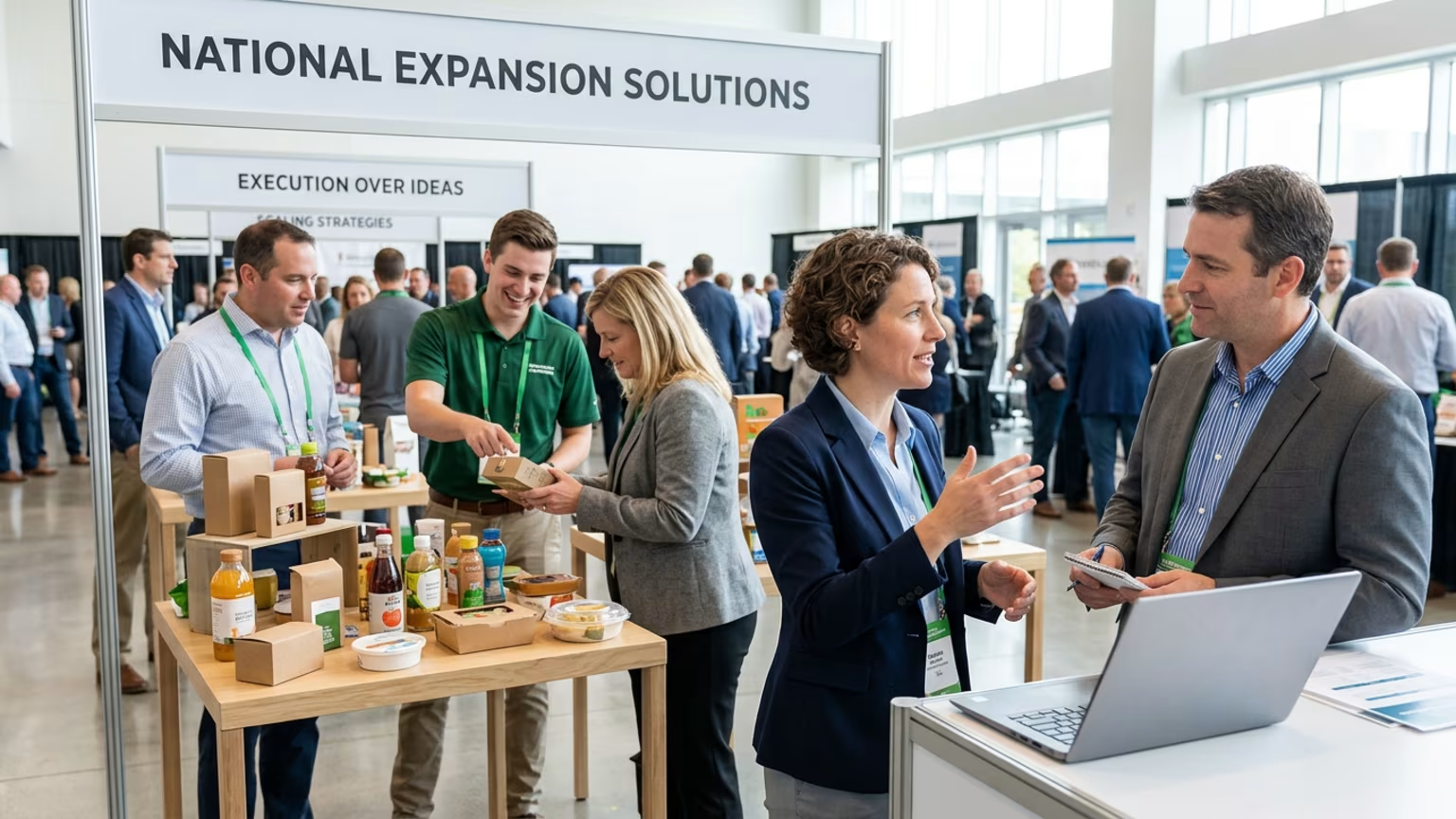
A field marketing manager stands behind a sampling table at a massive food convention. Visitors grab free energy bars and smile before disappearing down the aisle. The team collects hundreds of badge scans in a few hours. The booth looks spectacular from a distance.
Not a single interaction translates into an actual retail order the following week. The brand collected smiles instead of commercial evidence. The staff feels exhausted after three days of constant pitching. Leadership looks at the expense report and questions the entire event strategy.
Brand awareness creates an illusion of momentum for emerging companies. The real crisis hits when teams try to take local trade show success and turn it into regional distribution. Expanding a food or beverage brand requires a unified approach to field marketing. Empty calories at a sampling booth will not satisfy a category manager.
Retail buyers want proof that people will actually purchase the item at full price. They want to see consumer demand translate into reliable register rings. A crowded booth does not automatically guarantee retailer confidence. Brands must transition from creating mere spectacles to driving measurable sales.
The consumer packaged goods industry is currently experiencing a massive shift in growth strategies. Countless founders can successfully launch a product in a few local stores. The true challenge lies in the messy middle of scaling operations across state lines. Moving beyond a limited geographic footprint requires entirely new capabilities.
Industry reports show an operator network called BeyondCPG is taking its New York program national to help brands solve this exact problem. The expansion highlights a painful industry reality. Companies are hitting a growth wall. Generating early traction requires a completely different skill set than managing broker networks and securing chain distribution.
Programs aimed at scaling businesses expect brands to have existing market traction. Recent market analysis suggests applicants often need at least $100,000 in revenue over the prior year to qualify for these operator networks. This threshold separates serious contenders from hobbyists. You cannot fake retail readiness when dealing with national grocery buyers.
The transition from a regional startup to a national contender exposes every operational weakness. Early stage companies often survive on founder charisma and local goodwill. This initial surge of energy masks deeper logistical flaws. Eventually the brand must enter new markets lacking that built in community support.
This expansion phase requires a massive capital investment in field operations. Many brands underestimate the sheer volume of personnel needed to support a national rollout. Teams scramble to hire brand ambassadors at the last minute. This rushed hiring process leads to inconsistent messaging at the sampling table.
Real growth requires a framework that pairs go to market discipline with consistent retail sampling strategies. The market rewards teams that prove repeat purchases and multi channel consistency. Field marketing leaders must build systems that produce commercial evidence instead of just distributing free product.
Founders and marketing executives must prioritize direct access to distribution channels over pure creative exercises. A beautiful product package means nothing if the logistics break down before the item reaches the shelf. Realizing this limitation separates amateur operators from seasoned industry veterans. Scaling a consumer product demands an unyielding focus on supply chain reliability.
The most successful companies shift their mindset from launching to scaling. Securing a regional grocery chain mandate demands airtight merchandising protocols. The brand must deploy trained staff to support the new retail locations immediately. Without live market proof buyers will quickly replace the product with a competitor.
A disciplined operator treats every field event as a data collection opportunity. Teams must integrate their live activations with broader digital retail media campaigns. Scale your retail operations by aligning field marketing directly with distributor schedules. This synchronized approach prevents catastrophic out of stock scenarios during major promotional windows.
The physical reality of the shelf dictates brand survival. A field marketing team might design a brilliant experiential concept. That concept collapses if the local broker fails to secure the endcap display. Success demands alignment between the people creating the hype and the people stocking the inventory.
Operator led networks replace the traditional incubator model. Mentorship alone cannot secure purchase orders. Founders need direct introductions to retail decision makers. Operational infrastructure transforms a regional specialty item into a household staple.
Scaling from a few local stores to national distribution demands precise field logistics. The days of sending temporary staff into a store with zero training are over. A documented playbook turns unpredictable interactions into repeatable sales velocity.
Trade show leads alone mean very little without downstream visibility. Proving the Return on Investment requires a strict separation between activity metrics and outcome metrics. You must map live interactions directly to shelf movement. Category managers want to see hard numbers.
Track specific lead metrics to monitor the health of the live activation. Monitor the total number of meaningful conversations. Track the volume of samples distributed per hour. Measure the immediate on site conversion rate if selling directly. These numbers indicate whether the field team is actually engaging the crowd.
Lag metrics tell the true story for retail buyers. Measure the sales lift in targeted stores over a thirty day window. Track consumer repeat purchase rates using post event surveys or loyalty data. Monitor the growth in retailer reorder volume following a targeted field campaign.
Many experiential programs fail to secure renewal budgets. Marketing leaders struggle to defend live events against highly trackable digital advertising channels. A lack of measurable data forces executives to treat physical activations as discretionary spending. This perception changes entirely when field teams deliver concrete conversion metrics.
Modern reporting platforms allow brands to track consumer behavior from the sampling table to the digital checkout cart. Scanning a QR code at a live event initiates a trackable relationship. The marketing team can monitor subsequent purchases over the following months. This continuous data stream proves the long term value of physical brand interactions.
A detailed performance report arms your sales team with undeniable proof. A broker can approach a national buyer with actual velocity data from regional tests. This evidence removes the risk for the retail partner. Store managers eagerly allocate premium floor space to brands possessing a proven history of driving foot traffic.
The shift from local favorite to national brand requires concrete proof of scale. Examining the track record of operator platforms reveals the value of disciplined execution. Several emerging brands have used structured growth programs to secure placements in major national chains.
Industry data shows that brands prioritizing operational rigor achieve impressive milestones. The BeyondCPG alumni network provides clear examples of this trajectory. A brand named Kekoa secured placements in one hundred Wegmans stores and expanded into Fresh Thyme. Another brand named Fabalish broke the million dollar quarterly revenue mark while planning for scalable retail opportunities.
These results stem from treating live events as strategic commercial proof rather than isolated marketing expenses. Consider the trajectory of a brand expanding into national retailers like Whole Foods. Achieving that level of access requires pristine supply chain management. The company must prove its concept repeatedly in diverse geographical markets.
Retailers simply do not take gambles on products lacking a proven track record of consumer conversion. Every consumer interaction must support the broader goal of expanding market access. A coordinated strategy bridges the gap between digital marketing efforts and physical retail success. A localized approach eventually evolves into a strong national footprint.
When your retail expansion plan outpaces your internal logistics the cost of fragmented execution is simply too high. Brands need a reliable partner to turn consumer interest into undeniable retail velocity. Book a strategy call with our operations team to stabilize your next national activation. Stop letting poor logistics ruin great brand experiences. Make every live interaction count toward your bottom line.

30 Years Experiential & Retail Activation Partner for CPG & Beverage Brands | Multi-Market Demos, Roadshows & Costco/Club Programs That Actually Sell