Robbie Thain
Founder, CEO

Brands like Cann realize digital ads cannot launch new beverage categories. Learn how operators use measurable physical sampling to capture market share.
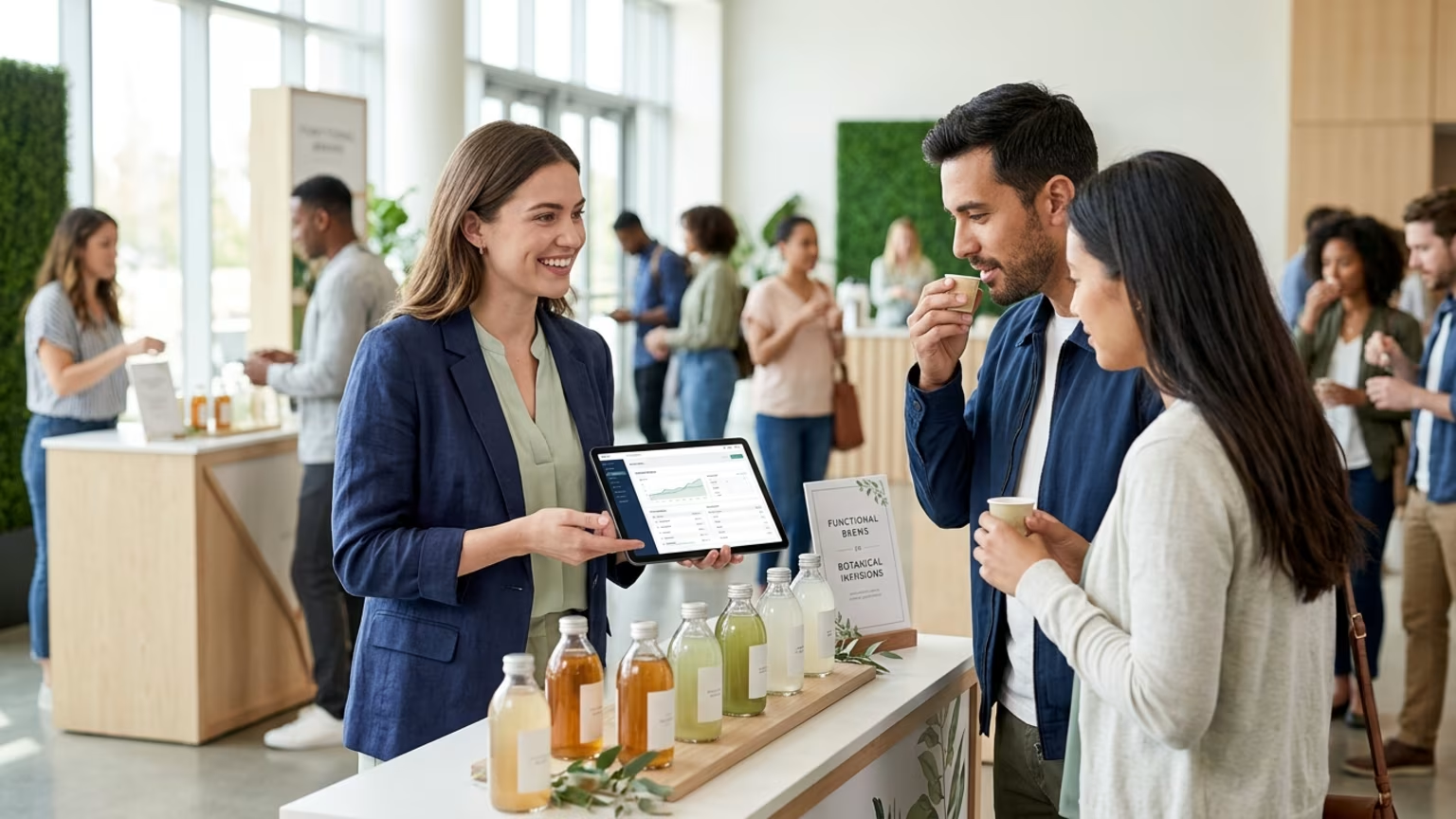
Relying on digital advertising to launch a new beverage category is a guaranteed path to marketing failure. Staring at a perfectly lit product photo on a smartphone screen will never convince a consumer to swallow an unfamiliar liquid. Cann (the THC beverage brand) and its forward-thinking peers have realized that physical product trial is the only engine that drives real behavioral change. The battle for shelf space and consumer loyalty has definitively moved from social media algorithms to the retail floor.
Many companies still waste millions on passive impressions while ignoring the necessity of sensory engagement. Marketing leaders who expect digital clicks to translate into retail sell-through are fundamentally miscalculating consumer psychology. A beverage purchase requires trust, and trust is built when a customer holds a cold can in their hands. Physical activations force a product to prove its value in real time.
The era of unmeasured brand theater is completely over. Today's most successful field marketing campaigns operate with the precision of a direct sales channel. Operators are now demanding that every physical interaction generates a trackable outcome and a measurable Return on Investment. If an event does not directly influence pipeline, it is simply an expensive party.
The explosive growth of alternative beverages provides hard data supporting the need for aggressive physical activation. Data from Shanken News Daily indicates that the hemp-THC beverage category grew 133% in 2025. This growth pushed the category to more than 1.6 million case-equivalents in volume. Such rapid expansion requires a level of retail support that traditional passive merchandising cannot provide.
Regulated cannabis sales figures demonstrate a similar upward trajectory for the beverage format. Headset reported that cannabis beverages generated $76.7 million in U.S. cannabis sales during the second quarter of 2026. This total accounted for 1.2% of all U.S. cannabis sales during that period. Furthermore, this figure represented a 9.3% year-over-year growth rate for the category.
Consumer substitution behavior adds another layer of empirical evidence to this market shift. A study summarized by ScienceDaily evaluated how participants altered their habits when introduced to these products. The research found that 58.6% of cannabis beverage drinkers reported substituting cannabis for alcohol. In contrast, only 47.2% of participants who used other cannabis products reported the same substitution behavior.
Local market reporting confirms these shifts are actively disrupting traditional retail operations. A 2025 municipal liquor-operations report detailed a clear shift in consumer preferences toward alternative beverages. This category included low- and no-alcohol products alongside THC and CBD beverages. The same report noted that local THC sales increased by nearly 25% from January through October 2025.
For a Vice President of Marketing, these statistics require a ruthless reevaluation of trade marketing budgets. Fragmented spending across disjointed regional events will not capture market share in a category growing at triple digits. Operators must consolidate their resources into highly measured experiential campaigns that guarantee product trial. The data shows consumers are willing to change their habits, but they require physical validation before committing.
The urgency to optimize these field budgets is severely amplified by pending federal action. STAT and Forbes report that a federal provision scheduled for November 12, 2026, would formally redefine hemp. This new provision would impose a strict 0.4-milligram total-THC limit per container for many products. Marketing leaders cannot afford to wait and see how this regulatory cliff will impact retail distribution.
This looming deadline means brands have a narrow window to establish permanent customer loyalty. Every dollar allocated to field marketing must drive immediate geographic sales velocity and clear retailer confidence. A brand manager can no longer accept vanity metrics like foot traffic or estimated impressions on a post-event report. They need hard proof that their activation dollars are moving inventory off the shelves today.
The pressure on trade marketing is also driven by shifting retail expectations. Major grocery chains and convenience stores require concrete evidence that a new beverage will perform before allocating prime placement. When a brand approaches a buyer, they need historical data proving their activation strategy moves units. Sales teams armed with clear ROI metrics from regional sampling events can negotiate better shelf positions.
Operators must implement operational discipline to turn a first taste into a repeat purchase with absolute certainty. The focus must be on converting curious prospects into loyal buyers at the point of interaction. Marketing teams must partner closely with sales directors to ensure activations happen near critical retail locations. This alignment guarantees that field teams are not just pouring samples, but actively closing sales.
The macro data fundamentally changes how brands must execute mobile tours and retail demonstrations moving forward. A passive folding table with branded tablecloths will fail when consumers need detailed education about an unfamiliar product. The National Restaurant Association's 2025 show featured a Hemp Beverage Pavilion for the very first time, according to Nation's Restaurant News. This industry inclusion signals that hospitality operators expect a standardized, professional approach to product presentation.
Entering these mainstream environments requires a highly trained team of dedicated brand ambassadors. Staff must be prepared to confidently guide consumers through taste profiles, ingredient transparency, and expected physical effects. Executing a repeatable retail roadshow requires intense logistical planning and uncompromising staff training. Without this rigorous preparation, a sampling event can easily damage a brand's reputation instead of building it.
Scaling these operations nationwide presents another significant operational hurdle for growing brands. Coordinating cold chain storage and shipping logistics across multiple states requires professional oversight. Without strict inventory control, a team might arrive at a premium venue only to find their product is warm or damaged. makai solves this by managing the entire process from central warehousing directly to the retail floor.
The results of disciplined execution speak directly to the bottom line when managed correctly. One of our clients, a Brand Manager in the alcohol beverage space, shared their experience: 'Working with Makai was a game-changer. The activation blew past all our KPIs and created a lasting emotional connection with our customers. Simply outstanding work.' This client saw their activation exceed all key performance indicators while building deep emotional connections with their audience.
Our team insists that operators treat every sampling zone as a structured sales environment. We design campaigns where every physical interaction is strategically mapped against a specific retail account or distribution channel. This level of operational rigor ensures that field marketing actively supports local distributor relationships. When logistics and strategy align, activations become a predictable engine for pipeline growth.
Integrating these detailed efforts with a consistent experiential strategy allows field teams to execute flawlessly. Brands must track how many qualified trials occurred and monitor the subsequent inventory depletion at nearby stores. We use detailed reporting protocols to prove exactly how physical engagement influences the broader supply chain. This approach turns a chaotic live event into a tightly controlled marketing instrument.
Operators must recalibrate their performance dashboards immediately to reflect the hard realities of physical product trial. Measuring a campaign by the number of cups distributed or the total event headcount is dangerously misguided. The only metrics that matter are trial-to-purchase conversion, immediate retail lift, and sustained geographic sales velocity. Field marketing programs must be judged strictly on their ability to generate measurable pipeline and defend critical shelf space.
The timeline for capturing early market share in alternative beverages is rapidly closing. When the regulatory environment shifts, only brands with established physical loyalty will maintain their retailer relationships. Operators who refuse to demand exact ROI from their live activations will quickly find their budgets reallocated. The most successful teams will be those who operate with uncompromising precision on the event floor.
Ultimately, marketing is about changing behavior in a crowded and noisy world. A well-executed activation clears away the confusion and allows a product to speak directly for itself. True influence happens quietly in the moments when a consumer finally decides to trust something new.

30 Years Experiential & Retail Activation Partner for CPG & Beverage Brands | Multi-Market Demos, Roadshows & Costco/Club Programs That Actually Sell