Robbie Thain
Founder, CEO

Choose retail sampling locations by shopper fit, product availability and retailer readiness, with clear staffing and measurement plans.
Choose stores where the intended shopper can try the product, buy it at that location and contribute to a measurable commercial objective. A practitioner quoted by Campaign Middle East captures the tension behind that choice: sample counts alone do not show whether shoppers tried something new, purchased or returned to buy again.
Makai specializes in retail demos, product sampling programs and roadshows that connect brands with audiences face to face. Our view is that store selection should protect that connection while giving the brand a credible way to assess trial and retail performance.
Use this decision sequence rather than selecting locations on traffic alone:
These are decision criteria, not a validated scoring formula. The available evidence does not establish universal traffic thresholds or guaranteed sampling lift.
A field-marketing planning guide identifies visit frequency and duration as operational factors. Timing therefore belongs in the location review, alongside shopper opportunity and product availability. A commercially focused program brief can hold those decisions before the location list becomes a schedule.
Retailer approval and product availability belong ahead of a booked visit. Confirm the store's permissions and execution requirements, then verify that the sampled item is listed and available to buy. Treat permits as a question for the proposed activity and location, not something automatically covered by a national store list.
The setup discussion should also cover the proposed sampling position. IAB Europe’s retail-commerce media discussion says placement matters and points to the potential impact of formats near shelves and checkout. That is useful placement context, not proof that checkout is the best sampling position in every store. Use it to discuss where shoppers can interact with the product and find it for purchase.
Scheduling needs an operating check as well. The field-marketing guide identifies store count, visit frequency and duration, and travel between locations as planning factors. It also identifies staff roles, training time and reporting requirements.
For each candidate location, bring those requirements into the same review as the commercial opportunity. A store that looks attractive on a traffic report still needs a workable visit plan. The selection decision should account for both.
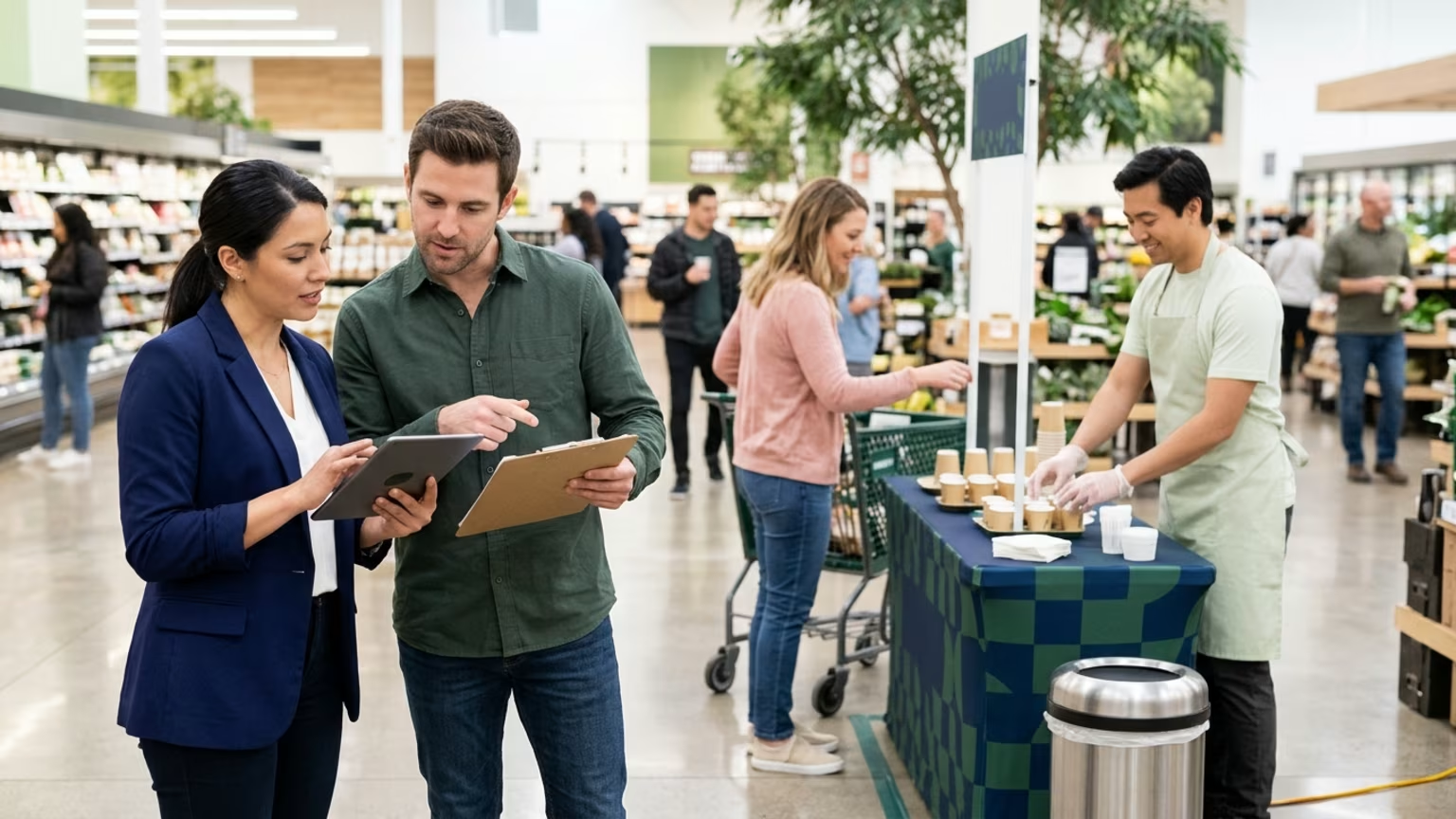
Makai’s retail demonstrations use trained brand ambassadors to support in-store sales through real conversations and product trials. That makes staffing part of store selection rather than a task left until the calendar is full. The question is whether the proposed staffing arrangement supports the experience the brand wants to deliver.
Our aloha-centered view is straightforward: the person matters more than the transaction count. A welcoming conversation and a disciplined operating plan belong together. We believe shoppers should feel invited into a useful product interaction rather than treated as another distribution opportunity.
Apply that view to the location review. Compare the store’s execution requirements with the proposed staff roles and visit duration. Account for training time in the operating plan, as the field-marketing guide recommends. Do not approve the location on the assumption that staffing details will resolve themselves later.
For the conversation itself, prepare language around the product trial and shopper’s questions. The goal is not to replace human connection with a rigid speech. It is to make the intended interaction clear enough that the staffing plan can support it.
Start by separating a retail purchase objective from a lead-generation objective. For a sales-focused demonstration, product availability and store-level sales may be central measures. When qualified leads are also an agreed objective, the plan needs an explicit handoff beyond the conversation.
Makai’s integrated capabilities extend from permitting to CRM reporting. Its positioning connects face-to-face experiences with qualified leads. A physical handshake, however, is not itself a routed CRM record.
The planning sequence should address three distinct decisions:
Our four-week, multi-market Costco sampling program for Pulmuone’s PlantSpired line delivered more than 65,000 samples and recorded an 18 percent sold-to-sale rate. Those are different measures of the program. They provide a concrete example of reporting trial alongside a purchase-related outcome, not a forecast for another store set.
For sales evaluation, the field-marketing guide recommends comparing activated stores with similar stores that were not visited. It also recommends reviewing results across multiple call cycles rather than relying on a single visit. That comparison supports evaluation without proving that every observed difference came from sampling.
Assess Return on Investment against the intended outcome and the program’s operating demands. Sample totals, lead records and sales results answer different questions. Keep those distinctions visible instead of compressing them into one impressive-looking activity total.
The field response should protect execution and the integrity of the evaluation. A disrupted visit should not be treated as evidence that shoppers rejected a properly delivered offer. First establish what actually happened at the location.
The field-marketing guide distinguishes execution measures from sales measures. Its examples include compliance, out-of-stocks found and fixed, and promotions in place. That distinction provides a practical basis for troubleshooting:
Replacement coverage and technical recovery procedures need their own operating plan; this framework does not establish a backup roster or device-recovery protocol. Settle recovery responsibilities before deployment rather than assuming they are included.
The location review can expose some of these risks before launch. Bringing inventory and staffing demands into the same planning discussion keeps the shortlist connected to what the field team must deliver.
Review the shortlist with the retailer and the people responsible for field delivery and measurement. Resolve shopper fit, purchase availability and permission questions first. Then confirm that the staffing and reporting plan matches the intended outcome.
Where feasible, identify similar non-activated stores for comparison before the program begins. The next useful planning document is a location brief that records why each store belongs in the program and how its performance will be assessed. That is a stronger basis for scheduling than traffic alone.
Selecting a store commits a brand to a shopper conversation as well as a location, and Makai handles the retail demonstration side of that decision. Its trained brand ambassadors conduct product trials and talk with shoppers to support in-store sales for CPG marketers and food and beverage brand managers.

30 Years Experiential & Retail Activation Partner for CPG & Beverage Brands | Multi-Market Demos, Roadshows & Costco/Club Programs That Actually Sell