Robbie Thain
Founder, CEO

Learn how experiential marketing and guided product demonstrations turn skeptical consumers into loyal buyers through concrete proof and operational clarity.
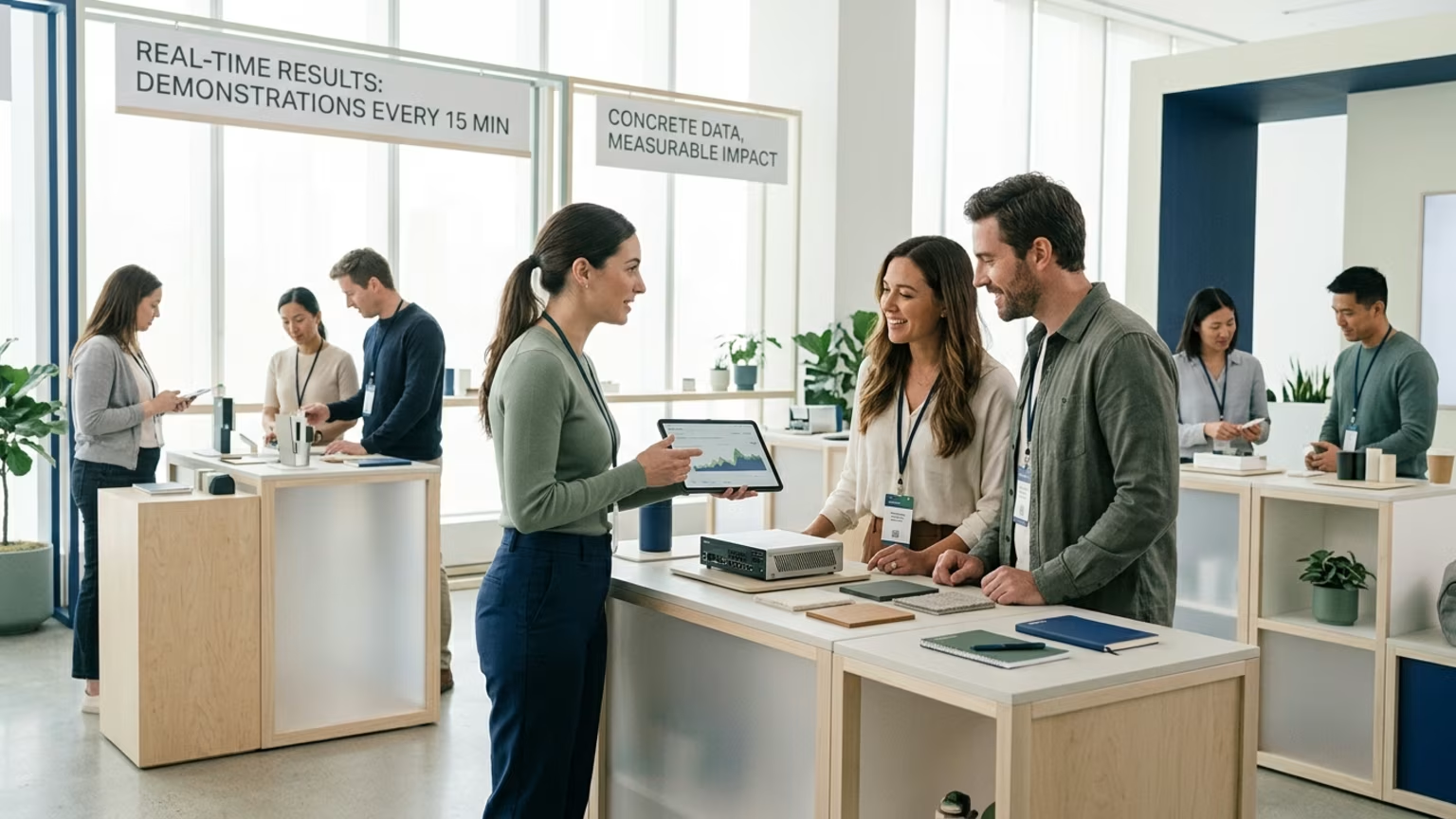
Your massive experiential pavilion is burning cash if your visitors leave without actually understanding your product. Most live marketing treats consumer attention like a passive audience waiting for an entertaining show. The reality is that modern buyers need concrete proof to overcome their natural skepticism about complex claims. Selling a functional beverage or a technical device requires more than just a loud DJ and a neon sign.
Marketers often confuse exposure with education. They build elaborate sets that look fantastic on social media but fail to communicate the core value proposition. Consumers walk through these spaces, grab a free tote bag, and immediately forget what the brand actually does. This is a profound waste of time, energy, and corporate resources.
The modern consumer is exhausted by empty marketing promises. They have been trained by decades of misleading advertising to doubt everything they read online. When they step into a physical activation space, they are looking for reasons to disbelieve your claims. A strong brand experience meets this skepticism head-on by providing undeniable physical proof.
If your product has a complex use case, you cannot rely on visual aesthetics alone. You have to physically prove why your solution is superior to the status quo. A live demonstration forces the brand to strip away the marketing fluff and show the actual mechanics. True belief comes from seeing the results with your own eyes.
Chief Marketing Officers lose sleep over funding giant trade show booths that produce zero qualified pipeline. They watch their teams spend hundreds of thousands of dollars on custom fabrication and travel. Then they receive post-show reports detailing nothing but badge scans and vague engagement metrics. This creates a beautiful disaster on the balance sheet.
National Experiential, citing PQ Media’s 11th Biennial Global Experiential Marketing Forecast, reported global experiential-marketing spending of $138.94 billion in 2025. The forecast projected 10.3% growth in the sector for 2026. The same outlet reported that 74% of Fortune 1000 marketers were increasing experiential budgets in 2026, citing EventTrack. Pumping more capital into flawed strategies will only magnify the losses.
Quad, presenting research conducted with The Harris Poll, described a consumer shift toward physical experiences after years of digital saturation. Many field operators completely ignore the decision phase of this equation. They focus entirely on creating positive feelings while failing to guide the consumer toward a transaction. Simply placing a product in a crowded room is not an effective sales strategy.
Many field marketing directors attempt to solve this problem by adding more staff. They hire dozens of brand ambassadors to stand around and hand out promotional materials. This approach simply creates a larger crowd of unengaged visitors who block genuine prospects from interacting with the product. Scaling a broken system only multiplies the waste.
A busy activation space can mask deep structural failures. High foot traffic does not automatically generate a positive Return on Investment if the crowd consists of unqualified leads. When executives judge success by the length of the line, they optimize for the wrong behavior. Companies must stop confusing crowd size with commercial traction.
Our alternative approach pairs warm hospitality with brutal operational discipline. We have been connecting brands with people through live experiences, retail programs, and national activations since 1995. Over three decades, we have built a track record of creating meaningful brand moments across the country. We know that a friendly greeting must be followed by a flawless product explanation.
You build trust by making unfamiliar benefits highly concrete. A 2026 livestream-commerce study found that sensory language was associated with stronger purchase responses and perceived authenticity. The study combined a large livestream-data analysis with two experiments involving 200 and 320 participants. It reported that sensory language had a stronger effect for experience goods than for search goods.
While the field analysis used Douyin data, the underlying need for sensory validation remains universal. Guiding a shopper through a physical trial turns an abstract promise into a verified reality. However, operators must verify these physical trials remain honest and clearly bounded. The Federal Trade Commission says advertising claims must be truthful, not deceptive or unfair, and supported by evidence.
The FTC specifically emphasizes solid proof for food, over-the-counter drugs, dietary supplements, and other health-related products. Brand ambassadors cannot improvise health claims or exaggerate performance metrics just to secure a sale. A compliant demonstration shows the product under specific test conditions and explicitly states the limitations. Maintaining this high standard of accuracy is how you turn skeptical prospects into loyal customers.
We tackle this challenge by designing demonstrations that isolate specific variables. If a product claims to be waterproof, we build a testing station that proves exactly that. We do not surround the test with distracting elements that dilute the core message. Clarity requires removing anything that does not actively support the central product claim.
Executing this requires rigorous planning long before the doors open. A brand must create a clear substantiation file detailing approved wording and specific limitations. Staff must escalate complex technical questions rather than guessing the answer. Leaders who master strong operational planning understand how strict boundaries actually improve consumer trust.
Marketing leaders must completely change how they define a successful event. You need to shift the focus from tracking raw impressions to measuring tangible business outcomes. A successful program delivers samples distributed to target buyers and secures retail meetings booked. Every element of the activation should drive the participant toward these specific goals.
Industry guidance recommends tracking experiential performance across reach, engagement, affinity, and pipeline outcomes. Experiential-marketing operators are increasingly discussing measurement frameworks that separate reach, engagement, brand affinity, and pipeline or revenue outcomes. Immersive-marketing market reporting also describes a shift from static campaigns toward interactive product education, personalization, physical-digital integration, and data-driven optimization. This industry evolution requires a massive upgrade in tracking methodology.
Connecting these metrics to a customer relationship management system is completely non-negotiable. Field teams must collect high-quality data during the actual product demonstration. You cannot wait until the event ends to figure out who was actually interested. By routing qualified leads directly to the sales team, you immediately capture the commercial value of the interaction.
Attendance, dwell time, and positive sentiment can indicate attention, but they do not prove incremental sales or long-term loyalty. If a consumer enjoys your technology demonstration but leaves without booking a follow-up appointment, the interaction failed. You must build a smooth bridge connecting the physical trial to the digital conversion point. Smart brands are studying how AI marketing tools turn live events into pipeline to close this exact gap.
Other industry summaries have reported strong consumer reactions to live activations, including higher brand positivity and purchase likelihood after events. You can capture that momentum by asking attendees a few rapid comprehension questions. If they can explain your core product benefit in their own words, they are primed for conversion. From there, you immediately offer a clear path to purchase or a retailer incentive.
Teams should constantly test different trial formats to find the highest converting model. A staff-led technical explanation might outperform a self-guided station for a complex software tool. A sensory tasting might require an immediate coupon offer to drive local grocery sales. Those who build systems for connecting live events to retail sell-through will always outperform those who just hand out flyers.
True belief requires visible proof. Flashy architecture and loud music will never compensate for a confusing product presentation. When consumers can physically verify your claims, their skepticism fades and their purchasing confidence grows.
The most successful brands treat live demonstrations as highly controlled scientific trials. They strip away the noise and focus entirely on operational clarity. They train their field teams to deliver precise information with warmth and authenticity. This methodical approach turns chaotic event floors into reliable commercial engines.
Demanding execution over aesthetics is the only way to survive in a challenging market. An activation must function as a precision instrument rather than a vanity project. When you prioritize clear comprehension over sheer crowd size, the results follow.
Converting technical product claims into transparent physical demonstrations requires highly structured field execution, which is exactly where Makai takes ownership of your live activations. We eliminate the difficulty of navigating complex event logistics, permits, and staffing by deploying our flagship Experiential Marketing capability. We create hands on brand moments that connect emotionally and turn customers into ambassadors. Request a proposal

30 Years Experiential & Retail Activation Partner for CPG & Beverage Brands | Multi-Market Demos, Roadshows & Costco/Club Programs That Actually Sell