Robbie Thain
Founder, CEO

Lavazza deployed a multi-venue activation at the Toronto International Film Festival. We break down the logistical reality of managing cross-city sponsorships.
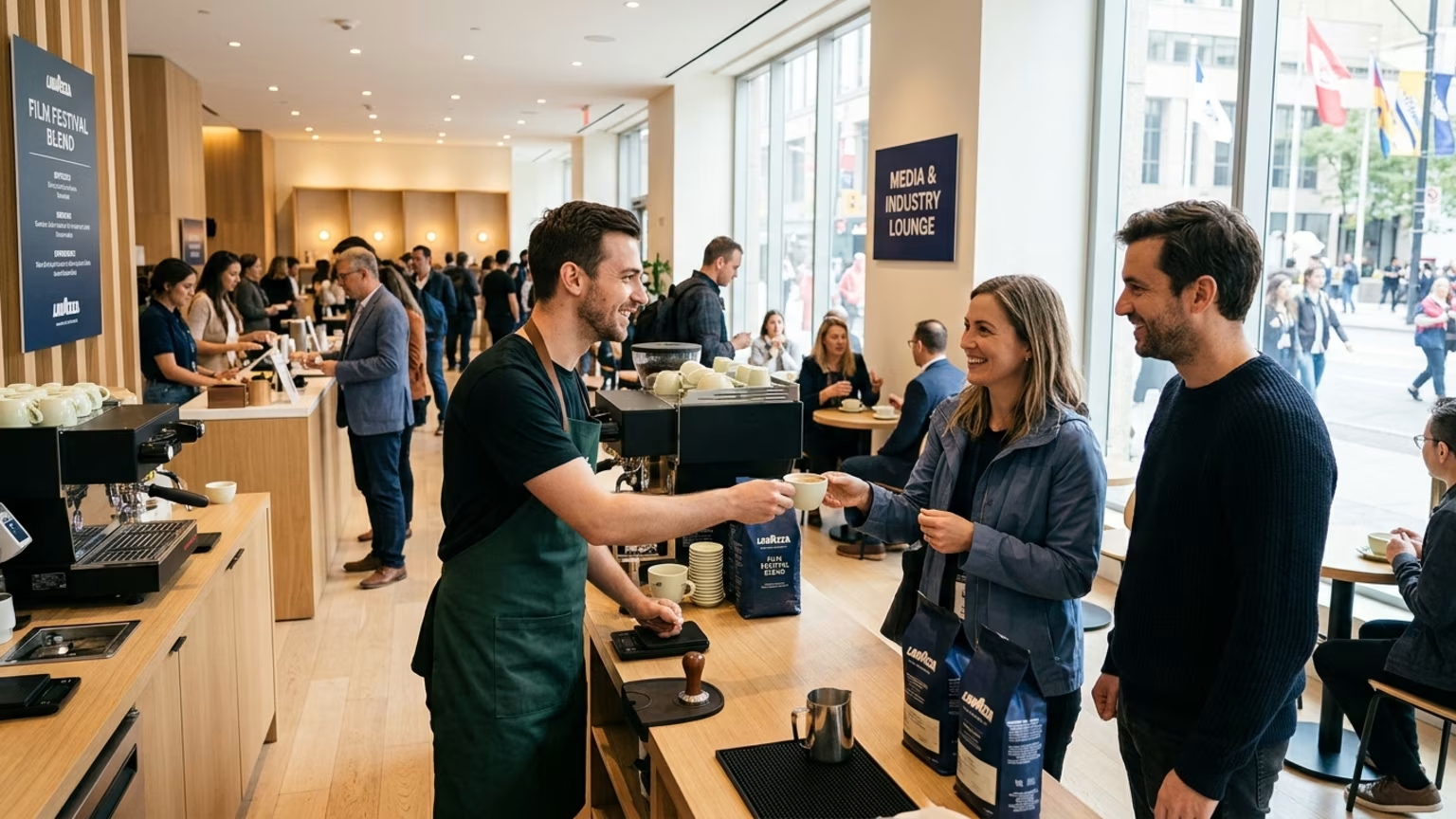
On September 10, 2026, Lavazza launched its most expansive activation program to date at the Toronto International Film Festival. The cultural partnership, which began in 2023, now extends through 2028. Lavazza serves as the Official Coffee Partner and the Gala Presenting Partner for the event. The 2026 festival ran through September 20, serving as the backdrop for a multi-venue physical campaign. This initiative represents a significant commitment to physical marketing formats for the consumer packaged goods sector.
By building a program with multiple touchpoints, the coffee brand tested a complex logistical model. Rather than relying on a single tent or stage presence, the strategy placed the product directly into the hands of different audience segments simultaneously. This approach requires intense coordination across city permitting, inventory routing, and field staff management.
The 2026 program split the brand footprint across four very different operational environments. At Roy Thomson Hall, a first-ever Lavazza Bar served coffee and signature cocktails to red-carpet talent and guests. This space functioned as a high-touch hospitality zone tailored for industry insiders and media personalities. Over at Festival Village, the Cinema Lavazza experience combined a movie theater and cafe concept with product sampling and branded merchandise. This consumer-facing zone prioritized mass engagement and sensory interaction.
The cinema-themed cafe leaned heavily into thematic design, creating a highly photographable environment for attendees. Simultaneously, a Union Station pop-up invited visitors to ring a bell to win prizes like coffee samples or merchandise. This simple physical action interrupts the normal commuter routine and forces a moment of direct engagement. Finally, the brand maintained a trade-market presence by providing coffee service at TIFF: The Market inside the Metro Toronto Convention Centre.
This distributed model targeted VIPs, general consumers, commuters, and industry buyers simultaneously. Retail Insider reports that Lavazza is targeting more than a doubling of North American business by 2028. The outlet also notes that regional revenue increased 26.9 percent in 2025, driven primarily by retail and e-commerce. While these company-level figures show aggressive growth targets, the published strategy does not directly attribute this revenue to the festival partnership. The public reporting identifies these business goals as strategic context rather than direct campaign outcomes.
For consumer packaged goods brands, running four concurrent formats during a major cultural event is a heavy logistical lift. You have to balance high-touch hospitality with mass sampling and structured business-to-business networking. Retail Insider reports that Lavazza evaluates partnerships like TIFF across brand awareness, product sampling, lead generation, social engagement, and sales. Segmenting these goals is a logical framework for any field marketing director managing a complex activation.
We believe that treating those five areas as distinct measurement categories is the right starting point for any operation. However, defining the categories is only half the battle for experiential marketing teams. You need documented outcome definitions and concrete evidence to draw business conclusions. The public reporting on this campaign does not publish activation-level counts or specific sales attributed to the program. Without those details, marketers cannot independently assess attribution or calculate return on investment.
In our experience, you cannot manage what you do not measure precisely. We provide clear reporting on reach, trials, leads, and sales to guide next steps in campaign optimization. Our measurement approach tracks awareness, engagement, and conversion, turning brand moments into actionable data that demonstrates business impact. When a brand scales a program to this size, the data collected on-site must bridge the gap between event interactions and retail registers.
When difficulty measuring real return on investment from live events limits campaign effectiveness, teams often rely on vanity metrics like badge scans. The true value of a distributed model lies in its ability to generate qualified demand from specific audiences. Trade events generate business-to-business pipeline, which requires an entirely different measurement protocol than a public pop-up. Public pop-ups generate consumer trial, which is tracked through coupon redemption and immediate retail sales lift.
Evaluating these outcomes demands a technical infrastructure that many field teams lack. Without unified data systems, leads collected at a red-carpet bar sit in a completely different silo than contacts gathered at a trade show booth. Bringing these streams together allows brands to assess which activation format actually drives the lowest cost per acquisition. This level of clarity justifies the substantial investment required to dominate a major cultural festival.
Linking physical interactions to business growth requires isolating what happens on-site from downstream retail outcomes. To prove the value of a 5 Key Elements to High-Impact Activations, teams must assign specific key performance indicators to each venue. A red-carpet VIP bar generates different metrics than a high-volume sampling tent. Measuring them with a generic formula limits a brand's ability to optimize future events.
Splitting a single festival sponsorship across multiple distinct locations changes everything about field execution. Each location demands a unique staffing profile and a specialized supply chain. Red-carpet hospitality requires trained mixologists and brand ambassadors who can navigate high-profile guests with polish and discretion. These team members operate in a tightly controlled environment where service speed and presentation matter equally.
Meanwhile, the Union Station pop-up requires high-energy staff focused on fast interactions and crowd control. Managing this type of consistent multi-market presence across multiple sites means operations leaders must decentralize their management. When one activation distributes merchandise and another serves complex coffee cocktails, inventory tracking becomes highly fragmented. Running out of cups at a transit hub creates an immediate bottleneck, while a stock issue on the red carpet damages brand perception instantly.
We navigated a similar operational matrix when we designed and managed a 40 by 20 foot trade show environment for Glanbia at Natural Products Expo West 2025. Instead of scattering a single brand across a city, we brought think!, Isopure, Optimum Nutrition, and Amazing Grass into one coordinated space. We handled concept, operations, staffing, and breakdown, with more than 14,000 recorded product samples distributed across the activation stations. By channeling multiple brand identities through a unified supply chain, we maintained strict inventory control without sacrificing individual brand experiences.
Executing mass distribution in high-traffic environments brings its own set of logistical hurdles. We ran a four-week Dole Whip summer sampling program across San Francisco, Boston, Tampa, and Orlando. The activations distributed more than 64,000 servings, and we built the creative assets so the concept could be reused in future campaigns. Handling volume at that scale requires a rigid timeline for freezer storage, localized transport, and daily restocking.
Applying that same discipline to a multi-venue festival presence keeps the activation focused on smooth consumer engagement rather than reactive problem-solving. This scale of sampling requires a strict supply chain to keep stations stocked without disrupting attendee flow. For multi-site programs like Lavazza at TIFF, field marketing managers must coordinate daily product drops and staff rotations across the city. Permit compliance, waste removal schedules, and localized union rules must align perfectly for the campaign to succeed.
Brand leaders often look beyond immediate event transactions when evaluating major sponsorships. Lavazza North America marketing vice president Daniele Foti said audience engagement had grown each year and helped make extending the TIFF partnership an easy decision. This highlights how corporate decision-makers weigh qualitative audience reception alongside structural business goals. It gives insight into why consumer packaged goods companies commit to multi-year cultural partnerships.
Foti framed the value of the cultural event as participation in an experience rather than simply buying visibility. He noted that traditional advertising cannot put people inside a real moment with a product. While this executive positioning highlights the qualitative appeal of the festival, operations teams must still bridge the gap between genuine engagement and measurable sales. Translating that real moment into documented retail velocity is the ultimate test of any field marketing budget.
When a premium brand expands its footprint across VIP lounges, consumer villages, and trade markets, the margin for error shrinks. Brands need to verify their agency partners can manage the complex permitting, staffing, and routing required to keep every location running smoothly. By integrating targeted gamification tactics for lead capture, companies can turn these scattered interactions into verifiable pipeline.
If your field marketing team deployed four distinct activations across a single city tomorrow, do you have the logistical framework and measurement protocols to prove which one actually moved product off the shelves? Turning real-world foot traffic into qualified pipeline requires absolute operational control.
When field marketing directors struggle to track cross-venue performance, proving the commercial value of a sponsorship becomes impossible. To solve the difficulty measuring real ROI from live events, Makai aligns your physical footprint with verifiable data capture. Using our Promotional Campaigns capability, our campaigns connect digital and real world touchpoints to boost visibility and spark brand conversations. Request a proposal

30 Years Experiential & Retail Activation Partner for CPG & Beverage Brands | Multi-Market Demos, Roadshows & Costco/Club Programs That Actually Sell