Robbie Thain
Founder, CEO

Kraft Heinz raised its 2026 outlook by heavily funding new products and retail execution. Learn why CPG brands must prioritize the physical shelf over pricing.

A field marketer stands in aisle four watching a shopper pick up a new product, glance at the price, and put it right back on the shelf. The digital media plan worked perfectly, but the physical store experience failed to convert. The Kraft Heinz Company recently raised its 2026 outlook after second-quarter results exceeded expectations. Management framed the improvement as early evidence that CEO Steve Cahillane’s turnaround plan is gaining traction.
Myth: You can rely purely on massive top-funnel advertising and price increases to fix a struggling consumer packaged goods portfolio. Truth: Relying solely on pricing will erode your volume over time if you do not support new product innovation with actual retail execution. Kraft Heinz understands this reality well. The company is actively pairing new product launches with rigorous commercial discipline to win at the physical shelf.
The tension between digital marketing scale and real-world execution is a constant battle for modern brands. When a brand launches an ambitious new product line, the corporate office expects immediate retail sell-through. However, consumers do not buy products just because they saw a clever advertisement on their smartphone. They buy products because they trust the brand, understand the value proposition, and experience the item firsthand.
Makai specializes in bridging this exact gap between digital awareness and physical retail conversion. Our focus is squarely on creating hands-on brand moments that connect emotionally and turn customers into ambassadors. When you ignore the store floor, you surrender your brand equity to chance. When you control the physical activation, you take control of your pipeline.
Smart marketing leaders often fall into a familiar trap when launching new items. Tight budgets and relentless time crunches force teams to depend on digital reach instead of physical activation. It is simply easier to launch an advertising campaign than to coordinate product trials across complex retail environments. When costs rise, brands often lean on price increases to hit revenue targets quickly.
This approach sounds perfectly logical in a boardroom where spreadsheets dictate strategy. Marketing agencies promise massive impression numbers that look fantastic on quarterly review slides. Executives see digital metrics climb and assume those numbers will automatically translate into retail sell-through. The allure of a clean digital campaign masks the messy reality of physical store operations.
This operational disconnect often peaks during critical trigger moments like a major product launch or retail expansion. A Vice President of Marketing might review a beautiful digital dashboard showing millions of targeted consumer impressions. These leaders are under immense pressure to prove that activations lead to sales lift, conversion, and Return on Investment. It is highly tempting to trust the dashboard over the chaotic reality of managing live retail demonstrations.
Relying on advertising alone ignores how human beings actually shop for food and beverages. Shoppers make split-second decisions based on packaging, price, and immediate physical appeal. When a brand introduces a reformulated product, the consumer needs a reason to trust the change. Digital ads cannot replicate the sensory experience of tasting a new item.
If the field execution is fragmented, even the best product will fail to gain traction. Inconsistent staffing and poor in-store presentation destroy consumer trust instantly. Brands end up with events that look busy but produce fog instead of hard evidence. The disconnect between the corporate strategy and the store floor becomes a massive liability.
The false assumption that pricing and media alone drive sustained growth fails on the event floor. Consumers need to understand and experience a product before they commit their hard-earned dollars to it. According to recent reports from The Grocer, Kraft Heinz’s second-quarter volumes fell 2.6%, while price contributed 1.3 percentage points to sales growth. Pricing can protect revenue temporarily, but it cannot solve a consumer perception problem.
To change consumer behavior, brands must pair innovation with specific consumption occasions. Kraft Heinz cited new product activity such as Kraft Mac & Cheese PowerMac, Capri Sun Hydrate, and Philadelphia Lactose Free cream cheese as part of its innovation push. Management described PowerMac as having launched in more than 35,000 stores. It also achieved top-quartile consumption rates according to recent earnings summaries.
Winning at the shelf requires a granular commercial model that prioritizes the physical shopper experience. Product, price, promotion, and channel placement must be coordinated seamlessly across the retail environment. Retail execution is the bridge that connects a brilliant product formulation to actual shopper conversion. When you skip this critical operational step, shoppers will simply abandon the product.
Experiential marketing turns fleeting consumer interactions into qualified leads for premium brands. A new product must be explained, sampled, and merchandised exactly where purchase decisions happen. Kraft Heinz treats execution as part of the growth system rather than as a separate communications function. This level of operational discipline prevents a launch from becoming a beautiful dumpster fire.
Kraft Heinz highlighted condiments, hydration, and desserts as areas of progress while acknowledging continued pressure in meats and meals. This uneven performance proves that execution and consumer reception differ drastically across categories. You cannot apply a uniform strategy to a massive portfolio and expect uniform success. Tailored execution at the shelf level is mandatory for categories that require consumer re-education.
Brands must treat retail execution as a core part of their overall product strategy. A launch needs a concrete plan for how shoppers will encounter, try, and purchase the item. A VP of Marketing reflected on our partnership: "Robbie, it was a pleasure working with you and your team. You turned our launch into an experience that connected with shoppers and built lasting excitement for our brand."
"We're already looking forward to the next project together." Our team created a launch experience that resonated with retail shoppers and generated momentum for future collaborations. The goal is to connect the physical experience to an outcome that sales and retail partners recognize. Brands that realize how strong floor programs secure premium retailer placements build their activations around measurable commercial behaviors.
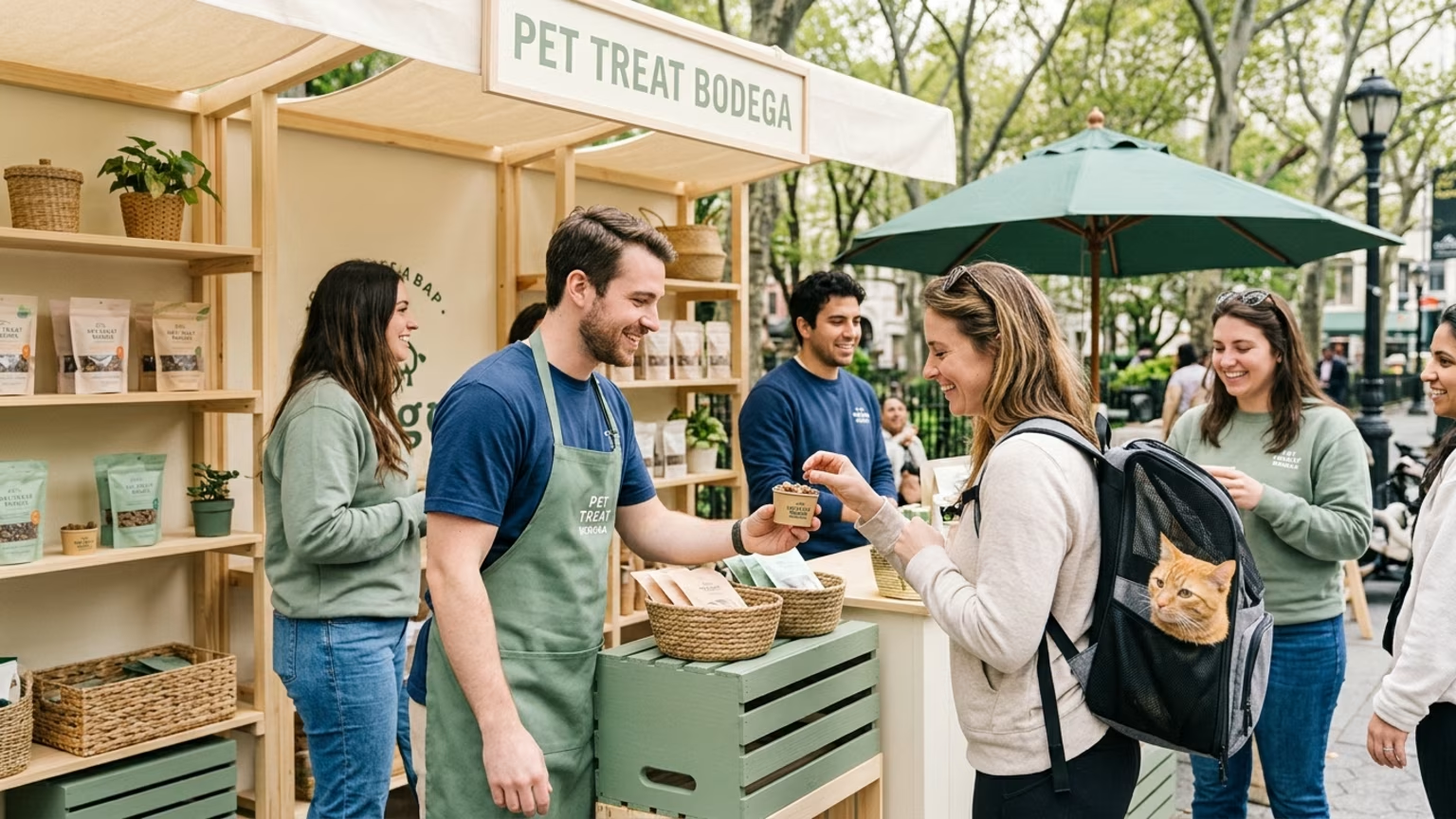
Sampling, demonstrations, and guided comparisons make product benefits tangible at the exact moment of consideration. It is not about throwing random brand ambassadors at a busy retail store. It is about deploying trained personnel who can communicate the value of a lactose-free or electrolyte-infused product clearly. By deploying reliable staff for local roadshows, companies ensure consistency across every location.
Execution must also be measurable and repeatable across different markets and retail channels. Field reporting should capture execution compliance, trial metrics, and actual conversion rather than just vanity metrics. This rigorous approach gives retailers concrete evidence about shopper response and local product demand. That evidence ultimately helps secure future display space, replenishment orders, and vital promotional support.
Effective experiential marketing also integrates with backend systems to track performance rigorously. Managing campaigns requires capturing data on retail sell-through, sample distribution, and localized consumer feedback. Without this data loop, brand teams are flying blind after the activation ends. Makai ensures every physical touchpoint is tracked and reported to validate the initial marketing investment.
The financial data from Kraft Heinz illustrates the required financial commitment for a true operational turnaround. According to Reuters, the company increased its planned incremental investment for 2026 by $100 million, bringing the total to approximately $700 million versus 2025. This scale of investment demonstrates that improving retail trends justifies supporting brands heavily instead of cutting costs. The strategy requires sacrificing some near-term profitability to produce more durable growth over time.
The results are beginning to show in the company's forward-looking revenue and margin metrics. Kraft Heinz now expects 2026 organic net sales to decline between 0.5% and 2.0%, an improvement from its previous forecast of a 1.5% to 3.5% decline. The company raised its adjusted earnings-per-share forecast to $2.03 to $2.09, compared with its previous range of $1.98 to $2.10. It also improved its adjusted gross-margin outlook to a decline of 10 to 50 basis points, versus the previous expectation of a decline of 25 to 75 basis points.
Market share metrics also reflect the initial impact of these focused operational changes. Investing.com notes the company reported that the percentage of U.S. retail revenue either gaining or holding market share rose to 30% in the first half of 2026 from 12% in 2025. Furthermore, consumption declined approximately 2.5% in the second quarter and approximately 1% in July. These figures represent a clear deceleration in the rate of decline rather than massive immediate growth.
Despite these improvements, the overarching financial picture remains incredibly complex for the brand. Second-quarter organic net sales were approximately $6.2 billion, down 1.3% year over year, while adjusted EPS fell 18.8% to $0.56. The updated outlook includes an estimated 100-basis-point headwind from lower SNAP benefits. Reuters reported that Kraft Heinz shares fell approximately 4% in afternoon trading as investors continued to question the turnaround effort.
Turning innovation into pipeline requires flawless physical retail execution, not just a massive digital media budget.

30 Years Experiential & Retail Activation Partner for CPG & Beverage Brands | Multi-Market Demos, Roadshows & Costco/Club Programs That Actually Sell