Robbie Thain
Founder, CEO

See how Jack Daniel’s uses the Dear Neighbor mobile tour to blend purpose-driven responsible drinking conversations with measurable retail sales impact.

The field marketing director stood in a scorching parking lot, watching attendees grab free promotional items and immediately walk away. She had spent a quarter of her budget on a responsibility campaign meant to build deep consumer trust. Instead, it was just another ignored booth in a sea of event noise. The return on her investment was practically zero.
This breakdown reveals how top beverage brands use structured mobile tours to turn complex social conversations into measurable retail lift. By standardizing field operations and defining clear behavioral metrics, marketing leaders can protect brand equity and drive localized sales simultaneously.
You know the typical chaotic scenario at a massive outdoor festival or trade show. Brands set up expensive footprints with the goal of connecting deeply with consumers. The reality is a loud, disorganized mess where brand ambassadors blindly hand out samples to distracted crowds. Nobody is having a meaningful conversation about the actual product or brand values.
The messaging gets completely lost in the rush for free items. When companies try to run purpose-driven campaigns in these environments, the result is often expensive brand theater. They place a corporate responsibility slogan on a vinyl banner and hope the audience absorbs the message. Staff members are rarely trained to facilitate real dialogue about sensitive topics.
The activation generates raw foot traffic but yields zero measurable Return on Investment or real behavioral change. Field marketing managers end up managing logistics instead of driving strategy. They spend their days chasing missing pallets and begging staff to stay off their phones. This lack of control turns a precise marketing instrument into a stressful liability.
The fix requires shifting from passive displays to a rigorous behavioral framework. We design live experiences to elicit a specific consumer action rather than just general brand awareness. For beverage brands, this means creating environments that prompt attendees to make a concrete plan. The activation must function as a facilitated conversation space.
We blend physical and digital experiences by integrating QR codes and mobile technology into a cohesive layer across retail and event experiences. This integrated tech approach is not a standalone service but an upgrade we apply to many types of experiential work to drive connected results. This methodology allows us to track consumer actions from the event floor directly to the retail aisle.
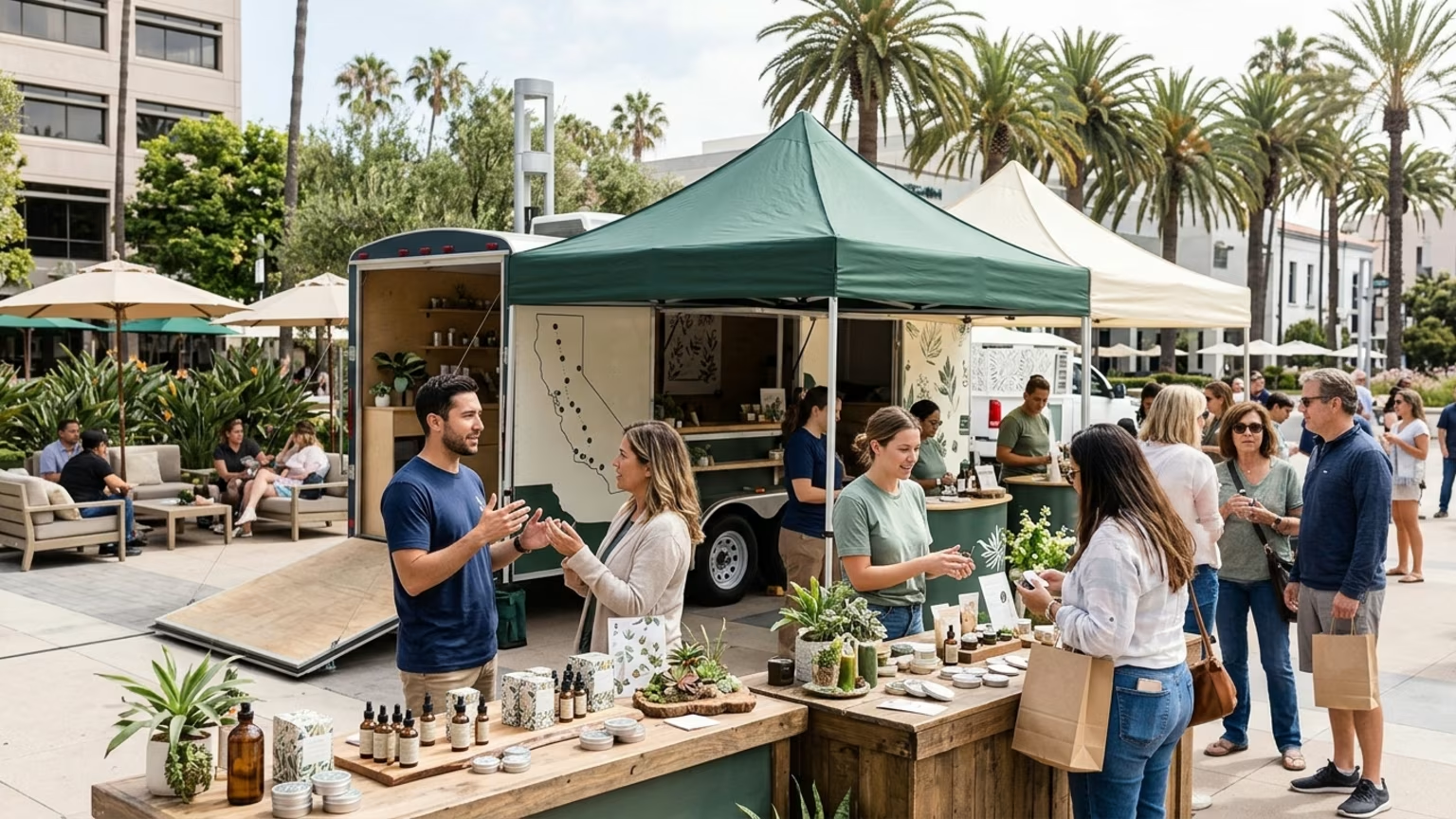
Brands that want to win regional market share know that mobile pop-up tours support retail expansion by bringing these structured interactions directly to target neighborhoods. The strategy relies entirely on hyper-local relevance. A neighborhood-scale activation builds trust much faster than a national ad campaign. Consumers respond better to human-sized, relational marketing efforts.
The most effective roadshows stop asking consumers to passively observe. They invite the audience to actively participate in the narrative. Field teams use structured prompts to guide attendees through sharing their own experiences and making small commitments. This interactive architecture turns a fleeting brand interaction into a memorable psychological anchor.
Many marketers worry that highlighting moderation will depress consumption. Category research consistently shows the opposite effect. Trust and long-term brand equity increase when brands acknowledge risks and reinforce moderation. These programs support corporate reputation with mainstream drinkers, regulators, and retailers.
Mobile tours require significant resources up front. The investment pays off when the physical footprint is highly repeatable. The build must be modular and constructed for multi-year use across different retail environments. The content can be swapped per market while the structural framework stays exactly the same.
The Jack Daniel’s ‘Dear Neighbor’ nationwide mobile tour offers a perfect example of this structured approach. Brown-Forman built an immersive traveling installation to spark dialogue about responsible drinking. The brand combined this mobile footprint with local bar and community events. This format brings their messaging into real-world neighborhoods with high-touch authenticity.
Industry analysts report that changing consumer habits are driving a major shift toward moderation. Over half of U.S. drinkers say they try to reduce their alcohol consumption at least sometimes. The no and low alcohol segment grew by high-single to low-double digits annually in recent years. Jack Daniel’s uses the tour to stay culturally relevant and maintain retailer goodwill amid these market shifts.
The brand avoids vague slogans and instead focuses on community-based harm reduction. They pair a modular pop-up build with facilitated conversations about being a good neighbor. This proves that live experiences can handle complex topics, still driving commercial value.
Experiential strategists note that brands cannot change behavior purely through digital impressions. Safe, facilitated, in-person environments spark honest conversations and shift community norms. The brands winning right now show up in real life with a clear, measurable purpose. They deploy assets that earn trust and defend category legitimacy simultaneously.
Alcohol company leaders consistently frame responsibility programs as foundational to the long-term health of the category. Moderate consumption is the only sustainable positioning for major brands facing regulatory scrutiny. Today’s consumers reward brands that acknowledge complexity rather than pretending alcohol carries no risks. The Dear Neighbor tour embodies this transparent approach perfectly.
There is an ethical tension in using immersive environments for a topic with real potential harms. Jack Daniel's addresses this by centering human stories and active listening rather than brand heroics. They give attendees agency to share their boundaries and make safe plans. They keep the physical product presence supportive rather than dominating the space.
Running a multi-city mobile tour requires operator-grade discipline from day one. Without tight logistics, field teams will burn out and execution will suffer.
Marketing operators face immense pressure to prove that activations lead to sales lift and retailer confidence. You cannot manage a national roadshow based on vanity metrics like total impressions. The program needs clean data, clear key performance indicators, and rigorous reporting. Teams must learn how to measure event results without guesswork to justify their budgets.
The exact lead metrics to track include unique visitors, average dwell time, and data capture opt-in rates. You must measure participation rates in deep engagement moments. This means tracking how many people completed a guided conversation or scanned a digital pledge. These early indicators show if the activation is actually holding consumer attention.
The critical lag metrics define your actual business impact. You need to track incremental units sold at nearby retailers in the weeks following the event. Compare short-term sales lift in test markets against control markets to isolate the event impact. Finally, measure changes in retailer display support and category performance to prove long-term commercial value.
Your next field marketing initiative needs operational rigor and a framework that demands measurable results. Stop treating live brand experiences as an unmeasurable expense. Book a strategy call to map out a mobile tour that turns fleeting interactions into qualified retail pipeline.

30 Years Experiential & Retail Activation Partner for CPG & Beverage Brands | Multi-Market Demos, Roadshows & Costco/Club Programs That Actually Sell