Robbie Thain
Founder, CEO

Explore how wellness and CPG brands navigate the operational logistics of patient-centric retail clinic sampling, turning health care investment into real ROI.
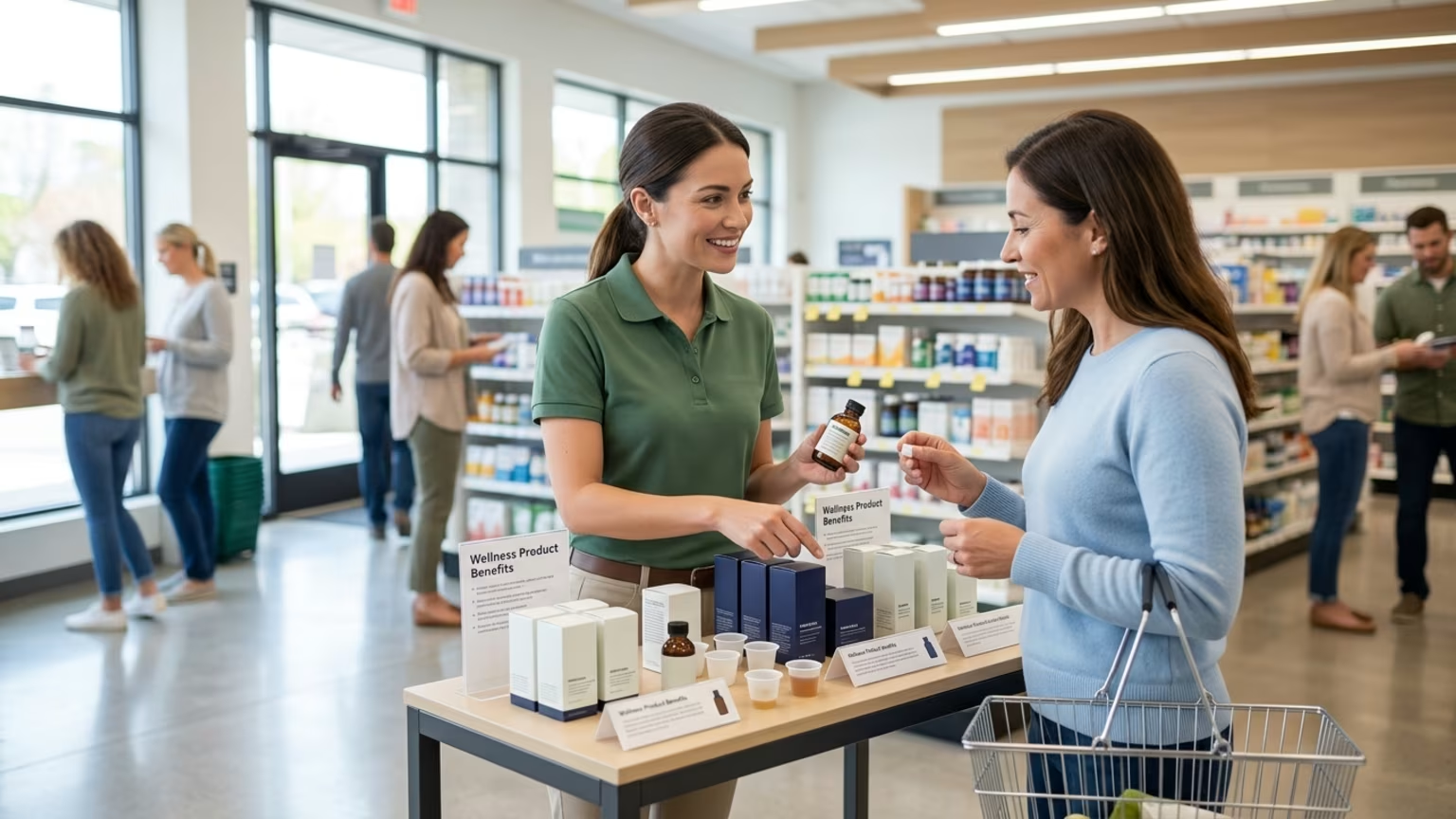
Most marketers assume that placing a wellness product inside a pharmacy automatically guarantees consumer trust. The reality is that clinical spaces are highly sensitive environments where poorly executed sampling campaigns actively damage retailer relationships. Activating in these care-adjacent footprints requires strict operational discipline and relentless attention to local detail.
Activating a health-focused product requires intense background preparation long before a brand ambassador enters a store. Securing local operating permits and scheduling exact vehicle staging times are non-negotiable requirements for clinical retail spaces. Teams must review site regulations carefully to ensure every physical footprint aligns strictly with local health codes. We blend physical and digital experiences by integrating mobile technology and real-world activations into a cohesive layer across retail locations. Phygital is not a standalone service but an upgrade we apply to many types of experiential work to drive connected results.
CRM routing setup is another critical pre-brief mandate for measuring Return on Investment accurately. A brand must build automated lead capture pathways that separate general product interest from private patient data. When companies invest in consistent in-store engagement, they rely completely on this secure data architecture. If a local pharmacy manager sees temporary event labor blocking prescription lines, the activation will be shut down immediately.
Rigorous planning prevents these operational failures before inventory even leaves the warehouse. Planners must map exact crowd flow patterns for every specific location category to maintain clear walkways. For brands trying to scale face-to-face marketing networks, pre-brief discipline dictates everything from localized inventory routing to intense ambassador training. Assuming that all neighborhood pharmacies operate identically will quickly ruin an expensive national rollout.
Executing a patient-centric sampling strategy demands absolute precision on the active retail floor. The current institutional investment environment is clearly capitalized and highly motivated. Reuters, citing LSEG Lipper data, reported $2.44 billion of July inflows into approximately 50 U.S.-listed health-care funds in 2026. This massive movement of capital followed nearly $1.5 billion of inflows in June, ending a three-month period of net withdrawals.
However, field operators must translate that high-level financial momentum into compliant consumer interactions. Field teams must follow a specific operational framework to ensure success.
Executing these precise steps helps brands connect live event growth to retail sales without violating consumer trust. The S&P 500 health-care index rose 11.2% over the three months covered by the Reuters report. This performance easily outpaced the 6% increase for the broader S&P 500 over the same period. Still, realizing these financial gains at the store level requires measured, highly compliant marketing tactics.
The first major logistical mistake brands make is relying on manual lead collection tools. Using paper clipboards or unverified offline forms in a health care setting routinely results in lost data. Amateur teams frequently deploy capture methods that fail entirely during busy retail pharmacy hours. When field representatives use generic spreadsheets, they lose qualified leads and risk compromising consumer privacy.
A proper operator builds automated digital pipelines that route information safely and efficiently. The second common failure involves severely underestimating crowd flow and unique patient missions across different retail formats. In the mass-merchandiser category, Sam’s Club scored 786 and Costco scored 770 in the J.D. Power 2026 study. These highly trafficked environments possess vastly different floor layouts than a traditional regional supermarket pharmacy.
For example, J.D. Power reported that H-E-B scored 773, Wegmans scored 749, and Publix scored 741. Forcing a massive activation booth into a tight clinical corridor at these specialized locations creates dangerous congestion. Proper execution requires adapting the booth footprint to the specific retailer environment to maintain baseline operational trust. Brands that ignore these physical constraints often lose their retail authorization permanently.
The health care sector continues to attract heavy institutional focus and substantial capital investment. Reuters reported that health-care-sector merger and acquisition value reached nearly $284 billion in 2026. This massive figure is rapidly approaching the $306 billion recorded in 2025. Furthermore, a Bank of America survey found global fund managers were 32% net overweight health-care stocks in July, compared with 14% in June.
Reuters noted that health-care stocks were trading at approximately 18 times forward earnings. This valuation sits above the sector’s 20-year average of 15 times but below the S&P 500’s nearly 20-times multiple. Christian Peng of Citizens Bank said depressed health-care valuations created potential opportunity for investors. Mark Hackett of Nationwide said investors were moving toward previously overlooked areas of the market, hoping for stronger earnings.
J.P. Morgan strategist Dubravko Lakos-Bujas and colleagues described health care as offering durable growth, technology-like profitability, valuation appeal, and vital portfolio diversification. James Harlow of Novare Capital Management noted that recent earnings and management commentary had helped reduce previously excessive negativity around the sector. Bloomberg’s sector page clearly reflected this optimism when it showed Pharmaceuticals, Biotechnology & Life Sciences rose 2.12%.
Still, a surging stock index does not automatically repair a broken physical customer journey. J.D. Power noted that mail-order pharmacy satisfaction increased 2 points year over year to 699, indicating that convenience remains a powerful draw. The true measure of a physical retail strategy rests entirely on the quality of the human interactions occurring quietly at the neighborhood level. Operators should watch post-event follow-up metrics closely to ensure these localized conversations actually convert into verifiable retail sales.
Achieving verifiable product trial in clinical pharmacy spaces demands flawless physical execution and secure data handling, which Makai delivers through integrated event management. We eliminate the risk of inefficient post event follow up and CRM routing while deploying our Storage & Logistics capability. We store your sampling product and event gear, then ship, track, and coordinate delivery nationwide so every activation stays on schedule.

30 Years Experiential & Retail Activation Partner for CPG & Beverage Brands | Multi-Market Demos, Roadshows & Costco/Club Programs That Actually Sell