Robbie Thain
Founder, CEO

Learn how to scale face-to-face marketing networks to drive retail growth. Master strategies to standardize field teams and prove ROI with clear metrics.
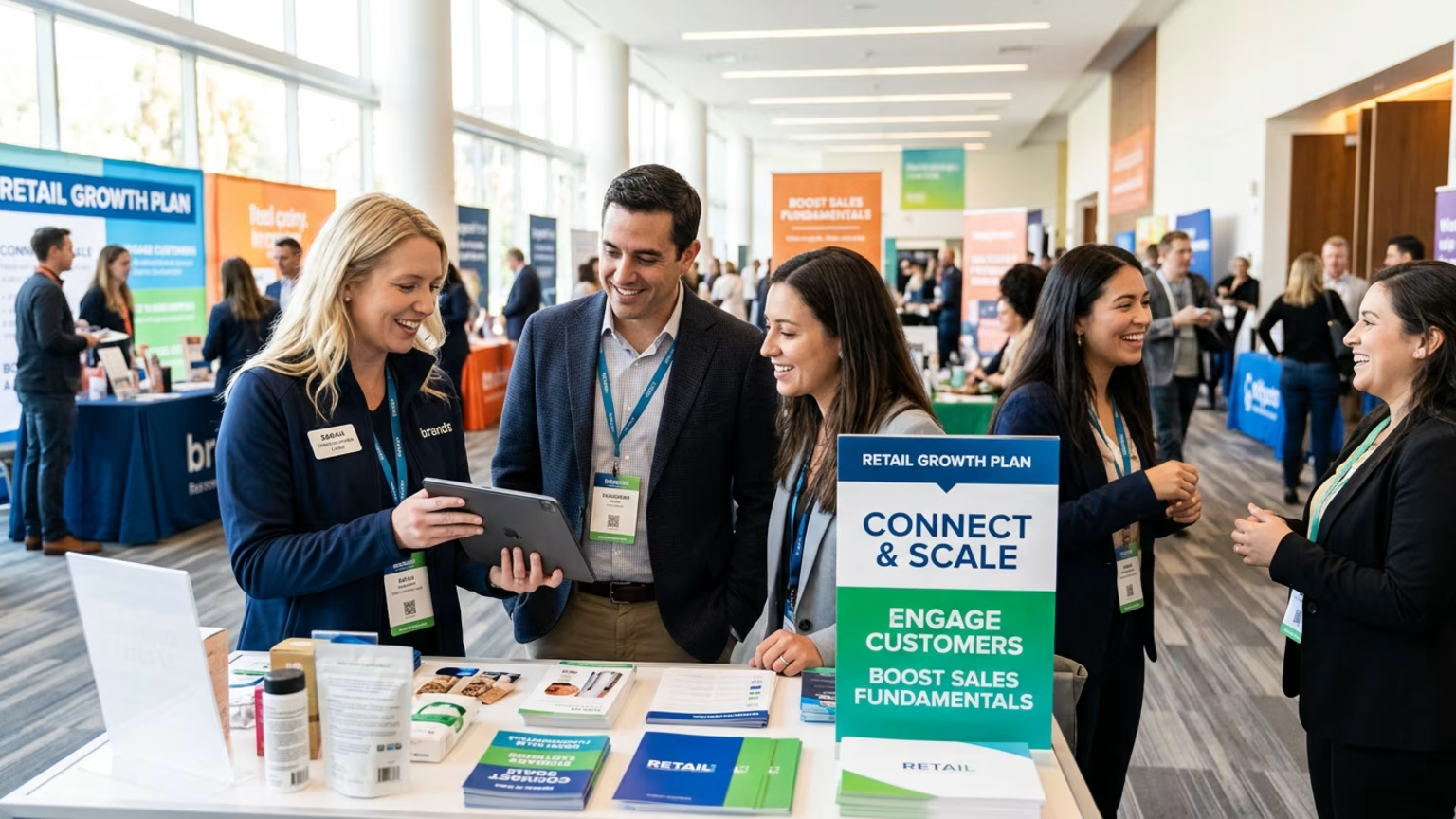
Sarah stood on the trade show floor holding a lukewarm coffee and a useless clipboard. Her three regional brand ambassadors were thirty minutes late to the most important product launch of the year. The sampling display looked incredibly sloppy. She needed a standardized field team yesterday.
Recent industry announcements show face-to-face marketing networks expanding across North America to meet rising demand for physical customer acquisition. Brands must adopt standardized field execution frameworks to convert screen-fatigued consumers into measurable retail buyers.
Marketing leaders frequently face a chaotic reality when trying to scale retail activations nationally. You hire independent local teams for product launches and simply hope for good results. The outcome is usually inconsistent brand messaging and poorly trained floor ambassadors. You receive missing performance reports and zero clear data on Return on Investment (ROI).
This unpredictable environment creates immense stress for field operations managers. Consumer screen fatigue is pushing brands back to physical spaces for direct engagement. McKinsey research on consumer sentiment indicates a growing desire for authentic physical interactions. Digital advertising costs are climbing rapidly.
Marketers struggle to manage dozens of regional agencies without a centralized management system. This fragmented approach burns budgets and damages critical retail relationships. Brand directors understand the pressure of supporting a major national retail push. When your product hits the shelves of a major big box retailer, you must drive immediate foot traffic.
Relying on disorganized local promoters leads to empty sampling tables and confused shoppers. The gap between your pristine marketing strategy and the actual floor execution becomes painfully obvious. Many CPG companies try to fix poor field execution by throwing more money at the problem. They book larger booth spaces or design more expensive sampling carts.
Better props will never fix a fundamentally broken staffing and logistics pipeline. If the person handing out your product cannot clearly articulate the value proposition, the sale is lost.
A systematic approach to outsourced field sales solves this regional fragmentation. Recent industry announcements reveal network aggregators expanding their operational footprints across North America. This model connects consumer goods companies with standardized independent sales organizations. A unified network guarantees uniform training and reporting across all active markets.
We run experiential and engagement programs coast to coast with local crews. Our smart logistics and permit expertise let us launch fast and maintain quality consistency in every region. This infrastructure spans from major metros to smaller markets. Our nationwide reach enables us to activate brands wherever their audiences are located.
This centralized control lets brands execute time-sensitive retail pushes with total confidence. You replace daily guesswork with operator-grade discipline. Marketing teams must align their field strategy with clear retail expansion objectives.
If you plan regional market entries, you need a network that can deploy staff simultaneously in multiple targeted cities. A unified network approach provides the infrastructure to support fixed timelines and high stakes. Standardization turns chaotic field operations into a highly reliable pipeline generator.
Trigger moments create immense urgency for senior marketing operators. A sudden Costco roadshow approval or a massive seasonal product launch requires immediate field readiness. You cannot spend three months sourcing local talent when the retailer expects active demonstrations next week. A network model provides the elastic scale required to meet these aggressive timelines successfully.
Rolling out a national field marketing campaign requires strict operational frameworks. You must eliminate the variables that lead to poor brand representation on the floor. Follow this exact sequence to deploy your next large-scale activation successfully.
You cannot manage what your field teams fail to measure accurately. CPG brands must move beyond vanity metrics like total booth visitors or smiles generated. You need hard data to defend your experiential budgets to the executive team. Success requires tracking distinct lead and lag indicators relentlessly.
Your lead metrics show real-time health during the actual activation. Track the cost per engaged consumer to understand your immediate operational efficiency. Monitor daily event attendance and the precise ratio of samples distributed to conversations started. These numbers tell you if your ambassadors are working hard or simply standing around.
Real-time visibility allows you to course-correct failing local activations immediately. Lag metrics prove the final business impact after the event concludes. The most critical number is your trial-to-purchase conversion rate. Marketing directors must demand data proving actual sales lift in the specific retailers surrounding the activation.
Compare brand awareness lift through pre-event and post-event survey data. This information justifies your ongoing field investments. If you are supporting brands launching new product lines, you must track retail buyer confidence. A successful face-to-face marketing network campaign will generate strong sell-through velocity data.
You can present this velocity data to retail buyers to secure permanent shelf space. Measurable outcomes remain absolutely non-negotiable for modern marketing operators.
A premium hydration brand needed to support a massive retail expansion across three hundred stores. Managing independent staffing agencies in fifty different cities created a terrible logistical nightmare. Quality control was nonexistent. The brand shifted to a unified face-to-face marketing network to handle the entire deployment.
This provided one point of contact for all regional activations. The new strategy eliminated inconsistent messaging and localized staffing shortages completely. The field teams executed synchronized weekend sampling events across all target markets simultaneously. Tracking field marketing performance became effortless through a centralized daily reporting dashboard.
The marketing team could finally see exact conversion numbers for every single retail location. This focused surge in face-to-face engagements generated a massive spike in retail sell-through. The brand secured long-term shelf placement by providing hard conversion data to their retail buyers. They proved that their product could move rapidly when supported by disciplined field execution.
The network approach transformed a chaotic launch into a highly predictable success.
The shift back to physical consumer engagement requires rigorous operational discipline. You cannot afford to let fragmented teams handle your most valuable retail relationships. The right network approach turns unpredictable live events into a steady growth engine. Take action today by auditing your current field staffing vendors for standardized reporting capabilities.
Book a strategy call to build a measurable physical activation plan.

30 Years Experiential & Retail Activation Partner for CPG & Beverage Brands | Multi-Market Demos, Roadshows & Costco/Club Programs That Actually Sell