Robbie Thain
Founder, CEO

Makai examines a vFairs proposal for exhibitor campaigns and dashboards, with practical implications for booth staffing and event measurement.
On October 21, 2026, vFairs published an Epic Events podcast page proposing exhibitor promotion built around organizer-held audience data. Boost Express co-founder and CRO Beezar Sirini discussed the model with host Muhammad Younas. The proposal pairs co-branded LinkedIn campaigns with live dashboards so exhibitors can compare campaign performance before deciding whether to keep spending.
For CPG and beverage marketing leaders, the operational issue starts where the campaign ends. An invitation to visit a booth needs an experience ready to receive that visitor. The dashboard and the field plan have different jobs.
The vFairs episode describes a proposed operating model, not a new event rule. Instead of selling only booth space or sponsorship visibility, an organizer could offer exhibitors campaigns that draw on its audience relationships and brand reach.
Under Sirini’s proposal, exhibitors select relevant audience segments. The organizer runs and approves co-branded LinkedIn ads through its own account. Individual contact details stay with the organizer rather than being handed to exhibitors.
The proposal has two campaign layers:
The episode recommends launching campaigns about three months before an event. It also recommends a live dashboard that lets exhibitors compare the organizer-backed campaign with their own campaigns. That comparison is intended to inform continued spending rather than treat attendance as the final measure of value.
Logistically, this separates audience promotion from contact-list delivery. An exhibitor would be buying a managed way to reach selected audiences. The field team would still need to turn any resulting interest into an appropriate conversation or experience.
The evidence has a clear boundary: the episode publishes neither its underlying campaign dataset nor a controlled test establishing that campaign exposure causes booth visits or revenue. It also does not establish that retaining contact details settles consent or platform requirements. The practical response is to agree on comparison metrics and data governance before testing the model.
At Makai, we welcome the focus on comparison rather than impressions alone. But we believe a campaign dashboard needs a defined place within the physical experience. Aloha should shape the welcome. Discipline should shape what the team is trying to accomplish.
For a beverage or snack brand, product trial and a qualified buyer conversation serve different purposes. Both can matter without being interchangeable. Our view is that a crowded booth should not erase those distinctions when the marketing team reports business impact.
We create experiential marketing programs built to connect emotion with action. Our process blends creativity with strategy and data. We craft experiences that engage all five senses so people can feel a brand rather than simply see it.
That positioning makes the handoff between promotion and participation central to our perspective. The invitation establishes an expectation. The live experience needs a clear commercial purpose without making the interaction feel like paperwork.
Our experience spans more than 1,000 campaigns across all 50 states. That range covers different products and audiences rather than one activation format. It informs our view that a common reporting framework should preserve the purpose of each experience instead of flattening every interaction into a scan.
For us, Return on Investment starts with defining the outcome the experience is designed to support. A consumer sampling moment may support trial. A trade show conversation may support qualified pipeline. Campaign performance provides context for those outcomes rather than replacing evidence of them.
Sirini’s proposed pre-event push is aimed at booth visits and meetings. The field implication is straightforward: the campaign objective needs a corresponding assignment inside the booth. This is where audience planning becomes an execution question.
Event Marketer reports that George P. Johnson (GPJ) recommends stakeholder discovery, agreement on objectives, KPI selection and a data-capture plan before an event. That is a useful planning foundation for evaluating the vFairs proposal.
Our position is that the field brief should reflect those agreed objectives. A team supporting product trial has a different assignment from a team supporting scheduled buyer conversations. The dashboard should report against that distinction rather than make it disappear.
This does not require treating every interaction as a sales opportunity. It requires clarity about which interactions belong in the commercial assessment and which serve another experience objective.
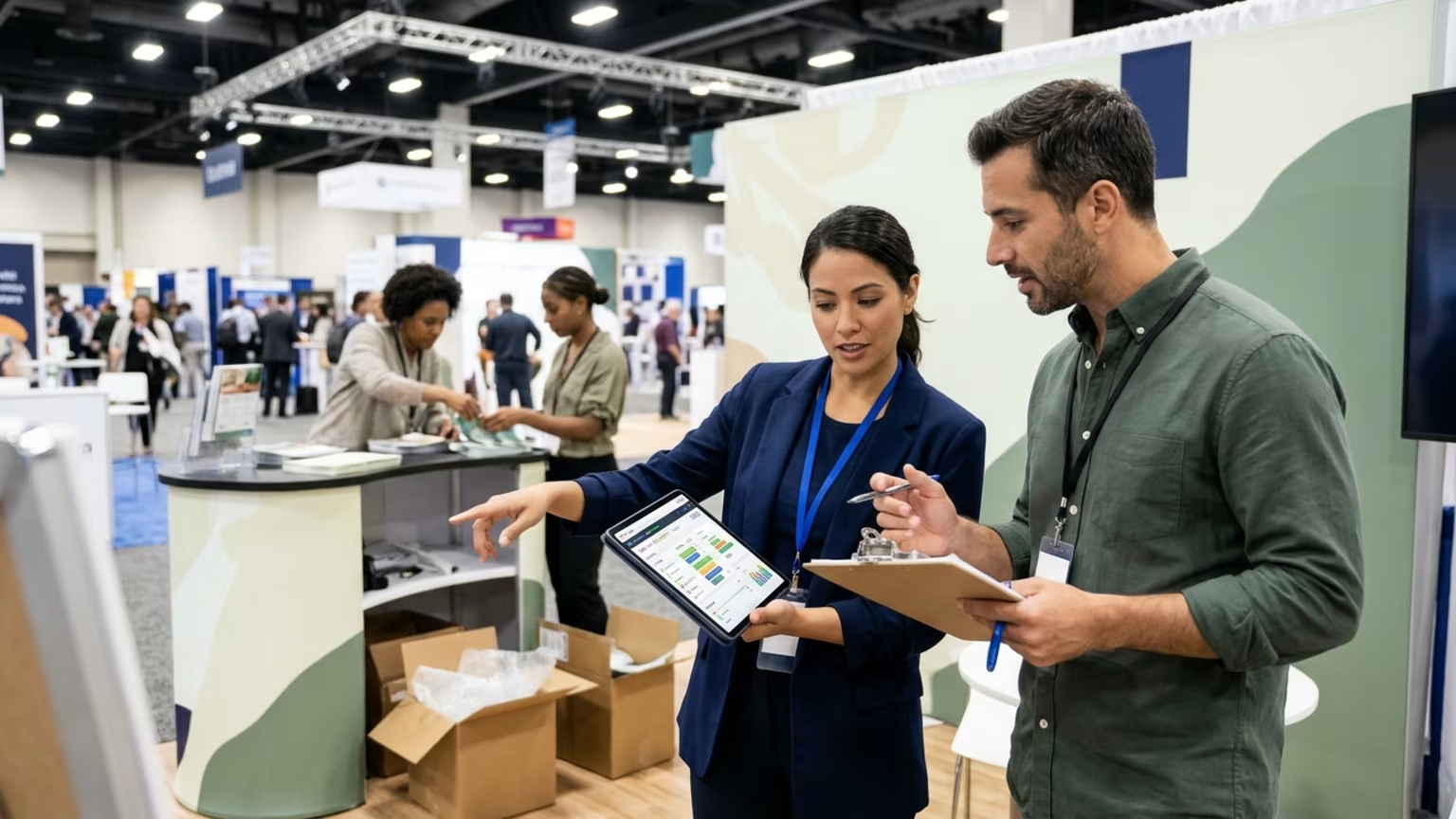
A campaign promoting meetings creates a different staffing question from a campaign inviting attendees to sample a product. The relevant issue is not simply how many people stand inside the footprint. It is whether their assignments match the promised interaction.
Makai’s retail demonstrations use trained brand ambassadors to support in-store sales through conversations and product trials. Our trade show services focus on spaces that attract attention and start conversations with a customer-conversion objective.
Those capabilities inform our view that staffing should follow the experience’s purpose. Sample distribution and qualified conversation should not become competing assignments by accident. That distinction belongs in planning rather than being improvised when visitors arrive.
Makai plans and manages trade show spaces with conversation and conversion in mind. Applied to this proposal, our view is that a meeting invitation should have a recognizable destination within the experience. Product trial should remain easy to understand for visitors arriving with a different intention.
A footprint can look active while leaving the team unclear about which interaction deserves attention next. We believe the design brief should connect the invitation with the intended conversation rather than prioritize visual activity alone.
That is the operational lens behind designing around demonstrations and meaningful conversations. The campaign promise and the booth experience should support the same objective.
The vFairs episode recommends comparing campaign results. Event Marketer’s measurement discussion extends the lens to participation and business impact. Together, those proposals support keeping promotion performance distinct from what happened during the experience.
Campaign results answer questions about promotion. A field record answers questions about the interaction. Qualified pipeline requires evidence beyond either one alone.
Our integrated services span permitting through CRM reporting. From that operational perspective, a minimum useful dataset for live interactions is a better planning focus than collecting information without an agreed use. The research supports defining the capture plan before the event rather than choosing measures after seeing the results.
Event Marketer’s October 2026 article reports that GPJ formalized its proprietary Experience Intelligence System. The approach organizes measurement around audience participation and brand sentiment alongside business impact.
In the article’s IBM example, the assessment looks across experiences at engagement and conversations as well as leads moving through the pipeline. IBM’s Sarah Meron advocates treating measurement as a learning loop across a portfolio over time rather than judging every activation separately.
For Makai, the useful lesson is consistency of questions without pretending every format has the same job. We work across retail demonstrations and mobile sampling tours as well as trade shows. Those formats can share a commercial discipline while serving different interaction goals.
A campaign comparison can inform the next media decision. A portfolio view can inform the next experience decision. Our view is that marketing leaders should preserve both perspectives rather than ask one dashboard to answer every question about event value.
The next decision is not simply whether to buy an organizer-backed campaign. It is whether the proposed promotion fits an experience with agreed objectives and a workable capture plan.
For CMOs and VPs of Marketing, that means evaluating the campaign comparison alongside the staffing assignment and booth purpose. It also means deciding how the resulting evidence will connect to pipeline reporting beyond the event.
Aloha at the booth. Discipline behind the numbers.
Before your next show, what will you change so the audience campaign and field operation are accountable for distinct steps toward qualified pipeline?
Campaign dashboards leave live-event Return on Investment unresolved when attention is mistaken for a commercial outcome. Makai addresses that measurement challenge through hands-on experiential campaigns that connect people emotionally with brands and are designed to generate qualified leads for CPG teams rather than rely on badge-scan totals.

30 Years Experiential & Retail Activation Partner for CPG & Beverage Brands | Multi-Market Demos, Roadshows & Costco/Club Programs That Actually Sell


