Robbie Thain
Founder, CEO

Learn how to capture high-quality first-party data at live activations by establishing a clear value exchange, limiting survey friction, and tracking ROI.
A large 2026 summary of Content Marketing Institute and MarketingProfs research reported that 91% of B2B marketers collect first-party data, but only 13% rate their strategy as advanced or leading. Most brand operators know they need to gather insights from physical activations. The problem is that poor execution turns live interactions into frustrating form-fills instead of seamless value exchanges.
Capturing first-party data at live events is the process of exchanging tangible immediate value for permissioned consumer intelligence that builds measurable pipeline. First-party data is information a brand collects directly from its own customers or visitors. An analysis of Content Marketing Institute research says marketers most often connect first-party data with better targeting, personalization, and customer understanding. Turning foot traffic into a strategic asset requires more than simply scanning badges.
Marketers must integrate digital mechanics into physical brand experiences without disrupting the consumer journey. Brands must design their activations around a minimum useful dataset. A beverage trial requires knowing the product variant sampled, the immediate reaction, and a retail preference. Collecting additional fields simply because a form supports them creates unnecessary roadblocks.
Every captured detail must answer one operational question about future brand strategy. Building a two-speed research system offers a fast path for most visitors and a deeper path for selected participants. The fast path relies on one tap or scan to deliver an immediate offer, while the deep path uses structured observation and short interviews. This structure keeps the event moving while still securing highly qualified consumer profiles.
In the physical world of consumer packaged goods, generating pipeline requires distinguishing operational participation from optional marketing permissions. LetzFair recommends collecting only data with a stated purpose while maintaining clear consent, retention, and access controls. Field teams must separate the information needed to deliver a product trial from the details used for behavioral profiling. EventHex recommends separating operational participation from optional tracking, profiling, and partner-sharing permissions.
Making a giveaway conditional on unnecessary marketing consent creates friction and degrades the consumer experience. Consent should be granular, specific, and actively recorded. A consumer scanning a code for a free sample should not be forced into a long email sequence just to receive the immediate benefit. Brands that respect this boundary build trust, which ultimately leads to higher conversion rates when the consumer is ready to buy.
Operators looking to connect live moments to downstream sales often struggle with data quality and compliance. Brands must explain what information is being collected and why it is needed. Providing a clear privacy notice and a realistic retention policy establishes a foundation of trust. Field staff need conversational consent scripts to maintain a natural interaction.
A brand ambassador can offer a store locator and a discount while mentioning that future product updates are completely optional. This approach makes the immediate benefit and the optional marketing relationship distinct. Treating consent as a transparent agreement rather than a hidden checkbox exercise secures higher quality contacts. Brands that respect privacy boundaries capture fewer fake email addresses and generate more reliable behavioral signals.
Asking too many questions creates cognitive burden for attendees trying to enjoy an event. Survey Practice identifies cognitive burden as a threat to data quality and describes survey length as one contributor. Research guidance from CASRAI states that questionnaire length is one of the consistently documented predictors of response rate and per-item data quality. A long form guarantees a high abandonment rate on the trade show floor.
Brands must ask fewer questions to get better answers. SurveyMonkey recommends keeping many surveys under 10 questions and using five or fewer questions for quick pulse surveys. The goal is to answer one operational question that will change how the field team executes tomorrow. Kantar advises marketers to make questionnaires easy, relevant, and worth the respondent’s time.
Closed-ended questions create less respondent burden than free-text fields. A smart design begins with a simple multiple-choice question and limits open-ended questions to highly engaged participants. A 2026 survey-methodology study found no consistent benefit from inserting a mandatory one-minute break into the survey configuration it examined. Adding unnecessary friction rarely improves data accuracy.
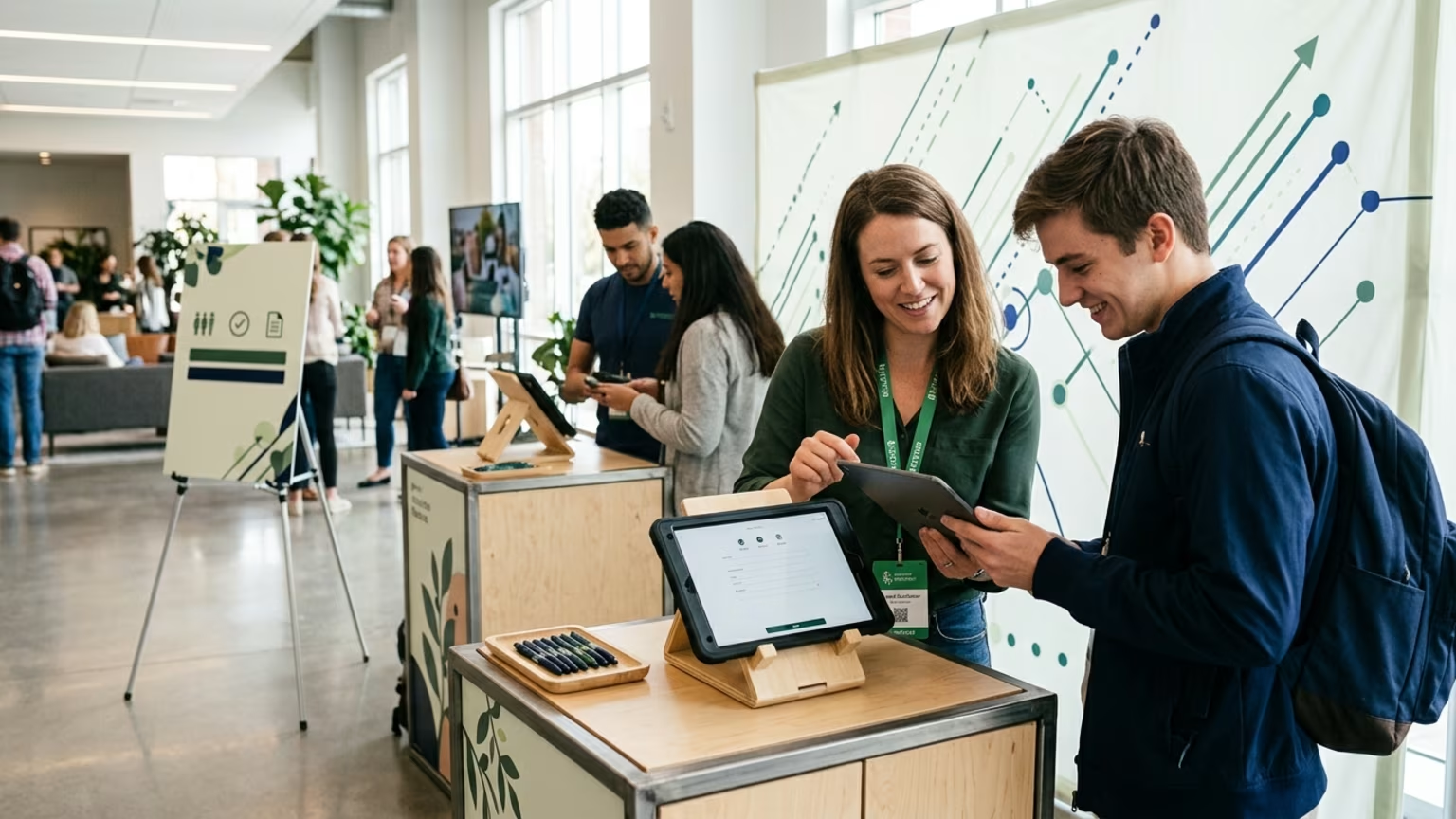
A digital scan must lead to an immediate practical benefit. A Forbes Business Council article notes that QR scans often provide practical information like schedules, feedback forms, and event details. Scanning a code to simply arrive at a generic corporate homepage is a wasted opportunity. Consumers expect a seamless transition from physical interest to digital utility.
Brands must require a simple action to claim an offer without creating a multi-step registration process. A 2025 Journal of Marketing Research study summarized by the University of Washington found that a trivial action could increase promotion redemption when it did not become burdensome. Marketers can effectively capture clean first-party data at live events by using QR codes to deliver digital coupons or product comparison tools. The destination determines whether the journey feels useful or burdensome.
Every digital path should be tagged by location, activation date, and creative variant. This tagging allows marketers to compare scans with downstream actions like survey completions or store locator usage. Providing clear instructions, such as scanning for a nearby retailer and a discount, establishes utility before the user even submits their information. Every field operator must prioritize offer redemption over an unqualified lead count.
Quantitative metrics tell brands what happened, but qualitative observation explains why. Shopper ethnography is described as useful for identifying decision-making routines, frictions, and contextual triggers that standard surveys may miss. Relying strictly on form submissions creates blind spots regarding actual human behavior at the activation space. Participant observation can provide evidence that surveys, interviews, or transactional data cannot capture on their own.
Field teams must systematically record where people stop, which product claims prompt questions, and what competing products sit nearby. A simple observation protocol requires the observer to note the location, audience context, and likely friction point. This structured approach prevents operators from relying on anecdotal feedback at the end of a long activation shift. These observations produce concrete actions for the marketing team.
If three shoppers ask whether a product contains caffeine, the field manager can immediately move the ingredient signage to a more visible location. Pairing observational data with digital capture ensures a comprehensive understanding of the retail environment. It turns subjective feedback into structural field improvements.
Tracking the success of an activation requires identifying behaviors that signal genuine purchase intent. A short survey might generate responses, but a high completion rate cannot compensate for missing answer choices or an unrepresentative audience. Pew Research Center describes quality checks that look for behaviors such as leaving many questions blank or repeatedly choosing the first or last answer option. Field teams must monitor incomplete answers and suspicious patterns that suggest attendees are just rushing to get a free item.
Operators must measure coupon redemptions and store locator usage instead of just counting total foot traffic. Incremental lift is best understood as the difference between actual results and a credible estimate of what would have happened without the promotion. Brands should avoid claiming incremental revenue based solely on a redeemed coupon without measuring a control group. Validating field metrics is crucial for teams trying to prove experiential Return on Investment to their executive boards.
Several experiential and survey vendors publish impressive performance figures, including response rates, opt-in metrics, and sales-lift benchmarks. However, operators should treat these figures as hypotheses rather than market-wide norms. The claim that experiential campaigns routinely generate 60 to 85 percentage points of purchase-intent lift relies on specific vendor examples, not universal standards. True measurement depends on rigorous, customized tracking.
A robust post-event dashboard tracks estimated reach, meaningful interactions, and trial completions. It must also report the cost per meaningful interaction and the cost per redemption. This reporting discipline prevents a large but unqualified contact count from concealing weak brand engagement. By establishing the measurement architecture before the event, brands can isolate the exact touchpoints that drive retail sell-through.
Collecting 91 percent of B2B marketers into the first-party data bucket means little if the collected information lacks strategic utility. Live event interactions become profitable when brands stop asking for everything and start measuring the few behaviors that actually predict sales. It requires relentless discipline to tie live interactions to concrete sales data without overwhelming the consumer. The bottom line is that capturing high-quality first-party data requires offering immediate value, limiting friction, and connecting every physical interaction directly to measurable retail pipeline.
Securing clean first-party consumer data without creating friction requires precise on-site execution, which is exactly where Makai takes ownership of your brand activation. We eliminate the headache of navigating complex event logistics, permits, and staffing by deploying our flagship Retail Demonstrations capability. Our trained brand ambassadors drive in store sales through real conversations and product trials.

30 Years Experiential & Retail Activation Partner for CPG & Beverage Brands | Multi-Market Demos, Roadshows & Costco/Club Programs That Actually Sell