Robbie Thain
Founder, CEO

Discover the conversion metrics that prove real event impact. Learn how to track lead qualification, retail sales lift, and pipeline growth beyond badge scans.
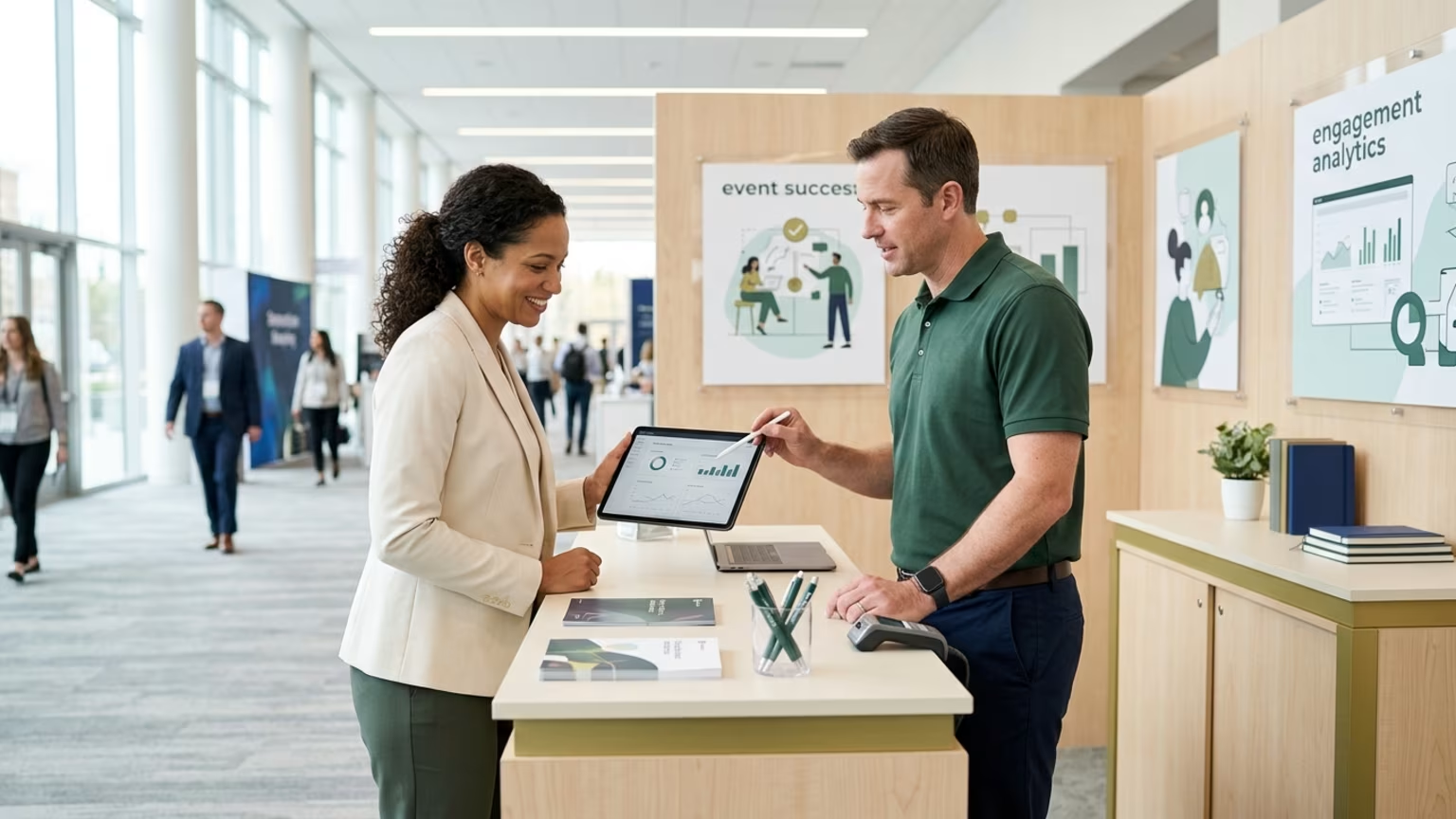
Capturing usable performance data starts long before the venue doors open or the roadshow trailer drops. In our experience, gathering credible metrics requires unglamorous preparation to guarantee that the physical footprint supports digital tracking. Securing proper permitting keeps the activation live long enough to reach statistical significance.
Staging vehicles thoughtfully to control crowd flow prevents staff from being overwhelmed. Setting up precise routing systems guarantees that a captured interaction flows smoothly into the right sales queue. When field teams design these footprints, they must integrate lead tracking into the earliest stages of spatial planning.
Placing a scanning kiosk in a high-traffic bottleneck guarantees useless data. Instead, teams should position qualification stations at moments of high emotional resonance. This prevents operators from replacing passive badge scans with equally meaningless digital noise.
A failure to configure these physical logistics means the backend reporting will inevitably fall apart. Field teams cannot retroactively qualify a lead if the initial capture moment was chaotic. The discipline of staging, crowd control, and data capture is what separates a vanity project from a measurable revenue generator.
Moving consumers from interaction to action demands a structured conversion ladder. Marketing teams must define this path before capturing a single lead. For B2B campaigns, this ladder typically moves from a booked meeting to a qualified opportunity and eventually to closed revenue. For consumer brands, the ladder tracks an initial trial to a retail purchase and finally to a repeat transaction.
The first step is establishing the rules of engagement for your field staff. A practitioner measurement framework recommends supplementing badge scans with fields covering pain point, buying timeframe, next step, and qualification. By mandating these fields, brands stop collecting random names and start building a prioritized follow-up queue. When field staff capture these fields accurately, the marketing department gains visibility into the full account lifecycle.
The second step involves setting up rigorous attribution frameworks to avoid over-crediting the activation. One trade-show measurement recommendation is to mark an opportunity as event-influenced while allowing other marketing and sales touches to retain attribution. This shared credit model reflects how modern B2B purchasing actually works. It prevents the event team from claiming total victory for a deal that marketing nurtured for months beforehand.
For consumer brands, proving impact requires a different comparative approach. A defensible design compares sales velocity during the activation with a pre-activation baseline and, where possible, with control stores or markets. Industry experts recommend comparing product sales velocity in activation markets with control markets when assessing retail lift. Furthermore, a brand-lift study can compare exposed and matched control audiences across awareness, consideration, favorability, and purchase intent.
Finally, leaders must establish staged reporting intervals to capture delayed conversions. Report event outcomes at staged intervals, such as 30, 60, and 90 days, while extending the window for longer sales cycles.
Even the most strategic plans break down when execution teams misinterpret field data. The first fatal mistake is treating every single floor interaction as a qualified opportunity. A scan is merely a record of exposure, and treating it as an immediate lead clogs the sales pipeline with uninterested prospects. Tracking the transition from an initial scan to a confirmed meeting is critical.
One vendor-published analysis reported a large difference between meetings booked in person and meetings obtained through later follow-up, but that figure should be treated as a vendor claim rather than a universal benchmark.
The second major failure point is claiming causality without proper controls. Teams often mistake pipeline value for closed-won revenue, or they assume a post-event sales spike is entirely due to their activation. Failing to account for seasonality, pricing changes, or competitor activity turns an executive report into a work of fiction. Without a control group, you are merely observing a trend, not proving a direct result. If a control group is neglected, every coincidental bump in foot traffic gets wrongly attributed to the marketing department.
The third mistake involves measuring retail sales lift without looking at the subsequent repeat purchase behavior. First purchases might just indicate a reaction to a heavy event discount. If the measurement window stops on the day of the event, the brand learns nothing about customer lifetime value. Teams must track the 60-day and 90-day intervals to verify that the initial trial created a durable brand relationship.
The final test of any campaign is what happens after the physical footprint is dismantled. We provide clear reporting on reach, trials, leads, and sales to guide next steps in campaign optimization. Our measurement approach tracks awareness, engagement, and conversion, turning brand moments into actionable data that demonstrates business impact. Teams must monitor the 30-day and 60-day conversion intervals rigorously to catch handoff failures between field staff and digital nurture systems.
Marketing leaders should immediately audit their CRM integration to ensure event influence is tracked accurately alongside other channels. A clean handoff prevents hard-won field data from rotting in a neglected spreadsheet. Map out your exact reporting cadence before your next activation to guarantee that no qualified interaction gets left behind.
Marketing leaders tasked with proving event impact constantly struggle to trace physical interactions back to closed-won pipeline. When Makai takes control of the activation footprint, that missing data link is restored. We solve the difficulty measuring real ROI from live events by deploying our Storage & Logistics capability. We store your sampling product and event gear, then ship, track, and coordinate delivery nationwide so every activation stays on schedule. Request a proposal

30 Years Experiential & Retail Activation Partner for CPG & Beverage Brands | Multi-Market Demos, Roadshows & Costco/Club Programs That Actually Sell