Robbie Thain
Founder, CEO

Match mobile tours, pop-ups, demos, and roadshows to your objective, with practical questions on permits, staffing, CRM handoffs, and measurement.
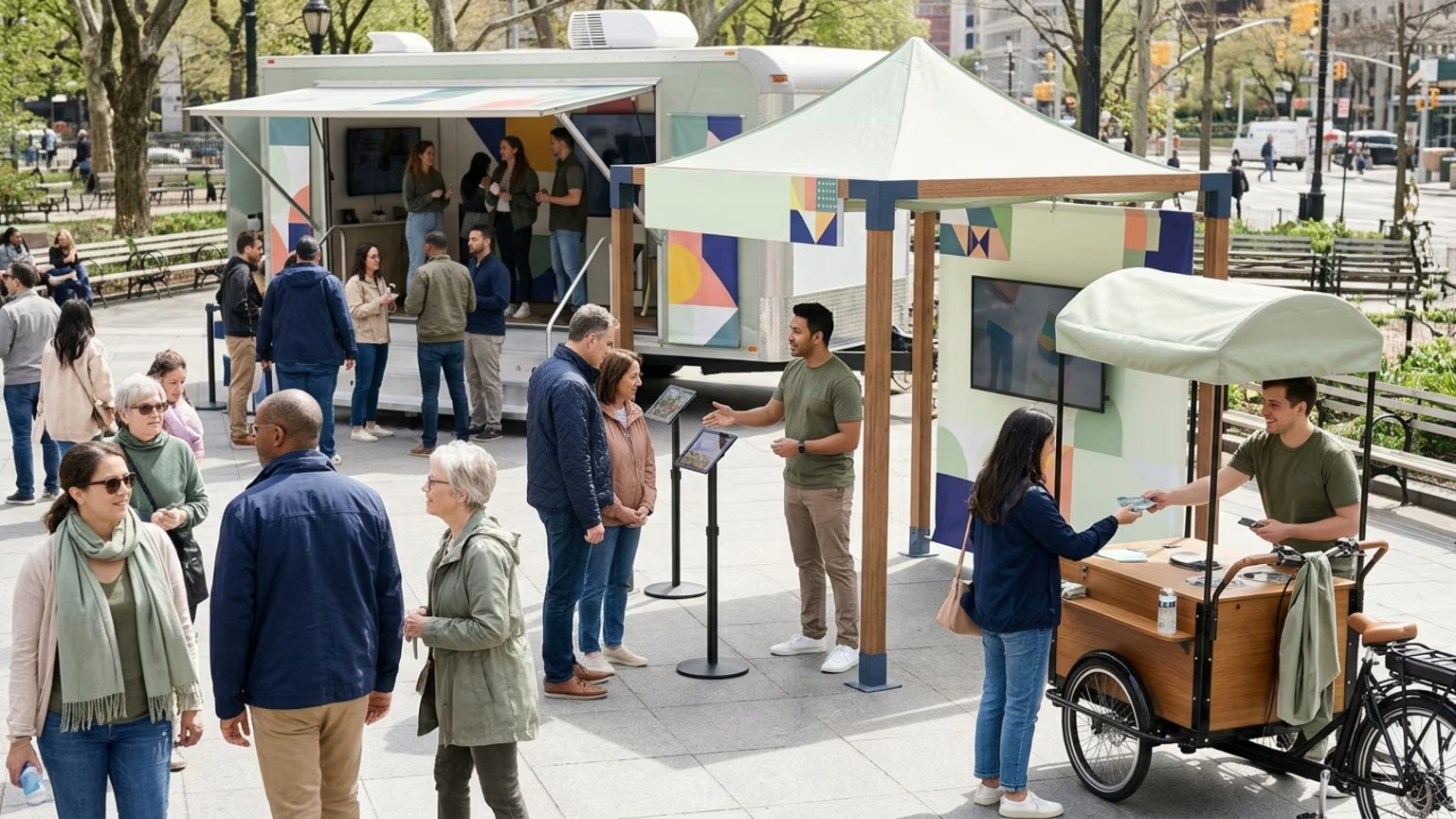
64% of consumers said trying a product at an event made them more inclined to buy, according to Channel Partners’ summary of EventTrack 2026. That finding gives marketers a reason to make the product encounter purposeful. It describes stated purchase inclination rather than completed purchases.
Choose the format around the action you need and the evidence required to evaluate it. In-store sampling has direct field-study support for generating trial. Mobile tours, pop-ups, and event roadshows should be evaluated as distribution and experience choices rather than ranked as universally stronger launch or lead-generation tools.
The practical distinction looks like this:
We specialize in retail demos and sampling programs alongside roadshows that bring brands face to face with their audiences. Our mobile launch activations are designed to accelerate trial and build trust during 90-day product launch windows. That is a program purpose, not a substitute for defining how success will be evaluated.
Start with a clear definition of the intended buyer action. Then assess whether the proposed format can support that action and produce evidence relevant to the decision.
The format name does not answer the permission question. Makai’s integrated services extend from permitting to CRM reporting. Our storage and logistics services include sampling products and event gear plus nationwide shipping, tracking, and delivery coordination.
That operational scope matters when a concept moves from a presentation into a physical location. By 2009, our work covered event and sponsorship activation alongside mobile tours and sampling at national scale. It also included event production and logistics.
The available evidence does not establish local permit requirements or a tested staffing and technology recovery protocol. It also does not rank these formats on audience access or location control. Those issues belong in a program-specific operational brief rather than a universal format checklist.
For planning purposes, ask:
These questions are a basis for comparing proposals, not evidence that one format is automatically simpler. A discussion about matching the physical setting to shopper intent can help keep audience relevance in view while the operational details are resolved.
Training should serve the conversation the objective requires. Makai’s retail demonstrations use trained brand ambassadors to drive in-store sales through real conversations and product trials. Our experiential work is designed to connect emotionally and turn customers into ambassadors.
For us, aloha means approaching people with warmth and respect rather than treating every visitor as a capture opportunity. We believe human connection and measurement belong together. A friendly encounter is valuable, but its commercial meaning still needs a definition.
A useful training discussion starts with the intended interaction:
These are questions for the training brief rather than claims about a standardized curriculum. They connect staffing decisions to Makai’s stated emphasis on product trials and real conversations.
In our view, the strongest staffing discussion is not simply about how many people will be present. It is about whether the human interaction supports the objective without asking the reporting to claim more than the encounter produced.
Start with the definition of a qualified lead, then specify the handoff into the customer relationship management system, or CRM. Channel Partners’ EventTrack 2026 summary reports that 51% of consumer event marketers named leads and data collection as their most important event metric. That finding identifies a measurement priority among respondents, not a winning lead-generation format.
Moving from a physical handshake to a useful CRM record can be planned around four decisions:
The proposed record should carry the context needed for that handoff. The reporting plan should then keep activity separate from qualification. This turns “collect leads” into a handoff specification rather than an undefined request for volume.
Our Little Debbie Share a Smile Tour illustrates why output categories need separate labels. We ran the program as a 21-market mobile activation using a branded truck and trailer plus Cupcake Smart Cars. Across the tour, we distributed 224,534 cupcakes and generated more than 2.4 million brand impressions.
Those figures document distribution and exposure. They are not qualified-lead counts and should not be relabeled as pipeline.
The same discipline applies to Return on Investment, or ROI. Counts document activity, while surveys describe stated perceptions or intent. A claim about incremental sales needs sales evidence with an appropriate comparison design.
Before choosing the format, agree on which evidence will demonstrate business value. Otherwise, the experience and the CRM report may end up answering different questions.
The field general’s contingency brief should separate the interrupted activity from the outcome the campaign still needs. A technology failure and a staffing no-show are different problems. Neither should disappear inside a report that describes the original plan instead of actual delivery.
Because the recovery procedure must be defined for the program, the useful comparison is whether each proposal makes its unresolved dependencies visible. The discussion should address both operating continuity and evidence continuity.
For a staffing no-show, ask which planned conversations can still be supported by the available team. Ask which activity would no longer be deliverable as proposed. Do not assume that keeping the footprint open means the intended experience remains intact.
For broken capture technology, ask what approved alternative exists and what information it can actually preserve. If capture is interrupted, the report should distinguish observed participation from records that were successfully collected. Planned leads are not collected leads.
For delivery disruption, connect the contingency discussion to the sampling products and event gear the experience depends on. Makai’s logistics capabilities cover storage and nationwide shipping coordination. That capability should not be mistaken for evidence that a particular disruption has an automatic remedy.
Our view is straightforward: a fallback is incomplete if it preserves the appearance of activity but leaves the business outcome undefined. The planning brief should make the operational decision and the reporting consequence visible together.
Build a decision brief before requesting a format recommendation. State the primary objective and intended audience. Add the proposed setting and the evidence required to evaluate success.
Then compare mobile tours and pop-ups with in-store demos and event roadshows against that same brief. The next research task is to resolve location-specific permissions and delivery dependencies while defining the lead handoff or sales comparison the objective requires.
Product trial and brand awareness are the intended outcomes of Makai’s mobile sampling tours, which take live experiences directly to audiences. For CPG marketers contending with low-quality trade show leads, Makai’s experiential campaigns and trade show activations focus on converting consumer interactions into qualified leads rather than treating badge-scan volume as the outcome.

30 Years Experiential & Retail Activation Partner for CPG & Beverage Brands | Multi-Market Demos, Roadshows & Costco/Club Programs That Actually Sell


