Robbie Thain
Founder, CEO

Creative briefs fail to control live events, but structured operational frameworks, multi-layer playbooks, and standardized governance protect multi-market.
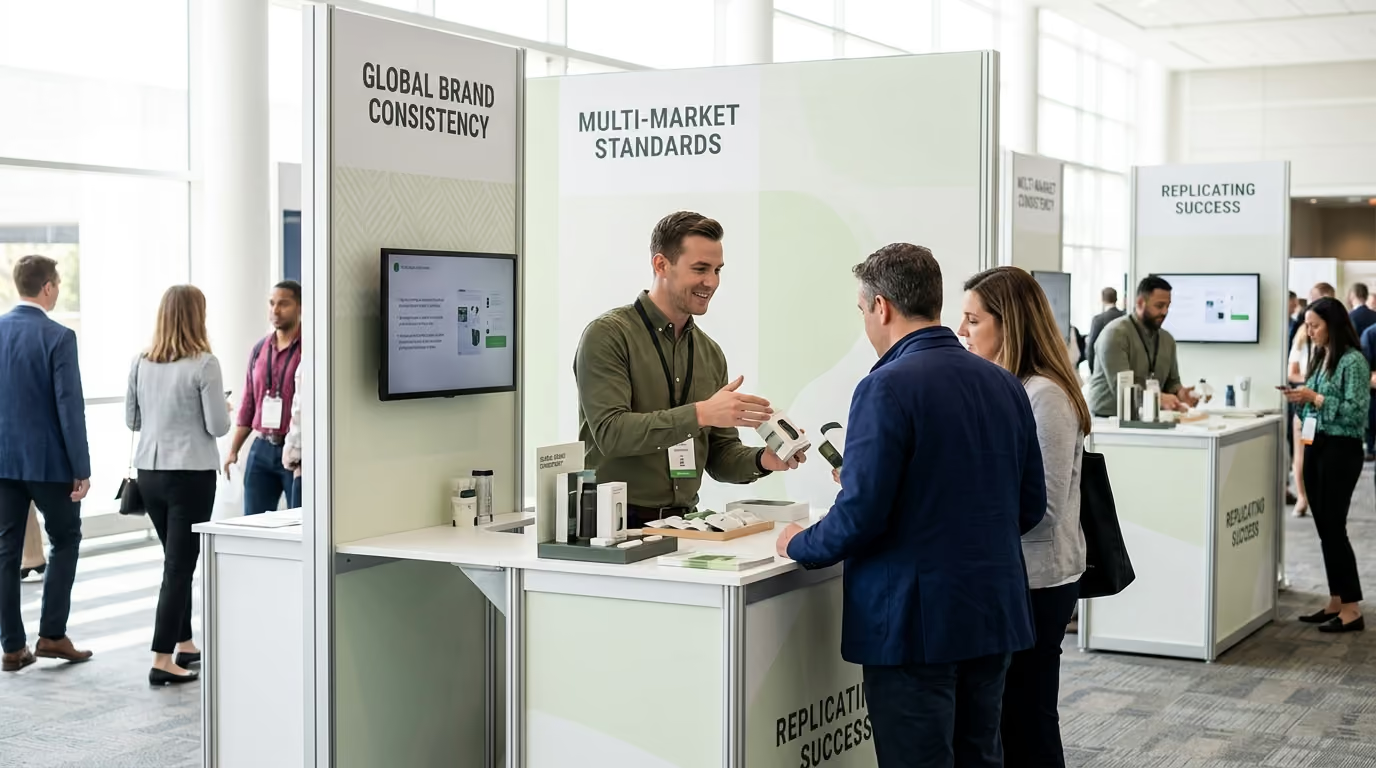
Standardizing multi-market brand activations requires a structured operating model that balances brand compliance with localized field execution. By establishing clear governance, modular playbooks, observable behavioral standards, and unified performance metrics, marketing leaders can scale physical campaigns across multiple cities while protecting brand equity.
A brand manager walks onto an activation floor in Chicago and finds an impeccably styled footprint, trained staff delivering precise talking points, and eager consumers lining up for product trials. Forty-eight hours later, that same manager visits a parallel activation in Dallas and finds a completely different scene. The signage is tilted against an unapproved barrier, the brand ambassadors are checking their personal phones behind the demonstration counter, and the lead capture software has crashed without a backup plan in place. This operational disconnect is all too common across national campaigns. When field marketing expands across disparate territories, regional vendor handoffs and shifting venue rules quickly degrade the original campaign concept.
Experiential programs fail when leadership assumes a creative brief is enough to govern real-world operations. Creative guidelines describe how an asset should look in a presentation deck, but they do not solve logistical friction on the ground. When multiple production partners, staffing agencies, and venue managers operate across time zones, execution variance compounds rapidly. Marketing directors must treat physical activations as disciplined supply chains rather than one-off design projects.
Building a repeatable execution system requires documented standards, strict operational checkpoints, and continuous field oversight. Without a clear governance model, field teams will improvise under pressure. That improvisation creates brand dilution, wasted budgets, and inaccurate performance data. To build an activation program that delivers consistent results in every market, organizations must replace vague creative guidance with an operator-grade execution manual.
The trade show floor or public sampling footprint is an unpredictable environment. On opening morning, local freight handlers deliver crates two hours behind schedule, forcing crew leads to assemble displays in a rush. Local venue restrictions suddenly prohibit the specific adhesive tape specified in the setup manual, causing temporary banner stands to sag. Ambient arena noise drowns out soft-spoken ambassadors, while spotty convention center Wi-Fi disables digital intake forms. In the middle of this chaos, agency staff must manage long consumer queues while attempting to deliver nuanced brand messaging.
These localized operational challenges create massive variance across markets. When a field team in Atlanta faces different logistical constraints than a crew in Seattle, unguided staff will invent their own solutions. One team may skip the mandatory product demonstration to process the line faster. Another market team might alter official product claims to answer a skeptical consumer question. By the end of a multi-city tour, central marketing leaders are left reviewing inconsistent lead numbers and disjointed brand experiences.
The financial stakes of these operational failures are significant. An industry summary citing PQ Media projections indicates that global experiential marketing spend reached $138.94 billion in 2025, with an expected expansion of 10.3% in 2026. The United States accounts for roughly 46% of that global total. When brands commit large operational budgets to physical experiences, execution errors directly threaten their Return on Investment (ROI).
Marketing operators face intense pressure to prove that live events drive real commercial pipeline rather than vanity exposure. Research from EY shows that 78% of surveyed consumers prefer experiential interactions with brands, and 88% of surveyed brands report increasing their experiential investments. However, the same EY research found that 71% of organizations view a lack of expertise as a major operational constraint. Furthermore, 57% struggle with budget pressures, while 43% report persistent uncertainty around measurement and ROI tracking. Standardized operational processes eliminate these gaps by establishing repeatable, high-converting workflows across every tour stop.
Achieving consistency across varied markets does not mean forcing every city into an identical physical box. Attempting to build an identical activation in a historic convention hall, a shopping center, and an outdoor festival will fail. True standardization relies on a controlled operating model where core brand codes, safety protocols, and customer journeys remain fixed, while specific executional details adapt to local venue constraints.
Research on global brand governance highlights a permanent tension between standardization and localization. Standardization builds operational efficiency and reinforces distinct brand assets, while local adaptation drives audience relevance. WARC defines brand governance as the operational framework used to protect creative integrity across assets while respecting regional cultural and regulatory differences. To balance these priorities, enterprise marketing teams must implement a federated execution model.
McKinsey analyzed more than 40 large consumer-packaged-goods enterprises and found that companies with locally deployed marketing functions supported by central centers of excellence consistently outperformed centralized peers in effectiveness and operational efficiency. In a federated framework, the central brand team establishes non-negotiable standards, regional teams translate those rules into market-ready tools, and local crews execute within defined boundaries. You can explore this dynamic further in our analysis of centralized versus local operating models.
To make this operating model practical for field teams, every element of an activation must be categorized into one of three structural buckets.
Fixed elements are non-negotiable requirements that cannot be modified under any circumstances without formal corporate approval. These components protect legal compliance, core positioning, and brand equity across all operating markets:
Flexible elements represent approved adaptation zones where local operators can modify tactics to suit specific venue physical realities, cultural contexts, or regional regulations:
Forbidden elements are explicit operational practices that local teams, vendors, and staffing agencies are strictly prohibited from implementing:
Clear decision rights eliminate field confusion and prevent unapproved improvisations. Local teams have full authority to manage shift schedules, rotate ambassadors, and adjust queue stanchions based on live foot traffic. However, modifying booth architectural structures, changing translation copy, or altering product demonstration protocols requires formal sign-off from regional leads. Global or corporate brand teams retain exclusive authority over logo modifications, legal claim updates, privacy policies, and public crisis communications.
A comprehensive activation standards system organizes operational knowledge into modular, accessible layers. Field teams cannot digest a single, dense strategy document while working on an active venue floor. The operating architecture must separate high-level brand strategy from tactical, shift-by-shift checklists.
The global experience brief establishes the strategic foundation for the multi-market campaign. It defines the target consumer tension, the required emotional takeaway, and the core experience logic that must occur in every market. Rather than dictating rigid physical dimensions, the global brief outlines the essential customer journey: attract, orient, participate, discover value, receive product proof, act, and share. Every regional activation plan must map directly to this sequence.
The master playbook serves as the primary technical operating manual across all participating agencies, production shops, and regional leads. This document is divided into distinct operational modules, allowing specialists to access their relevant sections quickly:
The market execution kit translates the master playbook into a site-specific operational package. Local producers assemble this kit prior to tour stops, detailing local venue schematics, approved translation decks, freight schedules, and municipal permits. It also contains local emergency contacts, regional weather contingency plans, authorized local supplier contracts, and documented site deviations. Teams scaling regional programs will benefit from our practical guide on standardizing brand execution across a national sampling tour.
Site tools are practical job aids designed for field staff executing the activation on the floor. These items must be straightforward, physical or mobile-friendly documents that require zero strategic interpretation:
In our experience managing activations across diverse venues, providing physical site tools dramatically cuts frontline execution errors. We run experiential and engagement programs coast to coast with local crews, smart logistics, and permit expertise that let us launch fast and maintain quality consistency in every region, from major metros to smaller markets. Our nationwide infrastructure enables us to activate brands wherever their audiences are located. Equipping local operators with structured shift tools ensures that our operational discipline translates into every customer interaction.
Maintaining physical and behavioral consistency requires precise, objective criteria. Ambiguous instructions like "ensure high visual impact" or "deliver energetic customer service" lead to inconsistent execution. Standards must outline exact measurements, clear visual boundaries, and observable actions.
Every activation footprint must enforce a clear visual order. The primary brand identity must anchor the physical structure, positioned at optimal eye-level viewing angles. Secondary zones belong to the physical product display, followed by key consumer benefit messaging, participation instructions, and clear calls to action. Partner or venue logos must remain secondary, never competing with core brand assets.
Visual guidelines must include side-by-side examples illustrating approved configurations alongside common field errors. For instance, show the correct usage of high-contrast typography next to an unapproved crowded graphic panel. Show the required spacing around physical product displays alongside an unacceptable cluttered counter. Explaining the reasoning behind visual rules helps local production vendors make compliant decisions when adjusting to unexpected booth dimensions.
Visual standards must also address digital touchpoints. Mobile registration screens, interactive digital product kiosks, and dynamic display panels must comply with established digital standards. The Web Content Accessibility Guidelines (WCAG) 2.2, published as an official W3C Recommendation in October 2023, mandate text alternatives for non-text content, proper color contrast ratios, and clear navigation paths. Applying these principles ensures digital displays remain usable for all visitors.
Staff behavior often causes more campaign variance than physical build quality. Brand ambassadors represent the human voice of the company, and their actions must be structured around observable, repeatable habits. Teams managing national campaigns can review our guide to multi-market brand activations for operations leaders for additional staffing frameworks.
Passive training briefings do not guarantee quality execution on the floor. Multi-market programs must require formal staff certification before workers step foot in an active venue. Staff members must review digital training modules, complete knowledge tests covering brand rules, and participate in practical role-playing exercises. Lead ambassadors and product specialists should be tested on handling challenging consumer interactions, presenting technical claims accurately, and escalating physical safety issues. An attendance roster only proves physical presence; practical certification proves operational competence.
Executing consistent brand activations across dozens of markets requires a predictable, milestone-driven operating rhythm. Operations leaders must enforce standardized workflows before launch, during active operations, and after footprints close. Detailed planning frameworks are explored in our guide on operational planning for live brand events.
Field execution is inherently dynamic. Even carefully planned activations encounter unexpected venue delays, severe weather disruptions, staffing shortages, and technical failures. Maintaining consistency across multiple cities requires structured escalation paths and real-time communication systems.
Field teams must understand exactly which issues they can resolve locally and which require immediate regional or corporate intervention:
Every field lead must possess clear, documented authority to halt activation activities when critical safety or compliance thresholds are breached. The Event Safety Alliance provides comprehensive guidance covering crowd management, weather preparedness, temporary structures, and emergency planning. Its framework emphasizes proactive risk prevention over reactive crowd control.
Similarly, the international risk management standard ISO 31000 establishes structured principles for identifying operational hazards and executing mitigation controls. Activation managers must pause operations immediately in the event of dangerous weather, structural instability, medical emergencies, compromised data privacy, or distribution of unapproved claims.
To maintain control across distributed teams, organizations must establish a single digital operational repository. Critical instructions, updated schematics, and approved claim cards must never exist solely within fragmented email threads or personal messaging apps. A centralized management dashboard provides all regional teams with instant access to version-controlled documents, daily scorecards, and open corrective actions.
When reporting live issues, field leads must use structured communication formats that answer nine essential questions: What happened? Where did it occur? When did it happen? Who is affected? Is anyone in danger? What immediate containment action was taken? What corporate decision is required? What is the deadline for this decision? Who owns the next step? This structured reporting eliminates guesswork and accelerates executive decision-making across time zones.
Every temporary operational deviation granted during a live activation must be recorded in a centralized decision log. This log details the nature of the deviation, the approving authority, the specific markets affected, and the expiration date of the exception. Without a formal decision log, temporary on-site compromises often become permanent, unapproved practices on future tour stops.
Data collection has become a primary objective for live activations. However, capturing consumer data across different states and international borders introduces complex legal and operational obligations. Data governance must be treated as a core operational discipline rather than an afterthought.
Lead generation mechanisms must comply with strict regional data privacy frameworks. The European Data Protection Board outlines clear requirements under the General Data Protection Regulation (GDPR), defining valid consent as freely given, specific, informed, and unambiguous. Consumers must confirm their agreement through a clear affirmative statement or deliberate action. Pre-checked marketing opt-in boxes are strictly prohibited.
Operational field protocols must separate basic event participation from marketing communication opt-ins. If a consumer enters a brand footprint to sample a beverage, staff cannot condition that trial on joining an email marketing list. Transparent value exchanges must be clearly stated on all digital registration screens. Consumers must understand exactly what data is collected, how it will be stored, and how they can exercise data deletion rights.
Field tablets and lead capture devices must be locked down through mobile device management software, preventing unauthorized app downloads or data exports. Staff members must never record consumer personal data on personal phones, paper notepads, or unencrypted local drives. All completed registration records must be transmitted to secure, encrypted CRM databases via secure network connections.
In many event venues, cellular networks become congested, or Wi-Fi connections drop entirely. Digital intake systems must feature secure offline capture modes that store encrypted records locally on the device until an encrypted internet connection is restored. When network access returns, the system must automatically synchronize records without creating duplicate entries or losing timestamps.
Experiential footprints must welcome consumers of all physical and cognitive abilities. Designing for accessibility from the start prevents costly on-site retrofits and ensures an equitable guest experience. Footprints must feature level thresholds, wide pathways to accommodate mobility devices, lowered counters for wheelchair access, and sensory-friendly zones where practical.
Digital touchpoints must adhere to WCAG 2.2 accessibility standards by including large-print options, clear contrast, and audio alternatives for video content. Field staff should be trained to recognize accessibility barriers, offer proactive assistance with dignity, and deliver alternative demonstration formats when requested.
Proving the business value of multi-market activations requires a balanced measurement framework. Historical event reporting often relied on soft vanity metrics, such as gross foot traffic or generic crowd photos. Today, marketing operators must track a clear chain of evidence from initial footfall to downstream commercial pipeline. Learn more about maintaining operational quality while expanding footprints in our guide to scaling brand activations with execution consistency.
Industry data confirms that marketing leadership now prioritizes commercial data over surface-level attendance. EventTrack 2026 reports that 51% of consumer marketers identify leads and data collection as their most important event-measurement metrics. An expanded summary of the EventTrack findings lists ticket sales at 47%, consumer engagement and attendance at 44%, data points collected at 37%, marketing opt-ins at 34%, post-event product sales at 30%, and social media shares at 27%.
To measure performance accurately, organizations must establish a standardized metric dictionary. A common pitfall occurs when different regional agencies report different definitions for the same metric label. For instance, Market A might count every passerby who grabs a sticker as an "engaged consumer," while Market B only counts visitors who complete a five-minute product trial. A unified metric dictionary prevents these discrepancies by defining exact qualifying criteria for every tracked data point.
To evaluate regional execution quality comprehensively, organizations should deploy a balanced scorecard. This model prevents field teams from sacrificing brand standards or safety protocols in pursuit of high lead counts:
Experiential research published by Reach3 in GreenBook outlines a three-stage measurement model: pre-test evaluations, in-the-moment live tracking, and post-event reflection. Pre-testing evaluates messaging clarity and audience interest before roadshows launch. In-the-moment tracking monitors operational throughput and live audience engagement, while post-event reflection measures long-term brand lift, retail sales lift, and ROI.
Furthermore, academic research on the Return on Integrated Experience framework demonstrates that combining functional, financial, and holistic brand metrics gives leadership a complete view of campaign performance, avoiding the trap of focusing solely on short-term sales or soft sentiment.
A leading consumer packaged goods snack brand prepared to launch a national, multi-market roadshow across twenty major metropolitan areas. The campaign was designed to drive trial for a new line of organic snack crackers, collect first-party consumer leads, and boost local retail sell-through across national grocery accounts. The tour spanned convention center trade expos, outdoor community food festivals, and suburban shopping center concourses over six months.
To manage this multi-market program, brand leadership implemented a federated execution model. The central team created a modular master playbook and distributed market execution kits to three regional production agencies. The agency network was bound by a shared visual hierarchy, standardized staff certification tests, and a centralized digital operational portal.
During the third week of the tour, the regional execution team in Miami encountered severe logistical friction. Outdoor heat indexes reached 95 degrees, threatening the stability of the refrigerated sampling inventory. Simultaneously, the festival venue unexpectedly prohibited the primary freestanding display arch due to localized wind load regulations.
Under an unstructured operating model, the local crew might have improvised an unsafe display workaround or served warm samples, compromising food quality and brand reputation. Because the team operated under a structured federated model, they executed pre-approved contingency protocols immediately.
The on-site floor manager enacted the approved severe-heat operational plan:
By relying on pre-approved adaptation paths, the Miami team delivered a flawless brand experience, protected consumer safety, and generated significant commercial return. The central brand team reviewed the incident logs and updated the master playbook with refined hot-weather guidelines, strengthening operational execution for subsequent tour stops.
Standardization is an evolving discipline, not a static document. Operations leaders must treat every activation season as a learning cycle. Capturing field data, analyzing recurring nonconformities, and updating operational playbooks ensures that multi-market programs become more efficient over time.
Within five business days of an activation closing, regional leads should conduct a formal post-market review. This meeting examines the daily operating scorecards, audit findings, customer feedback trends, and inventory variances. Rather than assigning blame for field errors, the review analyzes the root causes of nonconformities. If four different markets made unapproved adjustments to the customer queue layout, leadership must recognize that the original blueprint was flawed and update the master standard accordingly.
Organizations should hold quarterly calibration sessions with all participating production agencies, staffing suppliers, and regional leads. Sharing audit performance rankings, operational innovations, and field learnings across the supplier network raises execution quality across all territories. When vendors realize they are evaluated on objective compliance scores, their commitment to operational rigor increases.
Multi-market activations generate physical waste through single-use packaging, temporary signage, and structural displays. Forward-thinking brand leaders integrate sustainable management practices into their standard operating procedures. The international standard ISO 20121:2024 provides a complete framework for event sustainability management, outlining controls for reducing environmental, social, and economic impacts throughout the event lifecycle.
Activation standards should mandate modular, reusable display systems fabricated from recyclable or responsibly sourced materials. Production teams should eliminate single-use plastics from sampling operations, enforce on-site waste separation protocols, and source supplies locally to reduce freight transportation emissions. By weaving sustainability into standard operating checklists, brands achieve meaningful environmental stewardship while maintaining high visual and operational standards across all markets.
Revisit this playbook whenever your organization prepares to launch a new multi-city brand tour, onboard new regional production agencies, expand into unfamiliar geographic markets, or transition from legacy event marketing to performance-driven experiential activations.
Operational consistency across multi-market brand activations is not achieved through rigid creative uniformity, but through disciplined governance, modular standards, certified frontline behavior, and real-time execution controls.

30 Years Experiential & Retail Activation Partner for CPG & Beverage Brands | Multi-Market Demos, Roadshows & Costco/Club Programs That Actually Sell