Robbie Thain
Founder, CEO

While lavish entertainment often fails to build client trust, structured experiential hospitality strategically aligns guest journeys and account goals.

Experiential hospitality is not an open bar, an extravagant lounge, or a generic VIP dinner attached to a conference. It is a disciplined system of hosted interactions designed to create measurable relationship value and commercial momentum. The following guide outlines the strategic frameworks, operational standards, data capture protocols, and execution playbooks required to transform live corporate gatherings into long-term enterprise value.
Designing hospitality around mutual value creation allows organizations to turn high-stakes interpersonal interactions into qualified pipeline and account retention. Marketing leaders will gain an operational blueprint to plan, execute, and measure hosted experiences that serve strategic business goals.
Step onto any major trade show floor and the operational waste becomes immediately visible. Music blares from neighboring displays while badge scanners beep in continuous succession. Booth staffers lunge toward passersby to scan badges, desperate to hit arbitrary volume targets. Senior executives from target accounts walk quickly with lanyards tucked into jackets to avoid aggressive sales pitches. When invited to an offsite dinner, these same executives often find themselves trapped in loud restaurants where the sponsoring host pitches product slides over salad courses.
This scenario represents a complete breakdown of the guest value exchange. The host organization spends hundreds of thousands of dollars on venue rentals, catering, and travel. Yet, the interaction produces fatigue rather than affinity. According to research from the American Marketing Association, nearly 60 percent of surveyed organizations report that they cannot track event Return on Investment (ROI) consistently or derive clear commercial value from their investments.
The root cause is a failure of empathy and strategy. Most corporate hospitality plans prioritize what the brand wants to display rather than what the attendee needs to accomplish. When an activation treats a high-value customer as a passive target for sales messaging, trust erodes.
A lavish environment cannot compensate for disorganized logistics, unbriefed executives, or intrusive sales behavior. Trust is built through competence, listening, respect for time, and operational follow-through. When organizations replace aggressive promotion with structured hospitality, live gatherings shift from expensive overhead into relationship engines.
To build an effective hospitality program, organizations must separate hosted relationship design from broader promotional activities.
A broad marketing discipline using physical, live, or interactive touchpoints to create direct engagement between people and a brand.
The strategic promotion and execution of an event to support general marketing, pipeline, or branding goals.
A focused campaign or experience engineered to generate an immediate consumer action, such as product trial, sampling, or social participation.
Hosted entertainment, access, or catering intended to build goodwill with clients, partners, investors, or employees.
A targeted hospitality program designed specifically around named accounts, complex buying committees, or strategic alliance partners.
The discipline sitting at the intersection of these formats. It is an intentional, hosted experience where service design, personalization, peer interaction, and business relevance combine to advance specific enterprise relationships.
Experiential hospitality operates on three strategic pillars:
Research from Freeman demonstrates that 87 percent of business attendees identify discovering new products, solutions, and partners as the primary factor influencing event attendance. Freeman also found that 80 percent of surveyed professionals view in-person events as the most trusted marketing channel. When a company designs a gathering around peer problem-solving rather than self-serving presentations, it aligns directly with attendee motivations.
A successful hospitality program requires rigorous front-end planning. A strategic program connects high-level commercial objectives directly to on-the-ground attendee behavior.
Every hospitality program must begin with a documented brief answering seven core operational questions:
Do not segment attendees merely by job titles or company sizes. Segment them by their relationship state and strategic objective.
The primary objective centers on retention, contract expansion, executive sponsor alignment, and cross-functional education.
The focus shifts to risk reduction, peer validation, problem diagnosis, and deal acceleration.
The design emphasizes joint solution mapping, channel enablement, mutual pipeline alignment, and operational trust.
The strategy prioritizes listening, service recovery, direct executive access, and understanding revised operational constraints.
For every segment, marketing leaders should review how to build an experiential marketing strategy that drives business results to align account planning with measurable field execution.
High-value attendees receive dozens of generic invitations each quarter. An invitation must clearly answer four questions: Why this person? Why this topic? Why this format? Why right now?
Generic invitations fail because they offer vague entertainment instead of clear value. Compare these two approaches:
For key accounts, use a one-to-one outreach model driven by the dedicated account owner. Support the outreach with clean digital briefing pages that outline logistics, discussion topics, and confirmed peer attendees.
Address logistical edge cases during the invitation workflow:
An exceptional hospitality program views the event through a continuous chronological journey. Every friction point drains social energy, while every thoughtful operational detail builds relational equity.
The guest experience begins weeks before arrival. Send concise briefings covering transit options, check-in instructions, dress expectations, and venue access points. Gather dietary preferences, accessibility needs, and discussion topics through minimal, frictionless digital forms.
The first three minutes set the tone for the entire gathering. Eliminate traditional registration tables with long lines and awkward clipboards. Instead, deploy trained hosts equipped with discrete digital check-in tools.
Guests often feel vulnerable when entering unfamiliar social settings. Hosts must provide immediate, clear orientation. Point out private workstations, restrooms, quiet zones, and the main interaction areas. Give guests an immediate understanding of the schedule so they feel in control of their time.
The centerpiece of the gathering must balance professional insight with open human connection. Keep corporate presentations brief. Limit formal remarks to ten minutes, focusing on industry challenges rather than sales pitches. Use structured seating plans to position internal subject matter experts alongside guests with matching operational challenges.
Do not let an exceptional gathering fall apart during departure. Ensure pre-booked rideshare transport, personal luggage retrieval, and clear transit coordination are handled seamlessly. Provide attendees with a concise summary packet or digital access code before they exit.
Hospitality fails if the commitments made onsite disappear the following morning. The onsite team must log all notes, commitments, and requested introductions into the customer relationship management platform within twenty-four hours.
The success of experiential hospitality relies on the people in the room. Even the most polished venue fails if internal hosts stand together in clusters, check mobile phones, or launch aggressive sales pitches.
Internal hosts, executives, and brand ambassadors must follow explicit operational guidelines:
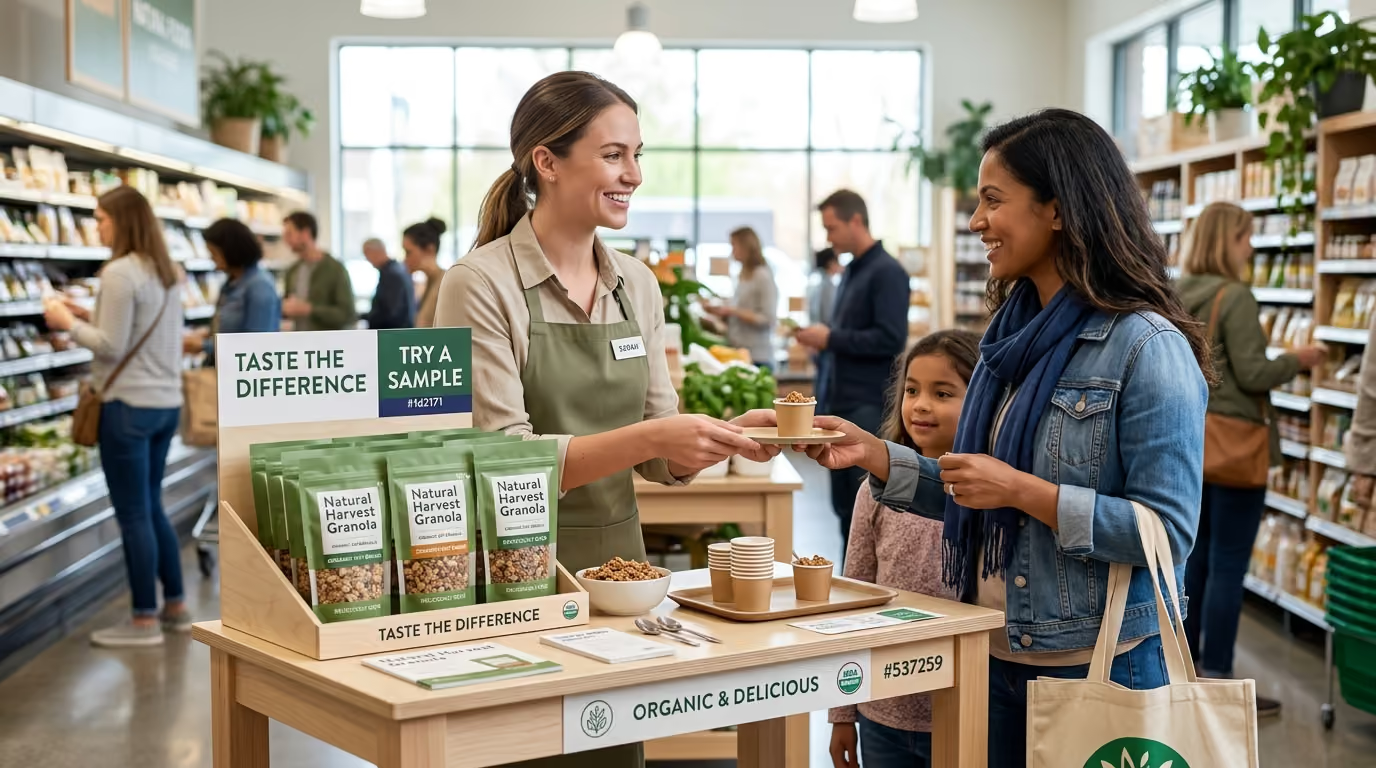
In our experience, we specialize in creating retail demos, product sampling programs, and roadshows that bring brands face to face with their audiences. Each program is designed to drive trial, build consumer relationships, and accelerate retail velocity across multiple locations. We apply these exact operational disciplines to trade environments to ensure every interaction feels natural, professional, and productive.
Teams looking to optimize their field execution can study designing trade show experiences that drive business results to improve their booth traffic and host coordination.
Structure the gathering around proven formats that encourage open dialogue:
Seat eight to twelve participants around a central business issue. A skilled neutral moderator poses questions, keeps comments concise, and ensures every attendee contributes.
Pair two enterprise clients with a senior technical specialist to dissect a specific operational issue. The format focuses entirely on solving an engineering or logistics hurdle.
Invite a long-standing client to share both the successes and difficulties of a recent project. Candid discussions about operational challenges build massive credibility with prospective buyers.
Pre-arrange fifteen-minute bilateral meetings between non-competing attendees who share identical operational challenges. Guests view these curated introductions as high-value networking.
Executing a flawless hospitality activation requires synchronized field discipline. Follow this step-by-step operational playbook across the complete project lifecycle.
Hospitality programs frequently suffer budget cuts because marketing teams fail to prove business value. Measurement must move beyond attendance headcounts and vanity feedback surveys.
A comprehensive measurement framework combines three distinct performance dimensions:
Measures the operational success of the environment. Did the venue acoustics allow easy conversation? Did registration flow without delay? Did attendees stay for the full duration?
Measures changes in attendee sentiment and trust. Do guests report feeling respected and heard? Did their confidence in the organization's technical competence increase? Freeman’s trust research indicates that 95 percent of attendees trust brands more after participating in an in-person event, while 70 percent of consumers report improved brand trust following live interactions.
Measures the quantifiable commercial output generated by the program across pipeline and revenue stages.
Marketing teams should adopt these standard formulas to calculate performance:
Track pipeline progression across four core milestones:
For advanced tracking strategies, explore first-party data capture methods for live environments and building a leadership business case using event data.
Experiential hospitality manifests differently across various industries and business models. These four proven patterns illustrate how to structure formats for maximum impact.
In heavily regulated industries such as healthcare, government, and financial services, compliance rules often place strict financial limits on meals and entertainment. Focus the event proposition entirely on accredited education, peer benchmarking, and business problem-solving. Provide options for attendees to pay for their own meals directly or opt out of social elements while attending the core educational sessions.
When an operational failure happens, such as lost luggage, missing dietary meals, or registration delays, address it immediately and without defensiveness. Assign a dedicated senior staff member to solve the issue on the spot. Provide an immediate remedy and follow up within twenty-four hours with a personal note acknowledging the inconvenience. Sincere, rapid operational recovery often generates greater trust than an event that went off without incident.
When a high-ranking executive sends a substitute colleague, treat the replacement with complete dignity and respect. Never make a substitute feel like a second-tier guest. Brief internal hosts immediately on the replacement's name, role, and operational background so all onsite conversations remain relevant and productive.
For executive-level programs, maintain a ratio of one internal host for every three to four guests. This ratio ensures that every table has an attentive conversation facilitator without making the gathering feel overstaffed by sales personnel.

30 Years Experiential & Retail Activation Partner for CPG & Beverage Brands | Multi-Market Demos, Roadshows & Costco/Club Programs That Actually Sell