Robbie Thain
Founder, CEO

Stop relying on digital ads to sell premium CPG products. Learn how side-by-side retail product sampling drives measurable trial and pipeline velocity.

Digital impressions cannot convince a consumer to buy a premium product they have never tasted or held. This guide outlines how side-by-side physical sampling protocols turn retail skepticism into measurable Return on Investment and pipeline velocity.
Advertising taste is the most expensive mistake a food brand can make. Brands spend millions trying to convince shoppers that their premium product is superior to a local favorite. Yet they watch those same shoppers walk past their endcap to buy the familiar competitor. Digital ads simply cannot transmit flavor profiles or texture differences across a smartphone screen.
On the typical trade show floor or retail aisle, chaos reigns supreme. Brand ambassadors shout over one another to hand out tiny cups of warm liquid or stale chips. Consumers are bombarded with competing sights and sounds. They filter out the noise by ignoring the promotional tables entirely.
Shoppers walk into wholesale clubs with a rigid list and a predetermined budget. Disrupting that routine requires more than a colorful banner or a clever slogan. Shoppers are highly protective of their preferred food categories. They view new premium entrants with deep skepticism.
When they do engage, the interaction is almost entirely transactional. Shoppers take the free item and immediately disappear without a second thought. There is no controlled interaction and zero baseline for comparison. Marketing leaders are left staring at empty inventory boxes and a complete lack of sales data.
They know foot traffic was high but lack proof that the activation generated pipeline. The brand theater looks great on social media but fails the spreadsheet test. Field marketing teams face immense pressure to justify their physical presence. They need a system that converts passing glances into qualified purchases.
To break through shopper fatigue requires a controlled sensory showdown. Instead of begging consumers to trust a packaging claim, put the competitor product right next to yours. The U.S. Meat Export Federation recently proved this with a highly calculated tasting strategy in London. They wanted U.K. shoppers to choose U.S. grain-fed beef over the local grass-fed standard.
They knew a billboard would never change deeply ingrained buying habits. The local consumers eat mostly grass-fed beef. To shift this behavior required an undeniable physical intervention. A new duty-free quota gave U.S. exporters unprecedented access to this market.
The strategy relies on staging an experiential intervention right at the point of purchase. You remove the abstraction of marketing copy and replace it with direct physical proof. This approach forces an immediate decision from the consumer based entirely on their own senses. It anchors your brand proposition to an undeniable physical reality.
The framework forces the brand to strip away all marketing fluff. It distills the entire sales pitch down to a single bite. This is experiential marketing in its purest and most effective form. The product must stand completely on its own merits.
You establish an immediate sensory contrast that the shopper cannot unsee or un-taste. This contrast becomes the foundation for all subsequent brand loyalty. A shopper might forget an advertisement within seconds. They rarely forget an unexpected flavor profile that outperformed their usual favorite.
Teams executing a costco roadshow strategy must prioritize this sensory proof over flashy booth designs. This framework demands precision in both presentation and data capture. A side-by-side test requires highly trained staff who understand the nuances of the comparison. They guide the consumer through the experience and ask the right questions at the exact moment of realization.
A flawless sampling event requires rigid operational discipline. You cannot just place two products on a table and hope for the best. Follow this systematic playbook to turn a simple taste test into a conversion engine.
When you start planning retail sampling at scale, standardized execution becomes your strongest asset. Consistency across every location guarantees that your data reflects true consumer sentiment. The physical environment might change slightly from store to store. The conversation and the tasting protocol must remain identical.
Brands must anticipate shopper pushback regarding price and sourcing. The U.S. beef exporters faced economic pressures with local inflation stretching consumer wallets. Their U.S. product commanded a premium price point compared to the local alternative. The taste ambassadors needed to justify this cost gap by emphasizing the superior marbling and tenderness.
Retailers respond enthusiastically to brands that bring structured foot traffic control. A side-by-side demonstration keeps shoppers engaged longer at the endcap. This increased dwell time benefits the entire aisle. Retailers reward this operational maturity with better placement.
Do not underestimate the logistical complexity of managing dual inventories during a live event. Your field teams must track the consumption rates of both the premium product and the competitor benchmark. Running out of the local control product ruins the entire experiment. Precision inventory management is just as necessary as the taste test itself.
Experiential marketing dies without hard numbers. You must stop counting smiles and start tracking the data that chief financial officers respect. The goal is to prove that hands-on interactions drive actual commercial outcomes. Teams must link trade show attention to sales pipeline to justify their budgets.
The leading metrics measure immediate engagement on the floor. Track the exact number of qualified interactions against total store or event traffic. Monitor the scan rate of your QR codes and the completion rate of the immediate preference surveys. Record the raw number of competitor products cited by shoppers during the conversation.
These indicators show if your staff is actually stopping the right people. Lagging metrics determine the true financial impact of the activation. Measure the exact percentage of tasters who place the product in their basket. Industry data indicates that successful side-by-side tastings yield a 25 to 35 percent conversion to basket add-ons.
Calculate the overall sales lift for your SKU during the activation window. Analyze repeat purchase intent and track long-term retailer buy-in for permanent shelf placement. A controlled sampling protocol often generates a 40 percent lift in purchase intent compared to passive displays. If you want us to help you build this reporting structure, you can book a strategy call with our team.
Retailers demand to see the post-event analytics before granting permanent shelf space. You must present them with undeniable proof that your product moves off the shelf. Hard data replaces subjective opinions during these critical buyer meetings. The numbers tell a story of consumer preference.
Data capture must happen in the moment of consumption. You lose the majority of your valuable feedback if you wait until the shopper leaves the store. Train your brand ambassadors to input qualitative reactions into their mobile devices immediately. These real-time field observations provide context to the hard quantitative data.
The most sophisticated field marketing teams integrate these metrics directly into their central CRM systems. This integration creates a seamless loop between field execution and broader marketing campaigns. Executives can monitor the financial impact of the live events in real time. The experiential channel finally earns its rightful place as a measurable revenue driver.
The U.S. Meat Export Federation needed to crack the highly protective U.K. market. Consumers in the region eat approximately 17.5 kilograms of beef per capita annually. This consumption is overwhelmingly dominated by local grass-fed products. Grass-fed beef is leaner and perceived as more sustainable by 62 percent of regional shoppers.
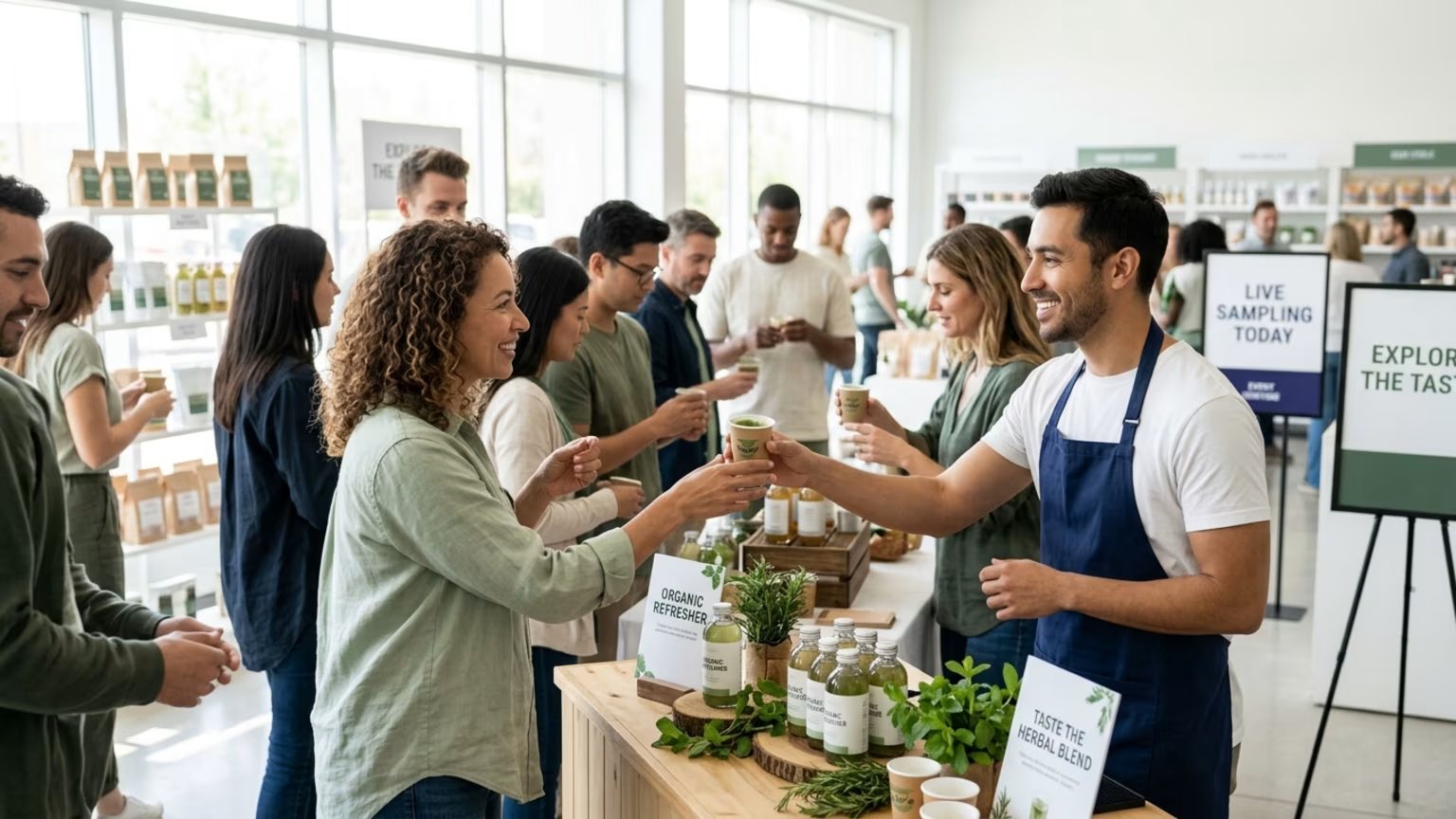
To change minds the federation launched promotional events across Costco locations in London. They offered shoppers a chance to taste U.S. grain-finished beef directly alongside the typical grass-fed product. The strategy highlighted sensory differences like tenderness and marbling. U.S. grain-fed beef offers significantly higher intramuscular fat.
This correlates with superior taste scores in blind tests. The federation reported these events as a massive operational success. Joe McManamon is a senior vice president for the group. He stated that this hands-on experience is central to building preference.
The sampling events targeted high-traffic warehouses serving millions of members. The direct comparison drove immediate trial and positioned the imported product as a premium alternative. Recent data from the Food Marketing Institute aligns perfectly with this outcome. Their analysts report that 68 percent of consumers are more likely to purchase a product after tasting it.
The strategy bypasses digital fatigue and attacks consumer skepticism directly. Food brands adopting this tasting protocol gain a distinct advantage in crowded aisles. Analysts at Kantar note that 72 percent of shoppers trust taste over packaging claims. Costco executives confirmed at recent trade shows that sampling is now standard practice for introducing new imported proteins.
The U.K. market entry faced significant regulatory and economic hurdles. U.S. beef exporters were limited strictly to non-hormone-treated cuts. This restriction capped their overall volume and raised operational costs compared to domestic sources. They had to maximize the impact of every single ounce of product.
The side-by-side tasting events provided the perfect vehicle for this high-stakes product introduction. Parallel sampling events in Asia previously yielded tremendous market share gains for the federation. They adapted this proven international playbook for the London warehouses. The physical proof overcame the inherent bias against imported meats.
The federation did not view these promotional samplings as isolated marketing stunts. They treated them as integral components of their broader global expansion strategy. The physical events directly supported their overarching brand narrative. They proved that a superior product will always win a fair comparison.
A product left on a shelf is nothing more than a promise wrapped in plastic. When a consumer tastes the difference, the debate ends entirely. The truth of a brand is always found in the physical experience.

30 Years Experiential & Retail Activation Partner for CPG & Beverage Brands | Multi-Market Demos, Roadshows & Costco/Club Programs That Actually Sell