Robbie Thain
Founder, CEO

e.l.f. Beauty raised its annual forecasts based on a strong value strategy and retail growth. Learn how physical mass retail drives trial and repeat purchases.
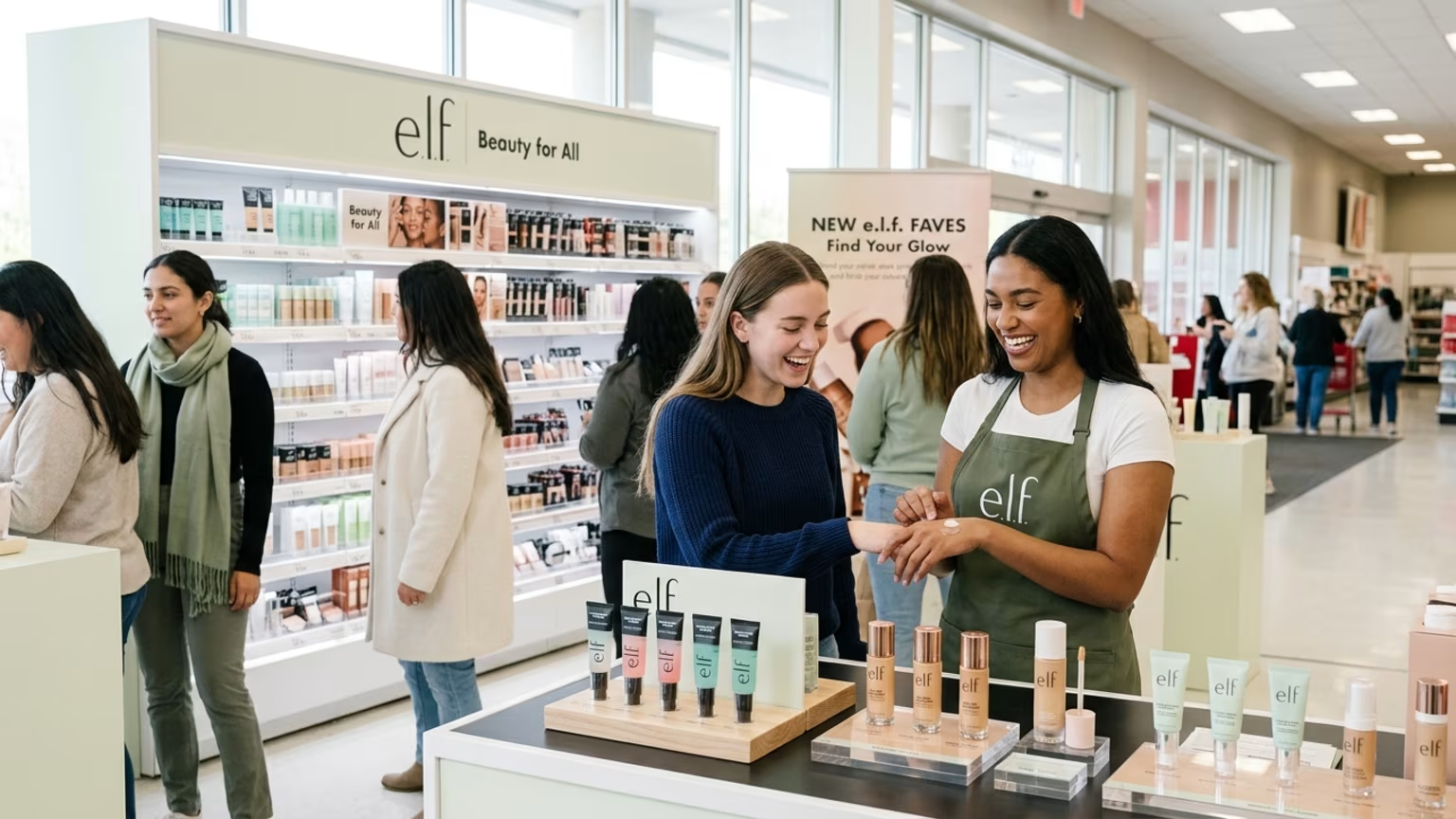
A retail buyer walks the beauty aisle looking for clear signs of consumer demand. Shelves are crowded with high price tags and confused messaging. This tension defines the modern physical retail environment. Brands like e.l.f. Beauty win by turning clear value into measurable pipeline.
Retail engagement is the systematic conversion of physical foot traffic into measurable sales pipeline. For e.l.f. Beauty, this concept means turning strong value propositions into actual retail velocity while U.S. consumers face persistent inflation and pressure from higher food and fuel costs. For the quarter ended June 30, e.l.f. reported net sales of $479.4 million. This result was up 36% year over year.
The performance easily beat the analysts' average estimate of $429.5 million, according to LSEG data cited by Reuters. The company now expects fiscal 2027 net sales of $1.94 billion to $1.97 billion. This is a significant increase from its previous forecast of $1.84 billion to $1.87 billion. The official release describes the revised outlook as 18% to 20% year-over-year sales growth.
This projection is up from the prior estimate of 12% to 14%. These financial figures demonstrate how effective positioning translates into real world demand. The results represent the 30th consecutive quarter of net-sales growth for the company, according to management's earnings announcement. e.l.f. also raised its adjusted diluted earnings-per-share forecast to $3.50 to $3.55 from $3.27 to $3.32.
Adjusted earnings per share reached $1.75 during the recent quarter. This result landed well above the 71-cent analyst estimate. The official outlook additionally projects adjusted EBITDA of $401 million to $407 million. This forecast sits higher than the previous range of $379 million to $385 million.
The company expects adjusted net income of $212 million to $215 million, compared with $198 million to $201 million previously. Beyond the financial reporting, this growth relies heavily on how products show up in physical retail. Approximately 75% of e.l.f. products are priced at $10 or less. The company even reduced prices on 10% of its portfolio after testing whether lower prices would stimulate volume.
CFO Mandy Fields told Reuters that the company is continuing to focus on value because it matters to consumers facing inflationary pressures. A value strategy only works if the shopper can instantly comprehend the offer at the shelf. In mass retail, the presentation must clearly communicate why a product is worth trying through packaging, shelf blocking, secondary displays and signage.
At makai, we understand this operational necessity firsthand. We create experiential marketing programs built to connect emotion with action. Our process blends creativity, strategy, and data to ensure every brand interaction drives measurable results. We craft experiences that engage all five senses, helping people not just see brands, but feel them, turning moments into meaningful business outcomes.
When a brand expands into new retail channels, the physical touchpoints must guide the customer naturally toward a purchase. e.l.f. launched a six-product hair-care assortment priced between $6 and $10 in June 2026. This rollout initially moved through TikTok Shop and the company direct-to-consumer site. It then expanded to Target.com before entering physical Target stores in July.
This progression highlights how digital awareness and physical retail can work together effectively. Executing a mass retail strategy requires three core components to function properly across physical environments.
The first component is clear value legibility at the point of sale. CEO Tarang Amin told CNBC that e.l.f. planned to reinvest approximately $50 million in tariff refunds into pricing, marketing, technology and working capital. Amin specifically described the pricing investment as part of creating a superior value proposition alongside increased marketing across the portfolio. This reinvestment ensures the brand can maintain its aggressive pricing strategy while supporting broader growth initiatives.
Brands that invest in a high converting retail demos and sampling strategy understand that price communication is critical for retail success. A beautifully staffed activation that creates awareness but leaves shoppers uncertain about price is incomplete.
The second component is category expansion combined with seamless retail execution. Bernstein upgraded e.l.f. to Outperform and raised its price target from $60 to $113, citing a stronger-than-expected start for the hair-care launch. Bernstein analysts estimated that hair care could become a substantial growth opportunity for the company. They noted that U.S. Nielsen-tracked hair-care retail sales were approximately $13.4 billion in 2026.
By comparison, skincare retail sales were $5.9 billion and fragrances reached $1.5 billion. Bernstein estimated that e.l.f. could reach approximately 0.9% hair-care market share by 2029. This projection represents roughly $210 million in potential incremental annual sales. Bernstein analyst Cristian Rios noted that e.l.f. Skin's market share in Nielsen-tracked channels increased from 0.6% in 2022 to 1.4% in 2026.
The third component involves measured international retail partnerships. The Rhode brand was acquired by e.l.f. in 2025 and is scheduled to launch in 19 European countries. Rhode is expected to contribute approximately 13 percentage points to full-year sales growth, according to an earnings-call transcript published by Investing.com. Meanwhile, the e.l.f. brand is expanding into Brazil through Sephora partnerships.
e.l.f. said only about 20% of its sales currently come from outside the United States. Competitors generate more than 70% of sales internationally, according to Reuters. Fields described this difference as a significant white space opportunity. Expanding across borders requires brands to adopt an AI driven local relevance strategy for retail activations to succeed.
Understanding true Return on Investment requires separating temporary financial benefits from durable consumer demand. The recent earnings report illustrates why careful measurement is necessary for operators. The company saw its gross margin increase by 1,400 basis points in the quarter. However, Reuters reported that this included a 1,050-basis-point benefit from tariff refunds.
This distinction is critical for evaluating true retail performance. Part of the profit improvement came from a temporary tariff-related benefit rather than solely from underlying brand demand or retail execution. Marketers should avoid interpreting the earnings upgrade as proof that consumer behavior has permanently shifted. The consolidated outlook also includes a material contribution from an acquired brand.
Smart brands track physical retail success through store-level sales lift, qualified product trials, and repeat purchases within a defined period. They implement systems like computer vision technology for real-time shelf compliance to verify execution. Retail partners are more likely to support expansion when brands can show commercial impact. A useful post-activation report must detail trial-to-purchase conversion and measure retailer-specific performance.
It should track geographic differences, display compliance, and monitor out-of-stock situations. Management cited upcoming product launches and international expansion across Rhode, Naturium and e.l.f. Skin as sources of continued momentum. Validating this momentum requires strict adherence to physical retail metrics and consistent reporting standards. Bernstein characterized the operating model of the company as particularly relevant to current consumers because of its social-media fluency, rapid innovation cycles and viral-oriented product development.
That analyst opinion highlights the need to connect digital buzz to physical reality.
Ultimately, converting physical foot traffic into measurable sales pipeline requires brands to combine a credible value proposition with relentless, measurable execution across every retail touchpoint.

30 Years Experiential & Retail Activation Partner for CPG & Beverage Brands | Multi-Market Demos, Roadshows & Costco/Club Programs That Actually Sell