Robbie Thain
Founder, CEO

Discover how CPG brands are shifting product sampling from mass distribution to measurable trials, driving verified retail conversion and repeat purchases.
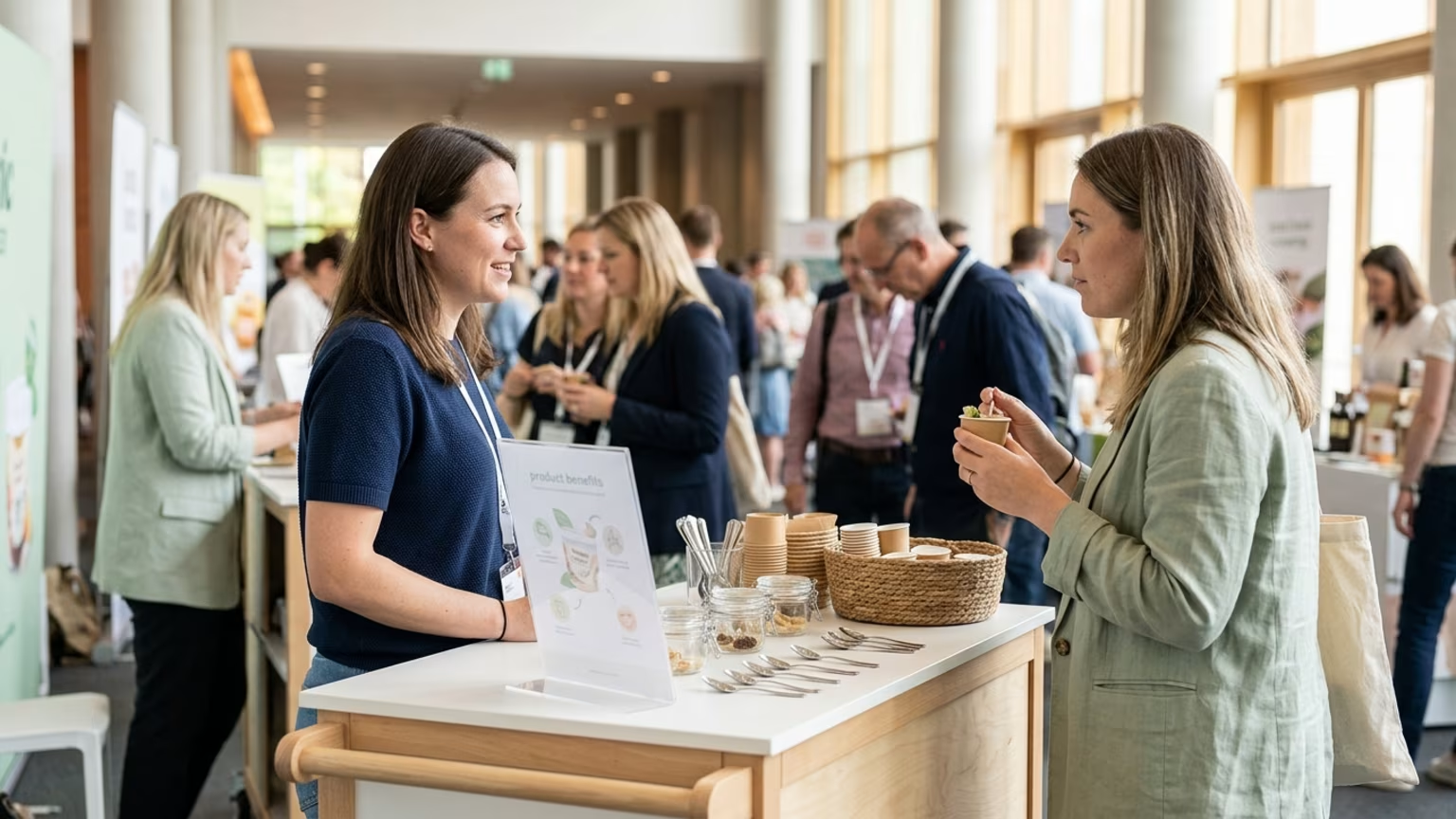
On August 19, 2026, the experiential marketing sector formally acknowledged a massive operational pivot away from mass sampling volume. Event Marketer published updated measurement guidance emphasizing that product sampling must prioritize qualified consumer actions over simple distribution counts. The era of evaluating field marketing solely by the number of units handed out is officially over. Brands are now expected to track the complete journey from physical trial to confirmed downstream purchase.
The core of this shift fundamentally changes how campaign success is defined on the ground. Instead of tracking the raw number of samples distributed, field operations must now measure qualified trials. A qualified trial requires a consumer who fits the target audience, engages in a relevant setting, and can plausibly buy the product. This logistical overhaul forces field teams to connect physical product trials to actual sales data or loyalty accounts.
At Makai, we welcome this rigid operational standard. Handing a premium beverage to an unqualified passerby is a waste of valuable inventory. Real hospitality means engaging the right consumer at the exact moment a product solves their actual need. We provide clear reporting on reach, trials, leads, and sales to guide next steps in campaign optimization.
Our measurement approach tracks awareness, engagement, and conversion, turning brand moments into actionable data that demonstrates business impact. CPG marketers rely on physical experiences to drive retail pipeline, and they can no longer fund programs that lack clear attribution. Measuring cost per identified trial forces teams to respect the physical execution required for success.
This focus on data quality over crowd quantity forces a complete rewrite of field operations. When the objective is a qualified trial, booth flow must be designed to facilitate real conversations and product education. Field staffing now requires more than just enthusiastic distributors pointing at a display. Ambassadors must be trained to answer objections, explain product benefits, and guide consumers toward a measurable next action.
Proper training ensures that every interaction adds value to the customer journey. Brand representatives need to confidently manage crowd flow while still identifying high value targets. This disciplined approach prevents the booth from becoming a chaotic distribution center. Operations leaders must document these workflows long before the activation goes live.
Product storage and delivery logistics also face much stricter requirements. Field teams must guarantee that the product arrives in perfect condition so the consumer experiences the intended sensory profile. Proper chilling, heating, and presentation are mandatory factors that directly influence purchase intent. Permits and site selection now heavily favor locations where immediate retail access is possible.
Starting with a commercial objective changes how marketing leaders select their venues. A high traffic event might generate thousands of low intent interactions, while a smaller venue might yield more qualified trials and better economics. A simple volume comparison illustrates this strategic difference. A program distributing 10,000 samples that generates a 5% purchase intent response yields more potential buyers than a 50,000 sample program generating a 1% response.
Brands must filter their audiences using variables that actually affect purchase probability. Category relevance, retail access, and repeat potential matter far more than general foot traffic. The goal is to place the experience in a context that reduces the distance between trial and transaction. For consumer goods, this often means activating near a shelf location where a well planned in-store sampling execution can trigger an immediate purchase.
Understanding return on investment requires looking beyond the wholesale cost of the sample itself. WTF Amplify's ROI framework states that campaign costs must include the physical product as well as packaging and freight. Storage, distribution, and staffing must also be calculated. Technology, incentives, and follow up communications complete the true cost model.
Failing to account for these logistical expenses completely skews the financial reality of the campaign. A program might appear profitable if only the wholesale product cost is measured. However, once freight routing and ambassador wages are factored in, that same campaign might actually be operating at a severe loss. True operational excellence requires complete budget transparency.
That same framework defines sampling ROI as attributable contribution minus total campaign cost, divided by total campaign cost. By dividing this total cost by the number of consumers who complete a qualification event, brands can determine their actual cost per identified trial. This level of financial clarity helps marketing leaders scale their repeatable retail roadshow programs with confidence.
The experiential industry still struggles with unverified claims and inflated conversion benchmarks. Nebuloid Tech Studio points out that claims suggesting sampling routinely generates 30% to 50% same-visit conversion often lack verifiable primary sources. Similarly, while secondary social posts claim that 70% of consumers are influenced by free samples, these statistics should not replace hard campaign data.
Agencies that promise massive sales lifts without providing matched location data should be questioned heavily. It is impossible to attribute a retail spike purely to a sampling event without controlling for other variables. Pricing changes, competitor out of stocks, and seasonal foot traffic all impact the final register receipts. A defensible measurement plan acknowledges these external factors rather than ignoring them.
Marketing leaders must separate verified new buyers from unverified self reported intent. A high conversion rate can easily be misleading if an activation only reaches existing loyalists. To prove true retail impact, Expose Brands recommends evaluating campaigns through genuine product trials and local stock movement. Marketing leaders should also track QR scans, retailer feedback, and the ultimate cost per sale.
Relying solely on purchase intent surveys creates blind spots in the attribution funnel. A consumer stating they intend to buy a product does not put revenue in the register. Stronger evidence comes from linking a shopper to a point of sale transaction, a loyalty record, or a verified ecommerce order.
A successful product trial is only the beginning of the consumer lifecycle. Brands must evaluate their sampling efforts against a defined purchase window. Kaizen Loyalty recommends tracking trial to purchase conversion within a defined 30 or 60 day window. They also advise tracking the time required for converted samplers to make their second and third purchases.
Without proper timing, retargeting efforts simply annoy the consumer. Sending a discount code before the buyer has even opened the sample is a wasted opportunity. Marketing automation platforms must be configured to respect the natural consumption cycle of the specific product. Patience in follow up often yields far higher conversion rates than immediate pressure.
These time to repeat measures help separate a one time promotional response from a permanent change in consumer habits. For example, a targeted beverage sampling strategy is only successful if that first taste leads to a permanent spot in the refrigerator. Follow up communications should be timed to actual consumption rather than sent indiscriminately.
A practical measurement funnel requires distinct denominators for every stage of the consumer journey. Exposure counts the people who pass the activation space or receive an invitation. Engagement tracks the individuals who actually stop and interact with the physical footprint. A qualified trial only occurs when a targeted individual actually uses the product.
Breaking the journey into these specific stages reveals exactly where a campaign is failing. If exposure is high but engagement is low, the physical booth design is likely fundamentally flawed. If immediate conversion is strong but repeat purchases lag, the product itself may not meet consumer expectations. Diagnostic data allows marketing operators to fix problems in real time.
From there, the funnel moves into strict commercial outcomes. Immediate conversion tracks purchases made during that exact same visit or live event. Deferred conversion measures purchases made within the defined follow up window. Finally, repeat purchase tracking confirms whether the brand has successfully acquired a long term customer.
Proving true business impact requires a rigorous measurement plan designed before the first unit is poured. CMO Magazine recommends using holdout markets, comparing activation locations with similar non activation stores, and connecting experiences to trackable downstream actions. This isolation of variables gives marketing leaders the credibility they need when reporting to their executive boards.
Isolating the impact of an event requires deep integration with retailer point of sale systems. Marketing teams should establish clear data sharing agreements with their retail partners early in the planning phase. This collaboration allows field operators to track basket attachment rates alongside the core product movement. When both parties share the same data, future program approvals become significantly easier.
First party data collection serves as the bridge between the physical footprint and the digital retention ecosystem. Beyond Marketing and Events emphasizes that modern programs must combine physical interactions with digital systems to build a closed loop measurement model. Capturing a unique identifier allows brands to measure customer lifetime value over the long term.
However, the quality of this data depends heavily on the integrity of the collection method. Wolters Kluwer notes that questionnaire design, sample selection, and sample size directly affect the reliability of market tests. Field teams must distinguish between probability samples and convenience samples when reporting their demographic findings.
A 2026 Cvent benchmark cited by National Experiential highlights the difficulty of this transition. The report notes that 95% of B2B teams consider proving event Return on Investment a top priority. However, 38% cannot do so, and 56% report difficulty measuring experiential returns. This gap between ambition and execution stems from outdated measurement architectures.
An AEVEA Pulse report cited by Meet In found similar expectations among brand leaders. Their respondents identified attendee experience and business impact as prominent event success indicators. The data showed 71.1% of respondents identifying attendee experience and 68.4% identifying business impact. This confirms that executives want actionable business results rather than just attendance metrics.
For grocery and mass retail programs, store impact should be part of the initial brief. Field managers must prioritize locations where the item is reliably in stock. A sample can then be immediately connected to a shelf purchase or a loyalty account. Reporting should focus on store level performance rather than just campaign wide totals.
Health and wellness products require a slightly different operational approach. Field execution must be designed around correct product use and consumer education. Brands should measure whether the consumer completes the intended usage occasion before asking for purchase feedback. This critical step distinguishes a blindly distributed sample from a qualified product experience.
Joe Federbush of Evolio Marketing recommends a structured approach to event surveys. He advises evaluating programs by looking at return on experience, emotional response, and business actions. This framework requires asking attendees not just if they intend to buy, but what specific action they will take because of the live experience.
This philosophy aligns perfectly with the need to shift focus from attendance volume to qualified participant behavior. The best field teams know how to invite a measurable next action without ruining the authenticity of the moment. By turning trade show sampling into actionable pipeline, brands can justify their experiential investments with concrete sales data.
Retail partners also demand tangible proof that a sampling event drives store level growth. A highly engaging activation that fails to improve shelf visibility or sales velocity offers very little value to the retailer. Stock movement, basket attachment, and sell through rates must be included in the primary reporting dashboard.
Does your current field reporting identify where a product trial becomes a transaction, or does it simply count the empty boxes left behind? The true value of a physical interaction is never found in the noisy moment it happens, but in the quiet routine that follows.
Distributing unmeasured free samples guarantees wasted inventory and zero visibility into true retail conversion. Makai navigates complex event logistics, permits, and staffing to ensure every interaction translates into qualified pipeline. We manage end to end Costco roadshows that bring brands to shoppers through live demos, real conversations, and measurable sales impact. Request a proposal

30 Years Experiential & Retail Activation Partner for CPG & Beverage Brands | Multi-Market Demos, Roadshows & Costco/Club Programs That Actually Sell