Robbie Thain
Founder, CEO

Turn your one-off trade show booth into an always-on engine. Learn how to launch roadshows and street activations that drive measurable retail ROI.
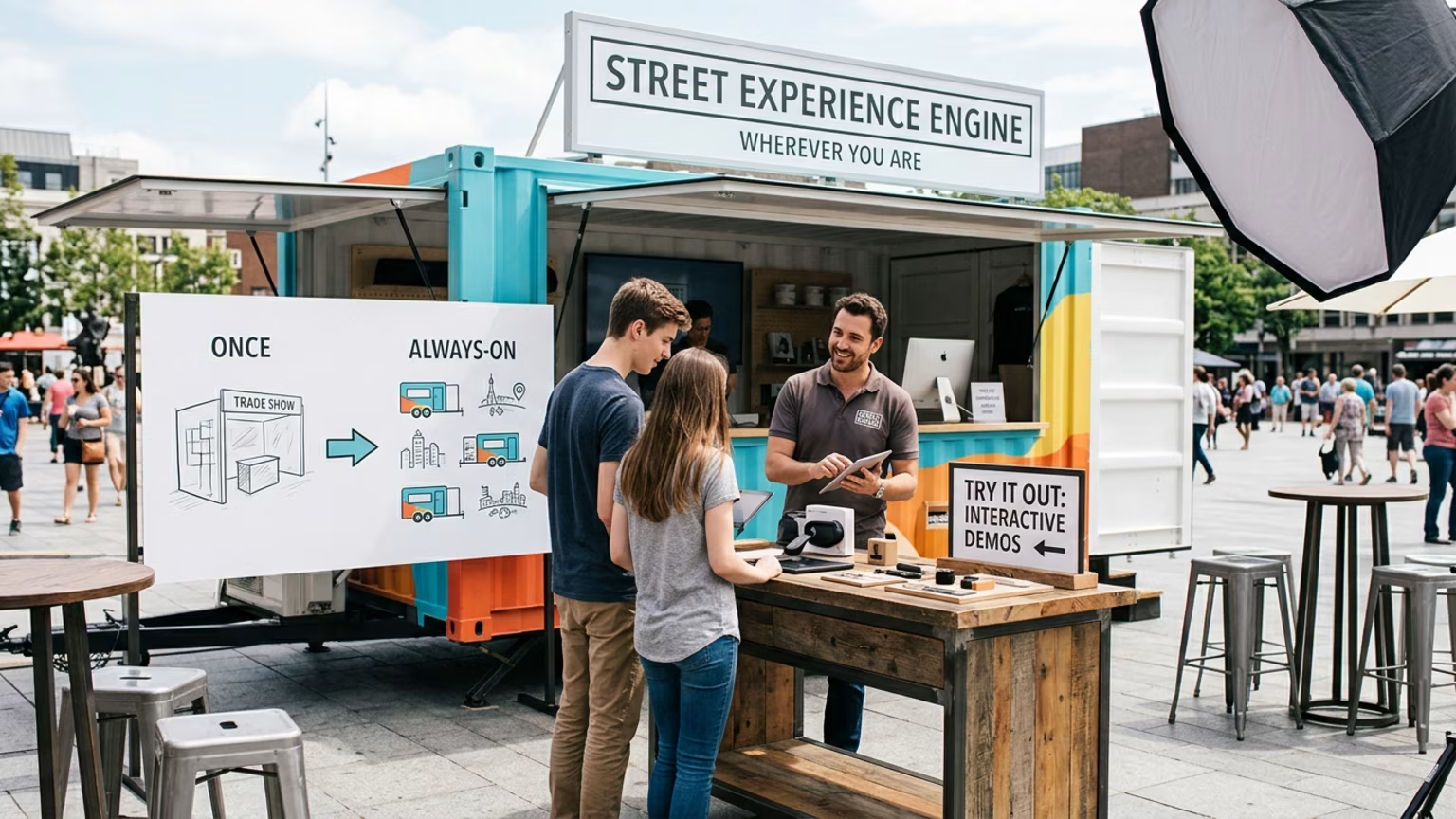
Industry analysts report that extending a core event strategy into ongoing regional campaigns can increase total engagement by over fifty percent. An always-on activation engine captures that concentrated booth energy and converts it into measurable retail sell-through across regional roadshows. This continuous deployment strategy stops budget waste and turns isolated live events into permanent pipeline fuel.
The convention center lights flip on and the chaos begins immediately. You spend three days scanning badges, handing out premium samples, and smiling until your jaw aches. Your field marketing team gathers hundreds of leads under the harsh glow of the convention center halogens. Then the expo hall closes, the pallets ship back to the warehouse, and the momentum dies completely.
Sales teams stare at a spreadsheet of cold badge scans a week later. The emotional connection you built on the floor fades fast when the follow-up is just an automated email blast. You dropped serious budget to create a physical brand moment with union labor and massive fabrication costs. Letting that investment rust in a dormant CRM pipeline is an operational failure.
The failure to connect the dots usually stems from broken internal communication. The trade show falls under the events budget, the street teams report to field marketing, and the retail demos sit with sales. This fractured structure guarantees an inefficient use of resources and mixed messaging in the market. A successful brand treats live events as a singular continuous timeline rather than competing departmental projects.
Trade show attendees suffer from massive cognitive overload. They walk past hundreds of flashing screens, towering displays, and eager sales reps screaming for attention. Expecting a single badge scan to secure a permanent place in their memory is a flawed assumption. You have to reinforce that initial exposure with targeted regional activations that meet them in their own neighborhood.
You need a framework that treats the expo booth as the starting line instead of the finish line. We call this the continuous deployment model for experiential marketing. It relies on mapping your post-show calendar before the booth is even built. You identify the highest value markets from your trade show data and deploy targeted street teams to those exact zip codes.
We have executed over 1000 campaigns across all 50 states, bringing brands to life in every major U.S. market. From retail demos in Seattle to roadshows in Miami and events in Honolulu, our teams activate brands wherever our clients' audiences are located. This national footprint taught us that trade show success requires immediate regional reinforcement. When buyers return home, they need to see your product actively moving off local shelves.
The strategy demands tight integration between your event staff and retail execution teams. You can use your main expo footprint as a testing ground for messaging, sampling mechanics, and product reactions. Winning concepts scale up into your revenue-generating roadshow playbook. Losing concepts get cut early to save your marketing budget from a failed national tour.
Designing this continuous flow requires a hard look at your actual sales cycle. If your product takes six months to hit retail shelves after a wholesale agreement, your roadshow should not launch immediately. You stage the street activations to match the exact moment the product becomes available to the end consumer. This precision timing prevents you from generating demand for an empty shelf.
A modular mindset applies to both physical assets and human capital. The script your team uses to pitch a distributor at an expo can be modified slightly for a consumer retail demonstration. This shared DNA across all brand interactions creates a compounding effect on brand recall. Every touchpoint feels distinctly familiar to the buyer.
Repurposing content and strategy from your primary events extends the lifespan of your initial investment. Research on event repurposing indicates that extending a single campaign's core message across multiple channels increases overall return significantly. You are simply taking the intellectual property you already paid for and putting it on wheels.
Moving from a stationary booth to a mobile field operation requires operator-grade discipline. You must systematize the transition to maintain brand integrity and budget control across multiple states.
Determine which regional expos actually drive enough retail buyer interest to justify a permanent booth presence. Cut the underperforming shows and reallocate that capital to direct consumer street activations.
Overlay your strongest trade show lead locations with your priority retail distribution zones. Send your mobile sampling tours to the exact cities where buyers requested immediate shelf support.
Design modular assets that work in a twenty-by-twenty expo space and a ten-by-ten Costco roadshow footprint. Properly planning event merchandise and modular displays reduces transition friction. This prevents redundant fabrication costs and keeps your visual identity consistent.
Funnel badge scans directly to field managers so street teams can reference specific expo conversations during local retail visits. This turns a cold regional stop into a warm follow-up conversation.
Hire brand ambassadors who can work the high-pressure trade show floor and then hit the road for the subsequent regional tour. Repeatable teams build institutional knowledge and deliver a much stronger consumer interaction.
Plan the shipping lanes from the convention center loading dock directly to your regional storage hubs. Do not send everything back to a central warehouse just to ship it out again two weeks later.
Use your mobile fleet to drop unannounced samples at key corporate campuses or busy downtown transit hubs. This builds aggressive local buzz right before a major retailer places their opening order.
Sync your street activation locations with geofenced digital ads. Consumers should see your brand on their phone an hour after they tasted your product on the sidewalk. Content marketing data indicates that answering consumer questions across multiple touchpoints increases conversion velocity.
Trade shows burn through premium giveaway items fast, often leaving nothing for the subsequent roadshow. Segment your warehouse stock early to guarantee your street teams have exactly what they need to execute.
Stop wasting post-show momentum and book a strategy call to build your execution roadmap.
You cannot scale an always-on engine without rigorous financial tracking. First-time Return on Investment reporting separates vanity projects from true pipeline generators. Lead metrics predict future success and guide your mid-tour adjustments. Track daily trial volume, cost per engagement, and qualitative consumer sentiment scores gathered by your field ambassadors.
Lag metrics prove the historical success of your activation against hard sales targets. You must track regional retail sell-through velocity during the exact weeks your roadshow hits that market. Monitor buyer reorder rates in the territories where street teams supported the post-show push. Comparing these figures against unactivated baseline markets proves the financial worth of bridging the gap to retail execution.
Your CRM must capture the entire lifecycle of a customer interaction. A contact might scan a QR code at your booth and then redeem a sample coupon at a neighborhood street festival two months later. Tagging these multi-touch physical interactions provides a clear view of your acquisition cost. When marketing leadership asks for results, you hand them a unified dashboard instead of a fragmented pile of receipts.
Reporting frequency matters just as much as the metrics themselves. Field managers should submit end-of-day reports detailing inventory levels, weather impacts, and foot traffic patterns. This daily data flow lets you shift resources toward high-performing markets instantly.
You should evaluate the qualitative feedback loop just as intensely as the hard numbers. Your field ambassadors act as the frontline intelligence unit for your product development team. They hear the raw, unfiltered opinions of consumers tasting your product outside of a controlled convention setting. This real-world commentary often reveals packaging flaws or flavor preferences that never surface in corporate focus groups.
Connecting these localized data points builds a massive competitive advantage. When you walk into your next retail buyer meeting, you are not just presenting trade show attendance numbers. You bring hard evidence that your post-show pop-up tactics actively clear inventory off their specific shelves. This level of operational maturity makes it incredibly easy for buyers to say yes.
A national beverage brand recently faced a massive disconnect between their primary expo appearances and retail performance. They built an expensive footprint at Expo West but saw regional sales stagnate within thirty days of the show. We restructured their approach to use the Anaheim event as a formal launchpad for a sunbelt sampling tour.
The team tested three different flavor profiles and sampling scripts on the trade show floor. The winning combination became the exact playbook for a three-month mobile tour hitting key retail locations across California and Texas. Field teams arrived in priority markets just as the retail buyers received their first wholesale shipments.
We deployed dedicated street teams to hit high-traffic pedestrian zones near the newly stocked retail outlets. Ambassadors handed out full-size samples and directed consumers to the nearest grocery aisle. The mobile routing matched the exact regional footprint the sales team had established during the trade show negotiations.
This activation shift required serious logistical restructuring behind the scenes. We had to coordinate refrigerated freight from the convention center directly to regional holding facilities. The permitting process for the street activations began three months before the first trade show booth even shipped. This aggressive timeline management kept the campaign entirely insulated from supply chain delays.
The retail buyers immediately noticed the difference in consumer velocity. Instead of waiting for organic discovery, the brand forced the issue by putting the product directly into local hands. Store managers reported higher repeat purchases in the weeks following the local street activations. The initial trade show conversation sparked the listing, but the field execution secured the long-term partnership.
This coordinated timing pushed localized sell-through rates up by forty percent compared to the previous year. The brand transformed an isolated industry event into a continuous revenue generator. Their expo budget finally worked for them long after the convention center went dark.
The real work begins when the expo hall lights power down. A brand that keeps moving outward builds trust that stationary competitors simply cannot match. Consistency in the physical world leaves a lasting mark.

30 Years Experiential & Retail Activation Partner for CPG & Beverage Brands | Multi-Market Demos, Roadshows & Costco/Club Programs That Actually Sell


