Robbie Thain
Founder, CEO

The Freeman Report reveals attendees want 64% of their learning outside session rooms. Learn how to transform trade show booths into educational environments.

The most valuable educational real estate at a trade show is no longer the keynote stage. For decades, brands treated the expo floor as a place for transactions while leaving education to formal presentations. That separation is officially obsolete.
Event-based learning is the deliberate transformation of physical interactions into structured educational moments that drive commercial intent. It bridges the gap between passive awareness and active pipeline generation. Freeman’s second Learning Report, “Unpacking XLNC: The Future of Adult Learning at Conferences and Trade Shows, Part Two,” argues that attendees increasingly view the entire event environment as a place to learn. This means the physical footprint must function as an educational tool rather than a static display.
According to Midwest Meetings, the report found that attendees would ideally spend 54 percent of their learning time outside traditional session rooms. Among trade show attendees, that preference rises to 64 percent. This means nearly two-thirds of desired learning would happen elsewhere. The 64 percent figure describes how trade show attendees would ideally allocate their learning time.
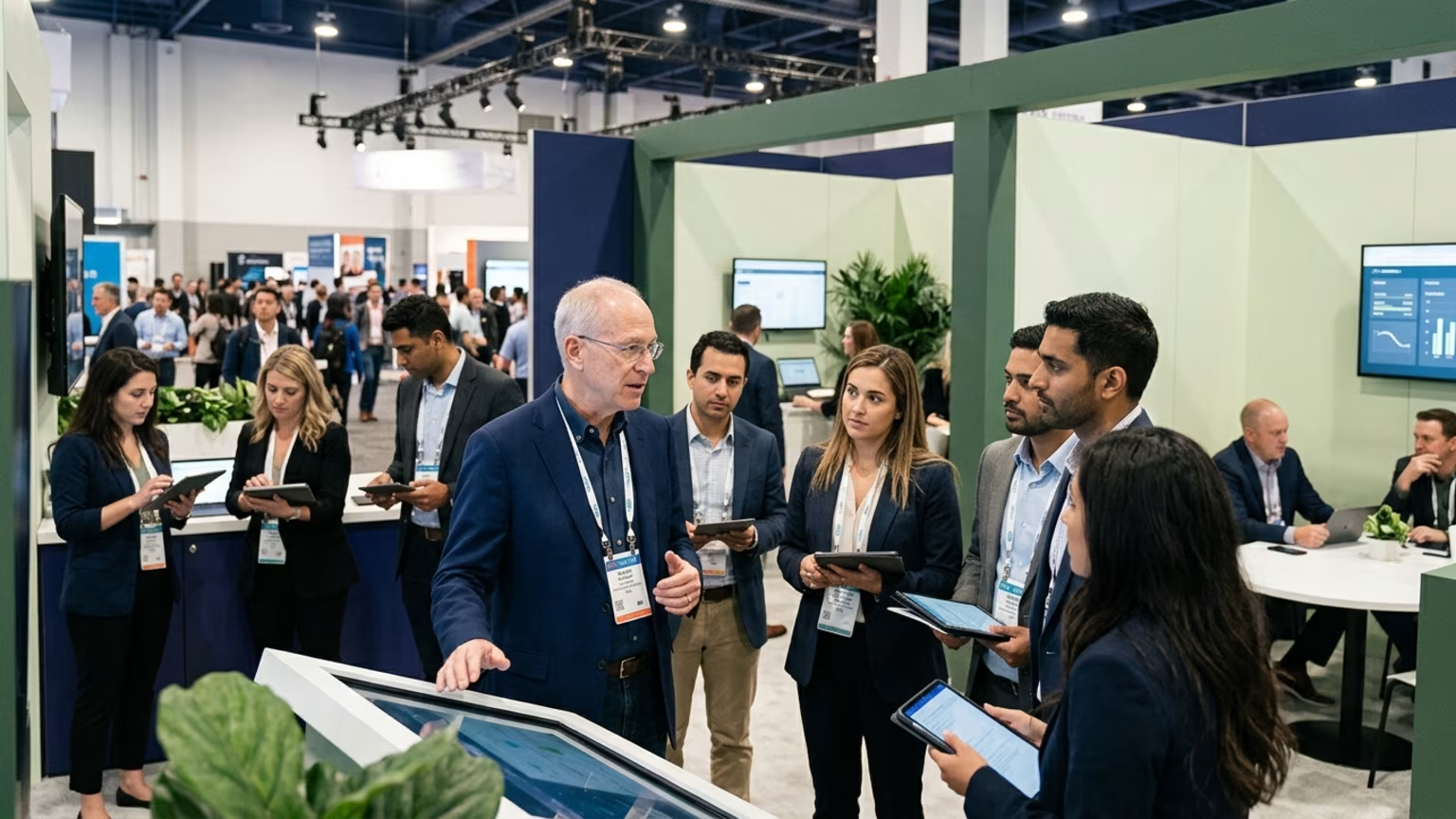
Breaking this concept down into the physical world of consumer goods requires a major shift in perspective. A trade show booth should not function only as a branded reception desk. It cannot serve merely as a passive lead-scanning station for passing traffic. Instead, the strongest opportunity is to make the booth a highly functional space that delivers immediate value.
Attendees want to test formulations, compare options, and solve actual work problems in real time. Midwest Meetings reports that two-thirds of emerging generations want more learning opportunities outside traditional conference rooms. The claim that two-thirds of emerging generations want more learning outside traditional conference rooms is useful as a directional signal. However, it should not be expanded into assumptions about all younger attendees’ preferences, buying behavior, or attention spans.
Informal learning outside the session room does not mean an absence of structure. A guided demonstration or an expert office hour can take place on the expo floor while retaining strict objectives. We build festival zones, premieres, and pop-ups that turn viewers into fans and fans into advocates. We design moments people want to share using music tie-ins, screenings, and live stunts to bring stories to life.
During these events, our crews manage execution and track reach and response metrics. This same operational rigor applies to trade shows by turning passive space into active engagement. Planning educational touchpoints requires discipline to ensure interactions lead to commercial outcomes.
Transforming raw square footage into an educational engine requires specific structural components. Brands must move past superficial engagement tactics. They need to anchor their strategy on three foundational pillars. Implementing these pillars requires a detailed exhibitor playbook for staffing.
The first requirement is placing genuine subject-matter experts directly on the floor. Attendees do not want sales representatives who simply read promotional slides to them. They expect immediate access to individuals who understand product performance, scientific backing, and complex use cases. Brands must visibly schedule these experts to answer substantive questions.
This shift demands a completely different approach to booth personnel and pre-event training. The focus moves from aggressive lead qualification to consultative problem solving. Visitors will naturally engage with a brand that helps them overcome a specific operational hurdle. The booth becomes a destination for actionable intelligence rather than a hurdle to avoid.
The second pillar involves structuring spaces for attendees to learn from one another. Unstructured conversations in a busy aisle often yield very little actionable insight. Designing specific formats like facilitated roundtables or post-demonstration discussion tables creates focused value. Peer formats require strict moderation and clear guardrails to remain productive.
When a brand facilitates a meaningful conversation between two buyers, it earns immense credibility. The company positions itself as a central hub for industry advancement and thought leadership. This approach turns a crowded footprint into an exclusive networking venue. It capitalizes on the natural human desire for peer validation and shared experiences.
The third component requires treating sponsored education as a trust-based product. Brands can sponsor expert clinics or hands-on demonstrations if they disclose the relationship clearly. Midwest Meetings notes that Freeman’s research indicates approximately 84 percent of attendees viewed sponsored sessions neutrally or positively when sponsorship was disclosed. The sponsor's product should appear as a credible solution within a broader relevant topic.
A sales presentation disguised as an objective workshop will instantly destroy attendee trust. Operators must apply the exact same quality standards to sponsored programming as unpaid programming. Transparency ensures the audience remains receptive to the underlying message and respects the brand. Honesty is the only sustainable strategy for commercial education in a physical environment.
Evaluating the success of expo-floor education requires moving beyond basic vanity metrics. Marketers should avoid treating booth dwell time or simple badge scans as definitive proof of revenue impact. Freeman recommends tracking attendance, engagement, qualified leads, content downloads, and post-event sentiment for sponsored learning. These metrics provide a baseline for understanding how attendees interact with educational programming on the floor.
To prove actual business value, operators must connect these interactions to downstream pipeline. This means tracking completed product trials, CRM opportunities, and specific retailer follow-ups. Planners must establish this precise measurement framework long before the show doors open. A disciplined approach ensures teams do not confuse a crowded booth with a profitable one.
This operational discipline is central to shifting trade show strategy toward measurable Return on Investment. Every educational touchpoint must eventually point back to commercial viability and pipeline generation. Brands that fail to measure the business impact of informal learning will struggle to justify their physical footprint. It is critical to measure Return on Investment with clean data to secure future event budgets.
Event-based learning fundamentally redefines the physical footprint as an active engine for commercial education rather than just a branded billboard. When operators treat the expo floor as a primary classroom, they transform passing curiosity into structured intent. The distinction between learning and buying has completely dissolved in the modern trade show environment.
The most powerful lessons are rarely taught from a distant stage. They are found in the quiet moments of real interaction where trust is finally built.
Rebuilding the expo floor into a structured learning environment requires translating educational strategy into physical reality, which is where Makai assumes full execution control. Makai resolves scattered attention and poor booth flow by designing deliberate attendee journeys that capture focus. We deploy our Promotional Campaigns capability to connect digital and real world touchpoints, boosting visibility and sparking meaningful brand conversations. Request a proposal

30 Years Experiential & Retail Activation Partner for CPG & Beverage Brands | Multi-Market Demos, Roadshows & Costco/Club Programs That Actually Sell