Robbie Thain
Founder, CEO

A five part decision framework for choosing the right experiential marketing environments. Learn how to map venues to measurable outcomes and pipeline growth.

Buying the biggest footprint at a crowded event is the fastest way to burn marketing capital without generating a single incremental sale. The first decision is never what activation to build, but rather where the experience can do the most commercial work. Operators must distinguish between buying mere attention and investing in measurable consumer action. A large audience only creates visibility if the environment directly supports your product context.
Global B2C and B2B experiential marketing spending reached $138.94 billion in 2025 after increasing 8.3% year over year, according to reporting on PQ Media’s latest forecast. Marketing Charts reports this market is forecast to grow another 10.3% in 2026. Consumer experiential represented approximately 70% of total experiential spending in 2025. National Experiential reports that EventTrack’s 2025 study found 74% of Fortune 1000 marketers planned to increase experiential budgets in 2026.
Within consumer experiential, consumer event sponsorship spending reached $50.25 billion in 2025, compared with $46.99 billion for live event marketing. Sports sponsorships accounted for $33.5 billion, or 66.7% of B2C event sponsorship spending. These figures show massive financial commitment to physical environments across the industry. However, massive spending in sports arenas does not prove those venues are the best environment for every product.
We have executed over 1000 campaigns across all 50 states, bringing brands to life in every major U.S. market. From retail demos in Seattle to roadshows in Miami and events in Honolulu, our teams activate brands wherever our clients' audiences are located. We see firsthand how critical venue selection is to campaign performance. Success requires placing the right product in the right physical environment.
For a VP of Marketing looking at a fragmented trade marketing budget, these billions indicate a high stakes environment. The pressure to prove Return on Investment from physical activations is heavier than ever before. Operators cannot afford to treat live events as vague brand theater. Every dollar spent on the floor must map directly to product trial, retail sell through, or qualified lead generation.
A large sponsorship might look impressive to the executive board. Yet, without a defined commercial bridge, it simply subsidizes a fan experience rather than driving incremental revenue. The modern marketing operator must evaluate venues by how closely the environment connects to a transaction. Brands need consumers to sample, compare, and ultimately purchase their products.
Live experiences require active participation rather than passive exposure. Common measurement inputs include footfall, engagement rate, and dwell time. Operators also track interaction depth, lead capture, and downstream pipeline. The commercial value of a venue depends entirely on whether the audience is relevant and whether the brand can create a measurable next step.
A recurring practitioner recommendation is to establish the measurement design before the activation is built. One experiential marketing source recommends commissioning a brand lift study before the event. They advise setting key performance indicator targets in the brief and designing audience capture into the experience. This aligns single activation results with broader cross activation evidence.
This macro trend forces a structural shift in how brands execute retail demos and mobile roadshow tours and pop up activations today. Strategy requires evaluating locations through a strict five part framework to eliminate wasteful spending. We must assess audience fit, purchase proximity, and brand context. Teams must also evaluate operational complexity and measurement potential. Brands that prioritize data led experiential marketing for retail engagement consistently outperform competitors who only chase impressions.
Audience fit ensures the people present actually match your target buyer profile. Operators must evaluate demographic relevance, the need state at the moment of contact, and category interest. A fitness center can be highly relevant for hydration products, but less useful when the audience is present for an unrelated need. Require an audience profile before booking any venue.
Purchase proximity evaluates how close the audience is to a transaction after the experience. This is often the decisive difference between environments. Retail stores generally offer the shortest path from trial to purchase because the product and checkout infrastructure are nearby. Other venues require bridges like QR linked ecommerce, retailer specific coupons, or post event email journeys.
Brand context determines whether the environment makes your product feel credible and culturally appropriate. Context is not decorative, as it changes how consumers interpret the brand. A wellness product benefits from a fitness center because the environment reinforces health and performance routines. The right question is whether the venue makes the brand promise easier to understand.
Operational complexity measures how difficult it is to execute the activation safely and consistently. Key variables include permits, insurance, and staffing. Teams must also account for weather exposure and brand presentation standards. Score each venue on the number of external parties required to operate and supply the experience.
Measurement potential asks if the brand can prove what happened beyond raw attendance. A measurement source recommends using exposed and control groups to calculate lift rather than treating post event responses from attendees as proof of causation. The same source describes brand lift measurement as a comparison between an exposed group and a matched control group. This is why experiential marketing Return on Investment tracking is a non negotiable element of the planning phase.
A defensible measurement plan separates exposure from actual engagement. Exposure measures qualified reach, while engagement tracks participation and dwell time. Brand effect measures consideration, and commercial action tracks samples redeemed or products sold. Finally, efficiency measures the cost per meaningful interaction or incremental sale.
Retail environments offer the shortest path from trial to purchase. A retail focused source specifically identifies the short path between experience and purchase as a major advantage because "the product is right there." Retail is optimal for product launches and driving immediate retailer sell through. The primary challenge is navigating strict retailer rules and execution standards.
The main risk is confusing generic shopper traffic with qualified engagement. A high traffic store may be a poor choice if the audience does not match the category. The store is also ineffective if the activation is placed away from the relevant aisle. Retailers must be able to provide usable sales data to validate the investment.
Festivals are strong for lifestyle targeting and cultural relevance. They generate shareable content and high volume sampling opportunities for consumer packaged goods. Purchase proximity is often low unless the brand integrates a strong digital bridge. Logistics, long operating hours, and weather exposure add significant operational complexity.
The activation should be designed around a meaningful behavior like tasting, building, customizing, or competing. The brand should also plan exactly what happens after the event. Festival attendees may not buy on site, so a defined sales window is mandatory. Attendance alone does not establish business impact.
A fitness center provides highly contextual trial for health, wellness, and performance products. Consumers are already in a routine that aligns with physical recovery or nutrition. This makes the brand promise easier to understand and experience firsthand. Operational complexity requires careful facility coordination and repeatable staffing models across locations.
The challenge is avoiding a superficial healthy lifestyle association. The product and interaction should solve a real need in the workout or recovery journey. Fitness environments can provide repeated access to a highly focused audience. They are especially useful when consumers need to experience a product's functional benefit.
Campuses deliver concentrated access to student and emerging adult segments. They are excellent for driving early brand affinity, product seeding, and app adoption. Brands must navigate institutional permissions, academic calendars, and student privacy rules. Linking these experiences to market level sales data requires intentional and early planning.
The venue requires careful attention to the distinction between reaching students and generating purchases. For low cost products, a campus activation may connect quickly to trial or sign up. For larger ticket items, the role may be awareness and consideration rather than immediate conversion. Operational oversight is mandatory to maintain brand standards.
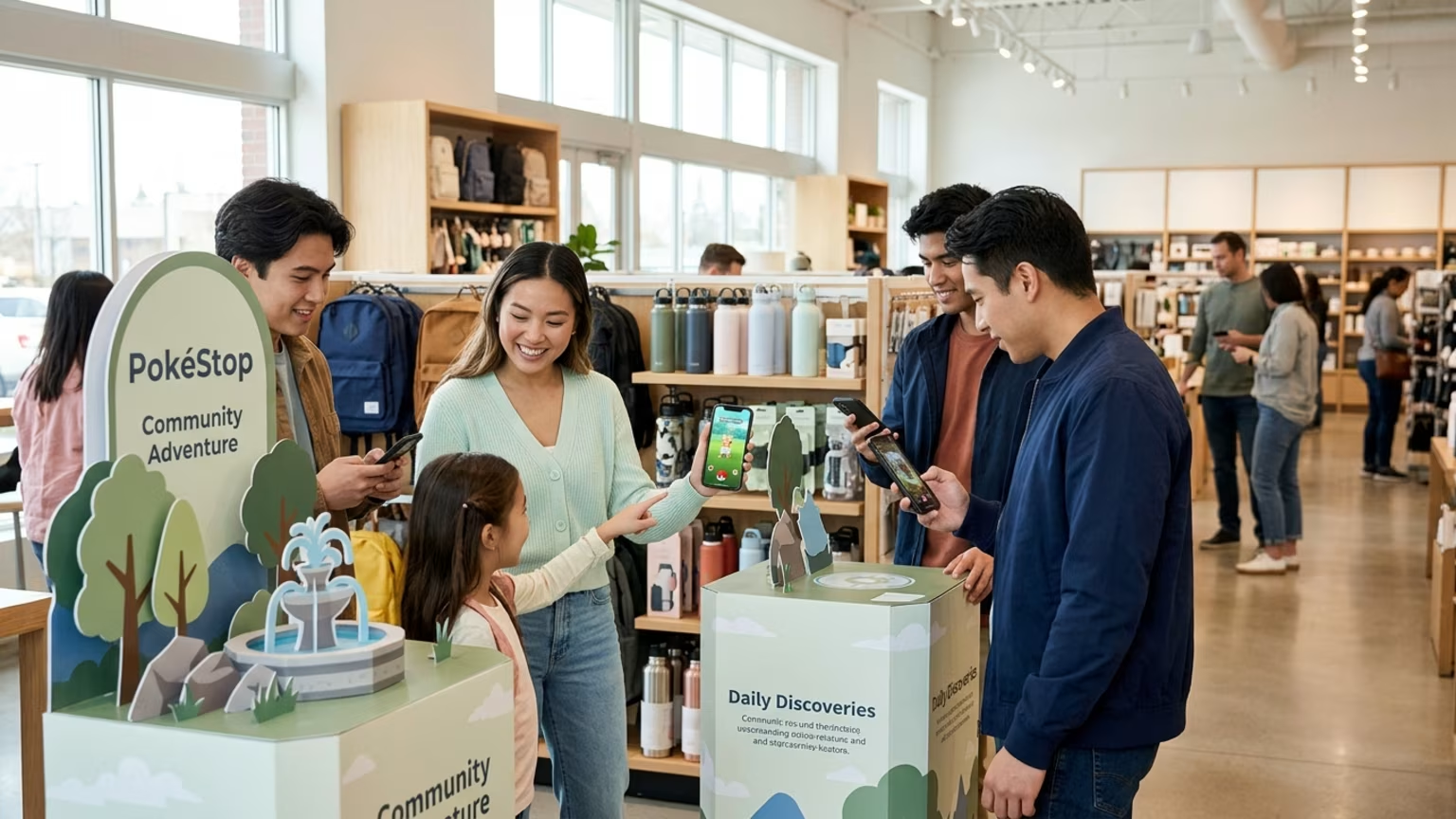
Community environments build local market trust and regional retail support. A brand presence must offer useful value rather than purely extractive promotion. These settings can be highly fragmented across different organizers and municipalities. Success depends on connecting the activation to local customer relationship management initiatives or retailer promotions.
Examples include neighborhood events, public spaces, and local fairs. The brand must earn its presence through useful services, resources, or local partnerships. A purely promotional footprint will fail to resonate with local buyers. These venues are best for regional market entry and building household engagement.
Sports venues offer massive reach and intense emotional context. Sports sponsorships represented $33.5 billion in 2025 and accounted for 66.7% of B2C event sponsorship spending, according to reporting on PQ Media’s data. Capturing commercial attribution from a distracted fan base requires highly strategic planning. The activation must provide a useful service rather than relying on passive logo placements.
A sponsor may receive massive exposure without generating a single meaningful interaction. The emotional connection may attach more strongly to the team than to the brand. To improve performance, the brand should define whether the objective is trial, data capture, or retail sales. Relying on attendance figures alone is a flawed strategy.
Operators must stop treating physical activations as an exercise in vanity. The venue dictates the evidence, and the evidence dictates future funding. Marketing leaders should audit their key performance indicator dashboards this quarter to ensure every environment maps directly to a measurable commercial outcome. True success lies in showing up exactly where your brand can prove its worth.
A framework that connects location, behavior, and evidence is more valuable than a venue list. The objective is not to be everywhere. The goal is to show up where the brand can be relevant, useful, and commercially accountable. Operational excellence is the final variable that separates profitable activations from costly mistakes.
makai creates high impact experiential marketing campaigns and trade show activations that turn fleeting consumer interactions into qualified leads for premium CPG brands. CPG marketers face difficulty measuring real ROI from live events, and our end to end Costco roadshows bring brands to shoppers through live demos, real conversations, and measurable sales impact.

30 Years Experiential & Retail Activation Partner for CPG & Beverage Brands | Multi-Market Demos, Roadshows & Costco/Club Programs That Actually Sell