Robbie Thain
Founder, CEO

Design retail sampling around useful product trials, human conversations, clear purchase steps, CRM handoffs and practical contingency planning.

Surveyed live-event attendees describe trying samples, making purchases and later looking for products in stores. Those are separate actions rather than one automatic journey. Design retail sampling to connect a useful product experience with a helpful conversation and a clear purchase destination.
In OAAA’s 2026 study conducted by The Harris Poll, 38% of surveyed live-event attendees said they tried a product sample. Meanwhile, 40% reported making a purchase. The study also found that 30% later looked for the product in stores and 27% later purchased it.
These are self-reported behaviors across live marketing events. They are not independently tracked transactions or proof that sampling caused a purchase. They should not become a universal conversion benchmark for retail demos.
The scope also matters in Chief Marketer’s coverage of purchases at real-world marketing events: the subject is event attendees, not a controlled evaluation of shelf-side sampling.
At Makai, we specialize in retail demos, product sampling programs and roadshows that bring brands face to face with their audiences. Those programs are designed to drive trial, build consumer relationships and accelerate retail velocity across multiple locations.
Our design recommendation is to keep three things connected: what the shopper experiences, what the conversation helps them understand and where the product can be purchased. A sample count alone does not describe that complete path.
Treat the physical setup and the shopper experience as parts of the same operating brief. Makai’s integrated services span permitting through CRM reporting. Our Storage & Logistics service stores sampling product and event gear, then ships, tracks and coordinates delivery nationwide.
That operational foundation matters because the experience being proposed must match the experience being delivered. A product trial cannot be planned separately from the product and equipment needed to present it.
For planning purposes, useful questions include:
A universal permit list, food-handling procedure or installation clearance is not established here. The project needs its own confirmed operating requirements rather than assumptions borrowed from another activation.
We also design mobile activations and roadshows for 90-day product launch windows. In our view, that defined planning horizon makes the connection between product availability and field execution a useful early discussion.
For a broader production brief, our guide to connecting the creative concept with field execution offers a relevant next planning lens.
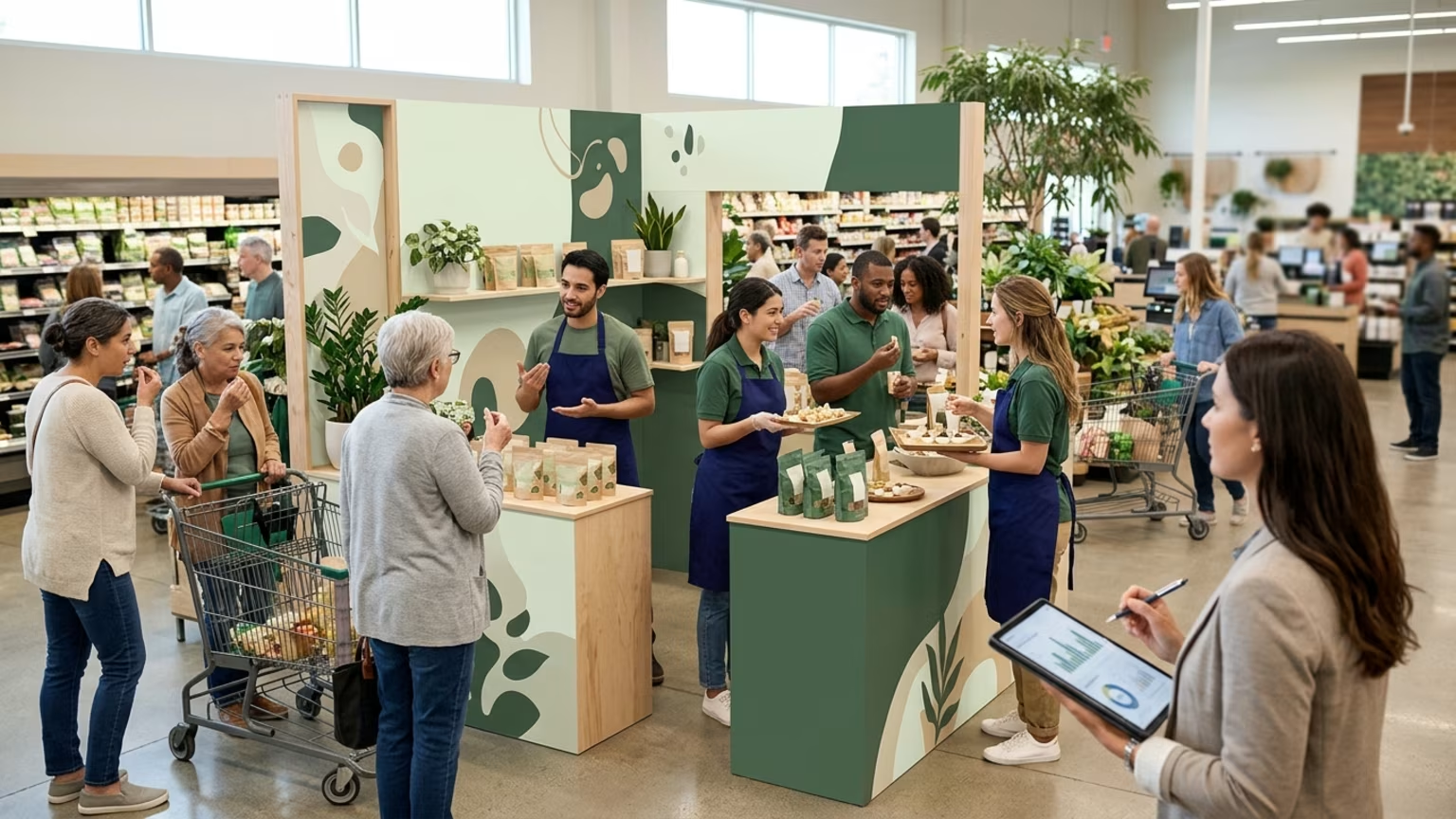
Makai’s Retail Demonstrations service uses trained brand ambassadors to support in-store sales through real conversations and product trials. The human interaction is part of the service, not decoration around the sample.
For us, aloha means approachability backed by operational discipline. The shopper deserves a warm invitation and an interaction that respects their attention. That principle does not require turning every encounter into a long presentation.
Our recommendation is to define the conversation’s purpose before writing its language. What should the shopper understand about the product after the interaction? What question should the ambassador be prepared to address? What next step should remain clear if the shopper wants to buy?
A training brief can express those decisions through a few practical prompts:
These are proposed briefing questions, not a claim about a proprietary Makai training sequence. They keep the focus on the person rather than on delivering a memorized speech.
In our experience, retail demos and roadshows are designed to build consumer relationships as well as encourage trial. Our editorial view is that the interaction should remain useful even when the shopper does not purchase immediately.
Teams refining that interaction can also examine experience design for more useful retail demos. Keep the conversation connected to the actual product rather than adding activity for its own sake.
Start by separating a product trial from a request for continued contact. A shopper accepting a sample is not the same thing as a qualified lead. Likewise, a contact record is not evidence of a purchase.
Makai’s positioning connects face-to-face experiences with measurable sales pipeline. Our integrated services extend through CRM reporting. The design task is therefore to describe what the physical interaction means when it becomes a digital record.
A proposed handoff can be expressed without naming a particular software platform:
This is a proposed design brief, not a documented Makai software workflow. The record fields, consent process and transfer method require project-specific definition.
The same distinction applies to Return on Investment (ROI). Reporting activity is one task. Establishing financial return requires a stated basis for evaluating the outcome against the investment. Our recommendation is to agree on that basis before treating a busy activation as a successful one.
We managed a four-week, multi-market Costco sampling program for Pulmuone’s PlantSpired line. The program delivered more than 65,000 samples and recorded an 18 percent sold-to-sale rate. The useful reporting lesson is that the distribution total and the purchase-related metric describe different aspects of the program.
Neither should be renamed a CRM lead count or presented as proof of incremental sales. Preserve the original meaning of each measure.
For the next measurement discussion, review the connection between physical trial and digital follow-up. Keep the question focused on what each record supports rather than what the dashboard appears to imply.
A contingency brief should describe decisions, not just list things that might go wrong. Our recommendation is to identify who can change the activity and what remains within the agreed scope when the original setup is unavailable.
The field plan should address these questions:
These are contingency planning questions, not claims that replacement staffing or offline capture is automatically included. Any fallback should be described according to the actual project agreement.
Makai’s Storage & Logistics capability includes shipping, tracking and coordinating delivery nationwide. That is a relevant operational input when product or gear is missing. It should not be confused with a guarantee that every disruption has the same recovery path.
For us, the reporting principle is straightforward: document the experience that happened. If capture stopped, do not describe unrecorded conversations as captured leads. If the activity changed, keep that change visible when interpreting the results.
The next useful step is a joint review of the experience brief and the operating brief. Confirm that the proposed product interaction matches what will be available on the floor. Then examine the shopper’s purchase destination and the meaning of each planned reporting measure.
Resolve the largest unknown before expanding the program. That might be permission for the setup, the follow-up handoff or the contingency scope. A clear plan for one activation is a better planning foundation than repeating an unresolved assumption across locations.
A retail sample can become a disconnected giveaway when the product conversation and purchase decision are planned separately. Makai’s Retail Demonstrations service uses trained brand ambassadors to drive in-store sales through real conversations and product trials. Its experiential marketing campaigns connect face-to-face interactions with qualified leads for premium CPG brands.

30 Years Experiential & Retail Activation Partner for CPG & Beverage Brands | Multi-Market Demos, Roadshows & Costco/Club Programs That Actually Sell