Robbie Thain
Founder, CEO

Plan booth sightlines, product interactions, staffing and follow-up while accounting for accessibility, crowding and execution failures.
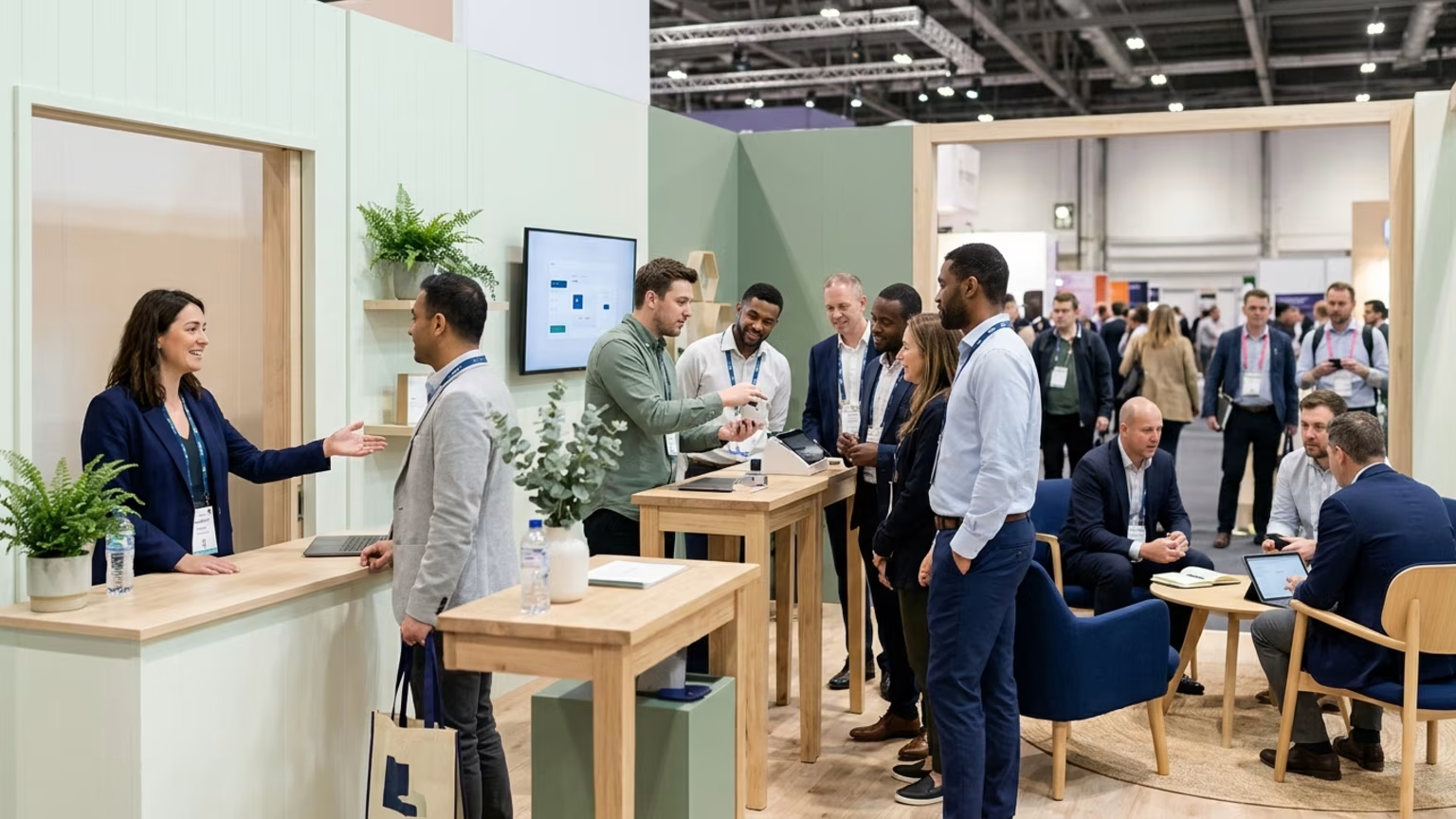
A crowded booth is not proof of a well-designed visitor journey.
Start with the action visitors should take: try a product, watch a demonstration or speak with a knowledgeable representative. Then plan what they need to notice and where that interaction can happen. Review the route with people and equipment included rather than judging an empty rendering.
At Makai, we create hands-on brand moments designed to connect emotion with action. For booth planning, our view is that the product experience and the conversation belong in the same design discussion. The floor plan should give both a clear purpose.
The layout recommendations below are practitioner guidance. They do not establish that a particular floor plan increases traffic, qualified leads or Return on Investment (ROI).
Think in terms of functions rather than a mandatory sequence of zones:
Trade-show design practitioners recommend clear messaging and open sightlines. They also recommend visible demonstrations and conversation areas away from congestion. These suggestions provide useful questions for a layout review rather than a universal blueprint.
Our team designed and managed a 40 by 20 foot trade show environment for Glanbia at Natural Products Expo West 2025. It brought think!, Isopure, Optimum Nutrition, and Amazing Grass into one coordinated space. We handled concept and operations plus staffing and breakdown. More than 14,000 recorded product samples were distributed across the activation stations.
That experience offers a concrete example of coordinating several product interactions within one environment. The sample count documents activity across the stations. It is not a claim about qualified leads or attributed sales.
For another planning perspective, consider how product trials and buyer conversations share a booth without giving every activity the same spatial needs.
Treat the visitor journey and the event requirements as connected planning work. A welcoming entrance still needs to fit the conditions of the specific installation.
In an IAEE interview, an exhibitor-side practitioner recommended giving people an open invitation to enter instead of requiring them to navigate a check-in desk. That is useful entry-design advice. It is not a reason to disregard an event's requirements.
Accessibility belongs in the main route review. Federal accessibility guidelines state that accessible routes are to coincide with or be located in the same area as general circulation paths. Access should therefore be considered alongside ordinary visitor movement rather than treated as a separate design exercise.
An exhibit-planning guide recommends reviewing:
The same guidance recommends accounting for venue-specific requirements. Confirm the conditions relevant to the proposed installation with the organizer and qualified personnel. Neither an open entrance nor this route principle alone establishes that a booth meets every applicable requirement.
This planning approach does not supply a permit list or approval schedule. Those need to be established for the particular event before the layout is treated as ready for execution.
Makai's retail demonstrations use trained brand ambassadors to support in-store sales through real conversations and product trials. Our experiential work connects emotional engagement with action. That human-centered positioning is the starting point for thinking about booth staffing.
For us, aloha means the exchange should feel welcoming and attentive rather than transactional. The visitor is a person with a question, not a unit of foot traffic. A useful interaction leaves room for that question.
For the staffing brief, connect the intended product action to the conversation it should support. Identify where visitors can be welcomed and where a knowledgeable discussion can happen. Place those responsibilities on the same sketch used to review circulation.
The training discussion should stay connected to that intended interaction. A product demonstration and a longer buyer conversation serve different purposes. Our recommendation is to make those purposes clear rather than asking a generic greeting to do all the work.
Thinking through the relationship between staffing roles and booth space can help keep the human exchange central to the plan. The goal is not a complicated performance. It is a relevant invitation followed by a useful conversation.
A physical handshake and a CRM record are different parts of the same business objective. The booth plan describes where an exchange happens. The operating brief still needs to describe what information should leave that exchange and who should receive it.
Makai's integrated scope extends from permitting to CRM reporting. That capability matters because attracting attention and generating measurable sales pipeline are related but separate responsibilities.
For planning purposes, distinguish three handoffs:
These are requirements to resolve, not a software integration protocol. A booth journey map does not specify a capture platform, field structure or transfer method. Those technical decisions need a separate implementation brief.
An IAEE discussion describes digital as complementary to exhibitions and identifies connecting qualified buyers and sellers as fundamental. That is a useful orientation for the handoff: digital reporting should preserve the purpose of the live exchange.
For the next layer of planning, examine how live interactions become usable lead records. Keep the qualification question visible throughout that work rather than making record volume the objective.
A staffing no-show or broken device changes the conditions represented on the plan. The field lead needs to reassess the experience that can operate now rather than continue referring to the original rendering.
The exhibit-planning guidance recommends testing layouts with realistic occupancy. It includes staff and visitors as well as demonstration audiences, devices and queues. Apply that same review to the changed setup.
The floor-level contingency questions are practical:
These questions address the visitor journey. They do not replace a staffing replacement procedure or technical recovery plan. Any alternative capture method also needs its own operating decision rather than being improvised from a layout sketch.
Our recommendation is to protect the useful human exchange rather than preserve every planned feature at any cost. A visible demonstration has little planning value if its audience occupies the intended entrance. Review the product interaction and the gathering space together.
The contingency brief should make clear which decisions concern the floor and which require operational or technical support. That distinction keeps a circulation review from being mistaken for a complete recovery procedure.
The next useful document is an annotated booth plan, not another mood board. Mark the intended product action and the space for questions. Add the expected positions of staff and demonstration audiences alongside likely queues.
Review that plan with the people responsible for event requirements and accessibility. Then resolve the staffing brief and CRM handoff separately. The practical test is whether the plan explains what visitors can do and how a relevant conversation continues beyond the booth.
An interrupted booth journey can separate a product trial from the human exchange that gives it purpose. Makai's retail demonstration work uses trained brand ambassadors for product trials and conversations that support in-store sales across regional or national food and beverage campaigns.

30 Years Experiential & Retail Activation Partner for CPG & Beverage Brands | Multi-Market Demos, Roadshows & Costco/Club Programs That Actually Sell


