Robbie Thain
Founder, CEO

CPG brands are adding market development roles to enforce stricter in-store execution. Learn how to align your physical activations with measurable ROI.
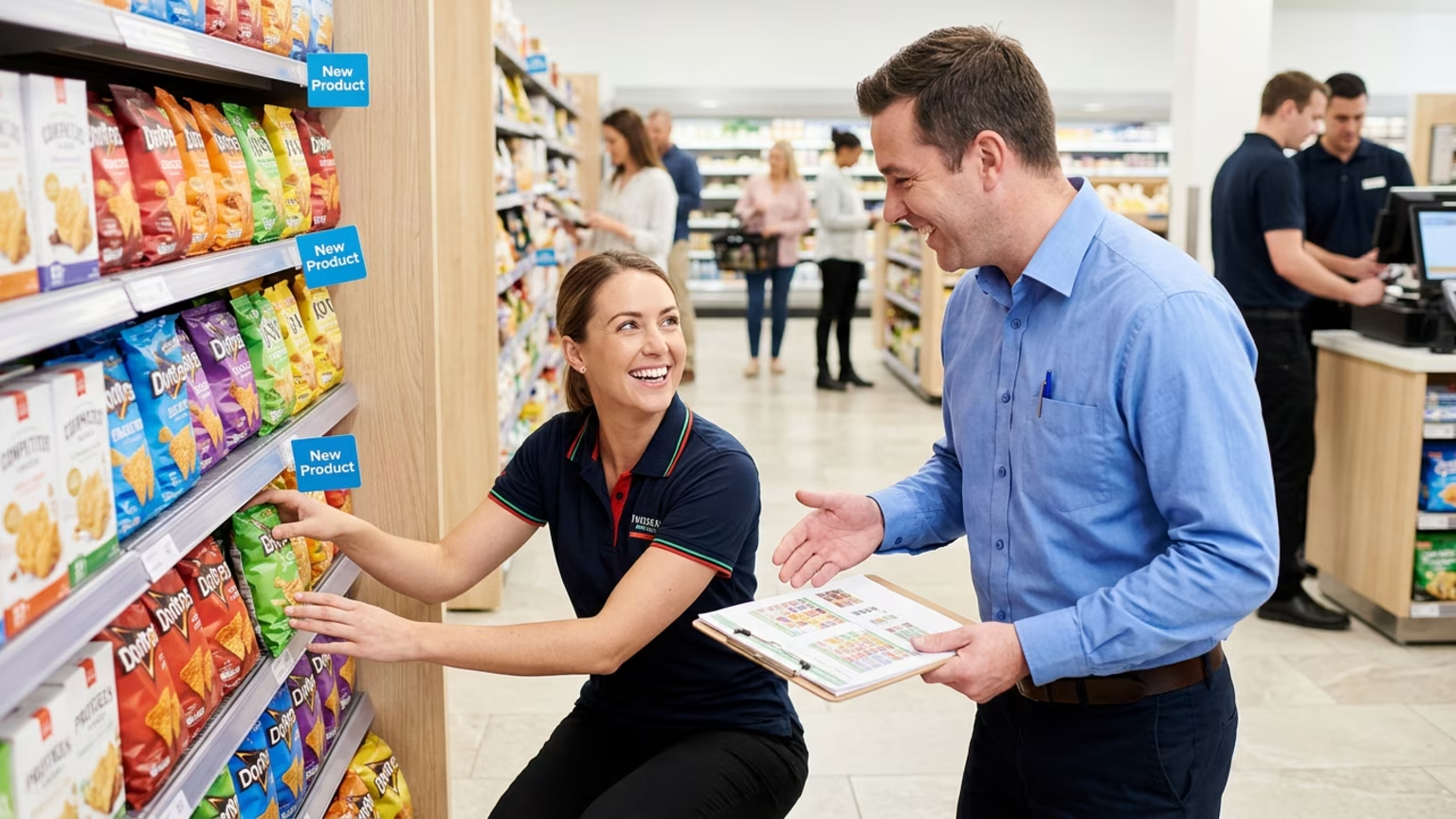
Major consumer packaged goods manufacturers are actively restructuring their field operations with specialized market development roles to enforce stricter execution and drive measurable sales lift. This operational shift transforms chaotic physical activations into highly coordinated commercial events that align directly with retail growth targets.
A pallet of promotional stock sits forgotten in the backroom of a major grocer and the brand ambassador stands near the front registers. Shoppers walk past the generic demo table without stopping to sample the new product. The local field manager spends three hours calling the distributor to track down missing signage rather than selling to the floor manager. This exact scenario bleeds quarterly pipeline dry.
The days of treating physical retail experiences as a casual afterthought are permanently over. Consumer packaged goods companies are now treating in-store execution and shopper engagement as high performance disciplines that require dedicated oversight. Recent data from the industry shows that food retail is evolving into a more experience driven ecosystem. According to an industry analysis of food retail, it is no longer just about placing products on shelves.
It is about bringing the right product to the right consumer at the exact right moment through a carefully controlled physical experience. To meet this operational demand, massive consumer brands are designing explicit market development frameworks. These new internal structures tightly connect digital retail media with live merchandising and physical field operations. For instance, job postings for a Retail Media Specialist at Bob's Red Mill require candidates to coordinate digital and in-store media for a seamless retail experience.
These specialists treat in-aisle visibility, physical merchandising, and brand activations as active performance channels. Trade marketing roles are expanding to require intense collaboration with big box retailers. A Trade Marketing Director at a company like Spectrum Brands is now expected to bring direct experience in retail customer negotiations, Joint Business Planning, and localized promotional execution. Companies that sell physical products rely on these leaders to secure prime shelf space and drive immediate category growth.
By treating the physical store as an integrated media channel, these brands guarantee that every dollar spent on experiential marketing directly influences the weekly sales plan. When retail buyers see an organized approach to store level execution, they are far more likely to authorize expanded product distribution. The modern brand must execute flawlessly on the floor to justify premium pricing against cheap private label alternatives.
Instead of waiting weeks to assess campaign impact, specialized commercial performance teams monitor daily execution signals to resolve localized store issues rapidly. Industry research highlights that companies like Labatt deploy these exact teams to translate performance insights into direct in-market action plans. They operate under a clear mandate to connect broad marketing concepts with actual shelf level reality. Every live interaction must justify its cost by generating clear Return on Investment and measurable unit lift.
These operational teams deliver simple, visual, and highly actionable reports that create a common understanding between sales and marketing leadership. They refuse to accept the standard industry excuse that live event data is too difficult to measure. When a brand scales up its physical presence, the leadership team expects complete visibility into the status of every single product sampling station. This rigorous approach effectively weeds out underperforming field agencies and rewards reliable partners who can execute complex logistics.
Hybrid field roles are becoming much more prominent in the food and beverage sectors to support this strategy. Recent job postings highlight positions like a Rum Ambassador for a major spirits brand. This specific role explicitly combines outside sales, physical retail execution, and ongoing brand development. The primary focus involves expanding physical brand visibility and actively growing retail accounts on a local level.
These positions prove that the modern marketer must be equally comfortable analyzing digital conversion metrics and negotiating display placements with a regional store manager. Connecting the digital planning phase with the physical execution phase requires incredible operational discipline. Brands that master this connection routinely outperform competitors who still treat event marketing as a separate silo.
Digital signals now serve as the immediate blueprint for localized retail activations. Forward thinking brands refuse to view online traffic and physical foot traffic as separate battlegrounds. E-commerce activity acts as a direct intelligence feed to jumpstart physical retail strategy. When a brand identifies a sudden surge in online search volume within a specific zip code, the market development team can instantly deploy a mobile sampling tour to that exact neighborhood.
This rapid response turns temporary digital interest into permanent physical shelf velocity. Accelerator programs and venture partners are actively pushing new brands toward this integrated model. Platforms like the ScaleUp Accelerator explicitly target emerging consumer packaged goods companies that sell physical products. These programs recognize that long term viability requires a differentiated physical shopper experience.
They train brand founders to use localized digital data to negotiate better endcap displays and more favorable promotional terms with regional grocery buyers. The physical activation simply becomes the final conversion point for a digitally primed consumer. Research consistently shows that highly engaged shoppers often complete CPG purchases within twenty four hours of identifying a need. You must put your physical product directly in their hands during that critical window.
Deploying a successful retail activation requires the precision of a massive supply chain operator. Brands that master experiential marketing rely on disciplined protocols to maintain control over nationwide sampling operations. You must build your internal systems to mirror the rigor of these new commercial performance roles. Here is the operational sequence to implement this strategy on the live event floor.
Companies with complex national footprints often partner with external experts to maintain consistency. As an example, General Mills partners with field marketing agencies to streamline demo execution and completely eliminate the headache of staffing fragmentation. This approach allows internal market development leads to focus on strategy rather than tracking down missing permits or replacing sick staff members. If you struggle to operationalize these advanced execution steps internally, it might be time to book a strategy call with our seasoned team.
High volume environments demand even stricter operational protocols. Planning a live product demonstration for massive warehouse clubs requires specialized expertise. Managing end to end Costco roadshows brings an entirely new level of logistical complexity to your brand. Your field managers must coordinate specialized storage, complex permit requirements, and rigorous inventory tracking to satisfy the warehouse management team.
The same operational standards apply to national expos. Winning a crowded convention floor requires far more than handing out free swag. Your field team must plan and manage trade show spaces that attract genuine attention and start qualified sales conversations. Your event marketing strategy must treat every booth visitor as a direct pipeline opportunity.
The success of your market development strategy hinges entirely on your ability to capture clean operational data. You can no longer rely on estimated foot traffic or vague brand awareness surveys to satisfy your senior leadership team. An Adweek Commerce All-Stars feature highlights that modern commerce leaders are focused on bringing excitement back to shopping and producing highly measurable results. You must separate your event data into clear lead indicators and concrete lag indicators.
Lead metrics give you real time visibility into the health of your live event. Track your percentage of planogram compliance to verify that your physical staging matches the negotiated retail contract. Monitor the exact number of incremental displays secured by your field team in each specific region. Finally, measure your average issue resolution time across all active markets. Top performing brands aim to resolve store level execution gaps in less than a single day.
Lag metrics tell the definitive story of your financial performance after the physical event concludes. Track the direct unit lift during the activation window compared to your baseline historical sales volume. Monitor the demo to purchase conversion rate to evaluate the raw effectiveness of your brand ambassadors on the floor. Finally, measure your overall financial return to prove that your physical operations are actually generating profitable revenue. Understanding how to measure experiential marketing ROI without guesswork is the only way to protect your operational budgets.
The theory of market development sounds great in a corporate boardroom, but it only matters if it works in a real grocery aisle. Executing a highly localized product launch requires both logistical dominance and deeply engaging consumer interaction. We recently helped a major brand launch a new product line by combining strict merchandising standards with interactive product sampling.
A Director of Brand Strategy in the CPG snack division shared: 'The Makai team turned our product launch into a sensory event that shoppers still talk about. From creative storytelling to flawless in-store execution, they made snack time unforgettable. We couldn't have asked for a stronger partner.' Our team created an in-store experience that left a lasting impression on consumers and became a memorable brand moment.
This specific activation utilized regional sales data to identify the absolute highest performing store locations. We deployed rigorously trained staff to manage the physical footprint, build out custom display shippers, and report inventory levels in real time. By integrating our field reporting with the broader retail media strategy, the brand saw a massive spike in weekly sell through volume. The execution proved that human-centered in-store experiences can drive immediate revenue when managed with operator grade precision.
When your brand bridges the gap between digital data and live physical execution, you stop running vanity campaigns and start building a measurable pipeline. Align your field operations with strict commercial discipline to win the aisle, satisfy your retailers, and convert modern shoppers.

30 Years Experiential & Retail Activation Partner for CPG & Beverage Brands | Multi-Market Demos, Roadshows & Costco/Club Programs That Actually Sell


