Robbie Thain
Founder, CEO

Live event footprints often waste contracted rights on passive foot traffic instead of disciplined engagement, audience segmentation.
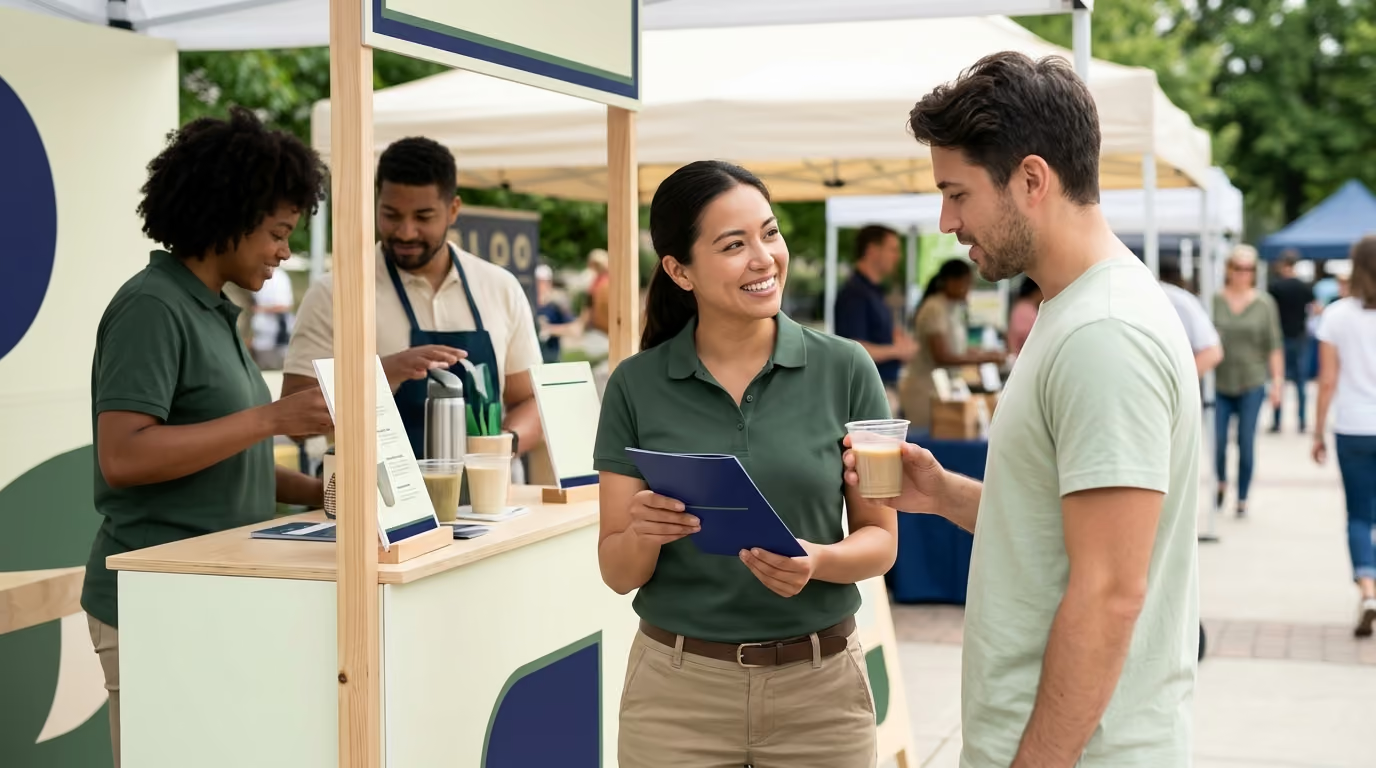
How to turn expensive sponsorship rights into qualified sales pipeline and retail sell-through is a question brand leaders search for every season. This playbook provides the definitive operational blueprint to bridge high-priced intellectual property rights and live field marketing execution to generate verified commercial outcomes.
Sponsorship rights grant legal access to an audience, but structured field marketing converts that passive attention into measurable product trial, customer acquisition, and retail volume. By treating rights packages as raw operational assets rather than static media placements, brands build disciplined activation systems that prove Return on Investment (ROI) across every live touchpoint.
Walk through the footprint of a major stadium concourse, festival ground, or trade show floor on any Saturday afternoon. You will witness millions of dollars in contracted rights dissolving into operational noise. Premium floor space sits cluttered with generic pop-up tents, spinning prize wheels, and disengaged temporary workers staring at their phones. Attendees swarm the counter for free branded trinkets, only to dump them into the nearest trash bin outside the gate.
Behind the counter, the field staff lacks basic product knowledge and brand training. They hand out samples to anyone with an outstretched hand, regardless of whether that person matches the target buyer profile. There is no crowd management, no structured consumer journey, and no clear script to qualify interest. Long queues block walkways, frustrating venue security and turning high-value prospects away before they ever reach the product counter.
Meanwhile, executive suites remain disconnected from the brand story playing out on the ground. Sales reps use premium hospitality passes to entertain casual acquaintances without structured meeting agendas or relationship tracking protocols. Nearby retail partners receive no advance inventory support, leaving local store shelves unstocked while event crowds search for the product they just tasted.
At the conclusion of the event weekend, marketing leadership receives a hollow recap deck filled with inflated vanity numbers. The report highlights gross foot traffic, estimated impressions, and total units distributed, yet cannot identify a single verified customer lead. The commercial pipeline remains flat, retail velocity shows zero measurable lift, and finance questions why seven figures went toward passive logo exposure.
Moving past static brand exposure requires an operational shift in how teams view sponsorship portfolios. According to global research by the World Federation of Advertisers, brands commit roughly 11% of their total marketing budgets to sponsorships and activations. Yet nearly three-quarters of practitioners report severe difficulty in measuring and proving direct commercial return.
Rights packages only establish the legal boundary of what a sponsor may execute. Real commercial value emerges when field operations convert those contractual permissions into controlled human behaviors. The foundational operating principle remains direct: rights create permission, activation creates relevance, field execution creates behavior, and disciplined measurement proves value.
To build a reliable activation system, brand operators organize their programs around a disciplined four-part architecture:
Every activation begins by auditing contractual rights to identify commercial levers beyond standard logo placement. Teams map category exclusivity boundaries, physical footprint allowances, access to talent, sampling guidelines, retail designations, and digital media inventory. Identifying strict contractual limitations early prevents expensive operational rework during live production.
A brand must establish a clear reason to occupy physical space within the sponsored property. The most effective activations solve an immediate problem for the attendee. Functional utility always outperforms promotional intrusion across live event environments. When your presence makes the live event easier, more comfortable, or more engaging, consumers reward the brand with sustained attention.
Field footprints must direct participants through a deliberate physical flow. Every square foot of space should guide an attendee from initial visual attraction toward active product interaction, qualified data capture, and immediate retail conversion. Random foot traffic must be structured into measurable participant throughput.
Attribution protocols must be locked before any physical asset enters the event floor. Operating teams align field data collection with existing corporate databases, retail scanner systems, and digital sales pipelines. This structure ensures every interaction connects directly to customer acquisition cost and lifetime value metrics.
Treating event attendees as a single homogeneous crowd guarantees wasted field marketing spend. A stadium holding sixty thousand people contains distinct consumer cohorts, each requiring a tailored engagement model and operational throughput speed. Effective field programs divide the property audience into precise operational segments before designing the physical space.
These consumers attend the event for deep, focused immersion in the subject matter. They want technical product demonstrations, ingredient transparency, and detailed performance conversations. Field teams staffing these touchpoints need advanced product training rather than basic promotional scripts.
This cohort values convenience, entertainment, and social connection over technical product details. They respond to rapid trial mechanisms, clear sensory benefits, and frictionless hospitality. Their physical journey through the activation must be fast, energetic, and visually distinctive.
Sponsorship reach extends well beyond the perimeter fence into surrounding retail corridors, grocery stores, and convenience chains. Shoppers within a five-mile radius represent immediate commercial targets who can be activated through localized retail promotions and co-branded point-of-sale displays.
VIP pass holders, corporate buyers, and retail category managers require white-glove hospitality and structured executive conversations. Their interactions must be managed by seasoned account leaders inside quiet, curated spaces rather than chaotic public concourses.
Audience planning must also respect changing consumer privacy behaviors. Research from Event Marketer indicates that 84% of older consumers refuse to share personal contact information with on-site event staff due to privacy concerns, even when offered merchandise incentives. Field teams must therefore provide clear, transparent value in exchange for consumer data, making digital registration an optional upgrade rather than an aggressive barrier to product trial.
Distributing physical product samples remains one of the most reliable methods to accelerate brand adoption, especially across consumer packaged goods, food, and beverage categories. However, handing out free products without operational control simply inflates costs without driving retail velocity. High-performance field marketing programs treat sampling as a controlled laboratory for customer conversion.
Our teams focus on designing high-throughput sampling footprints that maintain rigorous food safety and inventory controls while maximizing qualitative conversations. We blend physical and digital experiences by integrating QR codes, mobile technology, and real-world activations into a cohesive layer across retail, event, and tour experiences. This integrated approach ensures that every physical interaction creates an immediate digital pathway toward long-term customer retention.
Executing high-volume sampling requires disciplined adherence to core operational standards:
Temperature-sensitive products require certified commercial refrigeration, dedicated backup power generators, and strict digital temperature logging. Field managers must establish strict restocking schedules to prevent inventory bottlenecks during peak event foot traffic.
Modern consumer safety demands visible, unmistakable ingredient and allergen disclosures at every sampling counter. Field personnel must pass food handling certifications and complete intensive briefings on potential cross-contamination risks.
A brand ambassador has roughly fifteen seconds to deliver the core product proposition while serving a sample. Scripts must be conversational, memorable, and focused on a single primary differentiator, such as clean ingredients, unique flavor, or functional performance.
Every distributed sample must link directly to an immediate commercial action. Brand ambassadors pair trial distribution with geo-targeted digital coupons, retail locator links, or event-exclusive bundle promotions that route consumers to nearby physical stores.
Experiential marketing delivers value when consumers actively participate in a brand narrative rather than passively observing signage. Designing successful participatory activations requires balancing physical throughput volume with emotional resonance. If an interactive mechanic takes three minutes per person, a single station can only process twenty people per hour, severely limiting total footprint reach.
To maximize throughput without sacrificing depth, field architects use scalable participation mechanics:
Design athletic or skill-based challenges that take under thirty seconds to complete. Use automated digital leaderboards to create natural crowd gathering, clear spectator viewing angles, and healthy competition without physical bottlenecks.
Allow consumers to physically interact with product components, raw ingredients, or industrial materials. For food and beverage activations, blind taste tests and guided flavor comparisons prove product superiority faster than marketing copy.
Provide branded physical backdrops or interactive stages where attendees capture their own social media assets. Ensure lighting, camera angles, and branding elements are optimized for immediate mobile capture and sharing.
Consumers will willingly complete product registrations or brand surveys when the incentive offers authentic utility. Fast-pass access, premium seating upgrades, or exclusive brand collaborations generate significantly higher opt-in rates than generic promotional merchandise.
According to EventTrack research, 61% of consumers report being substantially more inclined to purchase a product after participating in an engaging live brand activation. Structuring your on-site mechanics around active consumer participation directly influences subsequent retail purchasing habits.
Corporate hospitality is frequently mismanaged as an unstructured entertainment line item. High-performing commercial organizations manage premium ticket rights, luxury suites, and curated VIP lounges as direct sales enablement environments designed to accelerate complex deals.
To turn hospitality packages into measurable revenue pipeline, marketing leaders should deploy a structured relationship management system across four phases:
Guest lists should not be filled on a first-come, first-served basis by internal staff. Commercial leaders must assign hospitality access to targeted accounts currently stalled in mid-pipeline stages or key enterprise clients approaching contract renewal.
Every internal host receives an operational dossier covering their assigned guests, current commercial opportunities, key account pain points, and strategic conversational objectives. Hosts operate with clear relationship milestones rather than approaching the event as a passive social gathering.
Elevate hospitality beyond open bars and stadium food by offering exclusive property access. Coordinated meet-and-greets with brand-aligned talent, private facility tours, and intimate executive briefings create memorable moments that strengthen commercial relationships.
Within twenty-four hours of event completion, internal hosts must log attendance records, conversation notes, and identified deal risks directly into enterprise customer relationship management platforms to trigger automated sales workflows.
A sponsorship activation isolated from physical retail distribution leaves substantial commercial value on the table. To maximize Return on Investment, field teams must connect on-site event excitement directly to the retail shelf where recurring purchasing occurs.
Coordinate event marketing calendars with local grocery, convenience, and big-box store managers months in advance. Secure premium endcap displays, floor graphics, and co-branded point-of-sale assets in high-volume retail locations surrounding the event venue.
Deploy localized mobile media campaigns around the stadium or venue perimeter during the activation window. Direct nearby foot traffic to partner retail outlets using digital incentives, limited-time bundle promotions, and mobile-enabled store locators.
Leverage intellectual property rights to produce limited-edition, event-themed packaging for key regional retail accounts. Exclusive retail packaging provides retail buyers with a compelling incentive to expand shelf space and approve off-shelf promotional displays.
To prove true incremental sales volume, compare sales velocity in retail stores within the activated event market against matched control stores in demographically identical markets that received no event support. This eliminates baseline noise and isolates the true commercial impact of your field program.
Live field activations provide high-value staging grounds for producing commercial content assets. Instead of treating photography and videography as an operational afterthought, field teams should deploy dedicated production crews operating against structured, pre-approved shot lists.
Develop an asset capture plan that details specific requirements for widescreen hero assets, vertical short-form social videos, customer testimonial soundbites, and macro product photography. Capture real-world consumer reactions and unscripted taste tests to validate brand claims across paid media channels.
Ensure on-site production teams execute airtight digital talent releases and crowd notice signage. Establish rapid-review legal workflows to review, approve, and deploy real-time content across digital channels while the live event is actively trending.
Transform high-energy activation footage into compelling commercial pitch materials for retail sales teams. Showing retail buyers documented proof of massive consumer lines, active sampling engagement, and local brand enthusiasm helps secure expanded retail distribution for upcoming product lines.
Flawless live execution requires rigorous operational discipline and clear accountability. The following step-by-step framework outlines the operational requirements across every stage of activation deployment.
Proving the business value of a sponsorship activation requires moving past disconnected vanity metrics. Research from Nielsen demonstrates that holistic sponsorship evaluations must measure across three distinct pillars: reach, brand equity, and behavior change. Nielsen's benchmark analysis across one hundred sponsorships revealed an average 10% lift in purchase intent among exposed fan bases, with every single-point gain in brand consideration driving a corresponding 1% increase in long-term sales velocity.
To deliver transparent reporting to executive stakeholders, field marketing programs organize metrics across four structured tiers:
Delivery metrics track baseline operational execution to confirm the field program ran as contracted:
Interaction metrics evaluate the depth and quality of audience engagement within the physical space:
Response metrics quantify shifts in consumer perception and purchase consideration generated by the live experience:
Commercial metrics prove the ultimate financial contribution of the sponsorship and field marketing investment:
To evaluate portfolio performance across multiple event properties, commercial leaders apply the standardized Return on Sponsorship Investment formulation:
$$\text{ROSI} = \frac{\text{Monetary Value of Media, Rights and Attributable Net Margin} \times \text{Strategic Brand Performance Factor}}{\text{Rights Acquisition Fee} + \text{Total Operational Activation Costs}}$$
A resulting score above 1.0 indicates that the total economic value generated directly exceeds the combined rights acquisition and operational activation expenditures.
To understand how this integrated architecture functions in practice, examine the operational execution of a high-growth functional beverage brand entering competitive regional markets. The brand secured official presenting sponsorship rights for a premier multi-city endurance marathon series. Rather than relying on passive finish-line banners, marketing leadership deployed a fully integrated field activation and retail conversion strategy.
The physical footprint was positioned directly at the official runner recovery exit, creating immediate functional utility. The brand provided chilled recovery samples, guided muscle mobility stations staffed by certified trainers, and digital photo displays featuring real-time race finishing times.
While runners engaged with the recovery stations, brand ambassadors conducted structured, thirty-second flavor demonstrations. They explained the functional electrolyte profile and delivered a mobile-scanned digital coupon redeemable at local grocery stores within two miles of the venue.
Simultaneously, the brand executed a regional retail takeover across one hundred eighty target grocery locations. Field teams secured secondary endcap displays featuring co-branded marathon visual assets. They coordinated with store managers to ensure full shelf inventory and executed Saturday product sampling inside high-traffic retail accounts. Corporate sales leaders utilized the property's hospitality access to host category buyers from major regional grocery chains, showcasing the massive consumer lines and enthusiastic trial on the ground.
The operational results proved the power of an outcome-driven activation model:
You can begin transitioning your sponsorship portfolio from passive logo placement into an active commercial driver this week. Review this prioritized operational checklist to align your team:
For deeper operational frameworks on designing scalable brand programs, review our comprehensive analysis in A Better Sponsorship Activation Framework for CPG Brands. To refine your on-site lead capture and qualification workflows, consult The Field Marketing Lead Generation and Follow-Up Playbook. You can also explore our methodology for proving field activation returns in 5 Metrics to Prove Field Activation ROI Beyond Vanity Metrics, or examine our full suite of turnkey field execution capabilities on our Brand Activation Services page.

30 Years Experiential & Retail Activation Partner for CPG & Beverage Brands | Multi-Market Demos, Roadshows & Costco/Club Programs That Actually Sell