Robbie Thain
Founder, CEO

Learn how to transform live sponsorships from passive awareness campaigns into measurable retail pipeline through strategic engagement marketing and execution.
Sponsorships get judged by logo visibility when they should be judged by commercial outcomes. Brands routinely spend millions on stadium signage and mistake passive exposure for genuine consumer action. The actual measure of a live partnership is how reliably it turns borrowed attention into measurable retail sales.
Consumer packaged goods companies face unique challenges when activating large live events. A technology firm can capture a digital lead form on a tablet and pass it to a sales team. A food or beverage brand must navigate a much more complex path to final purchase. The consumer must taste the product on site and then remember to buy it later at a local retailer.
This structural gap often leads marketing teams to settle for reporting on vanity metrics. They count the number of badges scanned or photos taken instead of tracking retail velocity. Breaking this habit requires a fundamental shift in how field programs are planned and executed. It requires a model that prioritizes verified product trial and retailer connectivity.
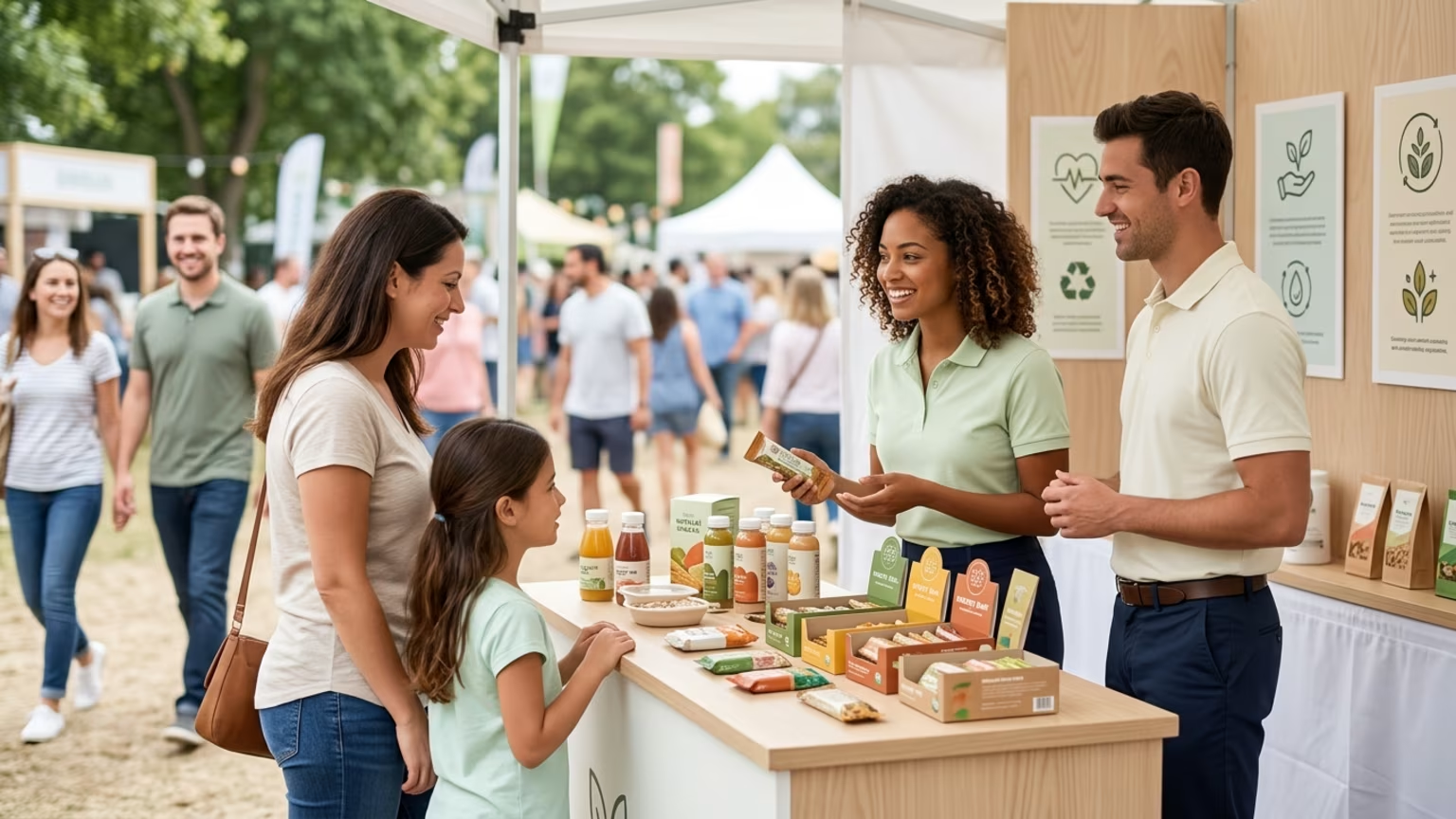
Sponsorship activation is the operational discipline of converting rented audience attention into verifiable retail pipeline. It removes the reliance on passive awareness metrics and replaces it with a structured path to purchase. We specialize in creating retail demos, product sampling programs, and roadshows that bring brands face to face with their audiences. Each program is designed to drive trial, build consumer relationships, and accelerate retail velocity across multiple locations.
Many programs fail because they confuse event presence with active consumer engagement. Renting a footprint at a major festival only guarantees that people will walk past your booth. Active engagement requires an operational mechanism that stops foot traffic and initiates a product trial. The definition of a successful activation must always include a measurable change in consumer behavior.
This definition is particularly vital for brands selling physical items on grocery store shelves. A successful live program must actively pull products through the complex distribution network. It should generate quantifiable momentum that regional retail buyers can see and verify in their own data. If the activation does not eventually trigger a restock order, it has not generated a true return.
Marketing leaders must therefore evaluate partnerships based on their ability to facilitate this trial process. They must ask whether the venue allows for proper sampling, safe food handling, and clear brand messaging. Evaluating these constraints early ensures that the field team can execute their primary mission effectively. Industry research from Nielsen reports that 81% of respondents trusted brand sponsorships at sporting events. The operational challenge is converting that initial goodwill into a documented retail transaction before the consumer leaves.
Slapping a logo onto a racing car does not automatically generate a Return on Investment (ROI) for a beverage company. A physical event must firmly connect the rented property with the live experience and final consumer purchase. Brand Activation Maximizer describes its Sysco NASCAR program as a model for this exact operational linkage. The program was designed to connect vendors, foodservice operators, retailers, and consumers around promotional windows and traceable case sales rather than awareness alone.
This specific case highlights the vast difference between an integrated sales campaign and a simple marketing trip. The Sysco NASCAR model prioritized measurable vendor growth and specific case sales over generalized brand sentiment. When you focus on the operational reality of moving boxes, the entire activation strategy changes immediately. You stop planning around optimal photo angles and start planning around field operations frameworks that support high volume sampling.
The physical world of consumer goods demands rigid logistical discipline to maintain product integrity. If a brand plans to sample cold beverages at a summer festival, supply chain routing is critical. A failure in refrigerated transport or local warehousing instantly ruins the consumer experience and wastes the partnership fee. These operational details matter far more than the size of the logo printed on the main stage.
Building a localized retail connection requires close coordination with regional distributors and store managers. Field teams must verify that local grocers have adequate inventory before the event traffic begins to surge. Sending thousands of newly convinced consumers to empty retail shelves destroys the momentum built during the activation. The field operation must be perfectly synchronized with the local retail supply chain.
Executing a sponsorship that moves retail inventory requires a specific combination of strategic and operational elements. The activation engine relies on four distinct pillars to capture and convert consumer attention.
Measurement planning must begin long before the activation floor opens to the public. AnyRoad recommends establishing pre-activation baselines for measures such as NPS, brand affinity, and purchase intent. Setting clear targets allows marketing leaders to track real movement in consumer perception and behavior afterward. A failure to establish these early benchmarks leaves teams guessing about their actual commercial impact.
Without a baseline, post event reporting becomes an exercise in finding numbers that look favorable. Establishing a pre event standard forces the team to define what success looks like in concrete terms. It also provides a clear mandate for the ambassadors working on the event floor. They understand that their goal is shifting specific metrics rather than just handing out free items.
A large crowd does not equal a conversion unless the interaction is meaningful and contextually relevant. Consumers need to taste the beverage, test the snack, or interact with the packaging in real time. The available planning guidance recommends setting objectives and KPIs before execution and capturing data on the ground. Once the interaction occurs, teams must transition smoothly into measuring and nurturing leads afterward.
This disciplined approach ensures you capture qualified leads for your pipeline rather than anonymous crowds. Brand ambassadors must be trained to guide conversations toward specific product benefits and usage occasions. The quality of the human interaction directly influences the likelihood of a future retail purchase. Precision on the event floor separates high performing campaigns from chaotic sampling programs.
A strong brand memory fades quickly if the consumer cannot immediately buy the product they just tried. The most effective brand activations link the physical trial directly to a highly visible retail pathway. This could mean distributing store locators, scanning digital coupons, or pointing consumers to a specific partner retailer. By making the next purchase step obvious, brands close the gap between live engagement and commercial reality.
Many consumer campaigns miss this crucial step and rely purely on the shopper remembering the brand later. Operational leaders know that friction is the enemy of conversion in any retail environment. If a consumer has to search multiple stores to find the item, they will simply buy a competitor. The activation must provide a frictionless bridge from the sampling booth to the checkout lane.
Modern field programs cannot rely entirely on the physical attendees present at the live venue. Nielsen research reports that 40.7% of global fans stream live sport digitally. Furthermore, that same research notes that 43.59% of younger sports fans watch related non-live content. This means the physical activation must be designed to generate content that travels across digital platforms.
Brands must ensure their physical footprints look compelling on camera to capture this extended digital audience. However, this digital extension should never compromise the speed or quality of the physical product trial. The primary goal remains getting the physical product into the hands of the live attendees. Digital reach is a powerful secondary benefit that amplifies the core retail activation strategy.
Teams must adopt rigorous methods to track the true commercial return of their major event investments. Pro Mobile Marketing explicitly advises teams to set one primary business objective and two or three supporting KPIs. This focus aligns closely with the accepted planning guidance for highly structured brand activations. It forces teams to ignore purely vanity metrics and prioritize verified sales velocity or trial volume.
Looking back at recent global sporting events provides a clear view of how targeted execution drives volume. Marketing Dive reported that the World Cup activation contributed to Coca-Cola trademark volume growth of 5% in the second quarter of 2026. This data point, citing an earnings call, demonstrates how major properties can support broader commercial momentum. While sponsorships operate alongside other marketing variables, their contribution to quarterly volume is a critical benchmark.
During that same tournament, aggressive field execution generated massive product trial numbers at the actual events. Marketing Dive reported that Coca-Cola and Powerade achieved average incidence of more than 80% at tournament venues in host cities. The source noted that this achievement was equivalent to approximately one drink per attendee at those specific venues. Capturing that level of venue penetration requires an absolute commitment to maximizing sponsorship returns through logistical dominance.
Measuring shifts in consumer mindset is another critical component of the post event analysis process. Nielsen analysis of 100 sponsorships found an average 10% purchase-intent lift among exposed fan bases. Tracking this specific metric helps brands understand whether the physical experience actually convinced consumers to consider buying. While purchase intent is not identical to final sales, it is a highly reliable leading indicator.
Teams must be careful to properly attribute these perception shifts to the specific field activation. A rigorous measurement program should utilize comparison markets to isolate the impact of the live event. This prevents teams from taking credit for sales that were actually driven by national television campaigns or seasonal trends. True measurement requires a disciplined approach to isolating variables and protecting the integrity of the data.
Sponsorship activation only fulfills its promise when it operates as a fully integrated retail sales engine. Real commercial value emerges when brands stop renting awareness and start engineering predictable paths to retail purchase. A beautifully designed venue space means very little if it fails to move inventory at the local grocery store.
Every rented square foot is an opportunity to prove a product works and earn a customer. When the noise of the event fades, the only truth left is the volume of new transactions. True operational excellence turns fleeting venue traffic into a permanent change in consumer buying behavior.
Judging a live sponsorship by audience size instead of actual commercial conversion creates massive operational waste, which is where Makai takes ownership of your event execution. We solve the problem of scattered attention and poor booth flow by delivering Engagement Marketing programs that turn passive audiences into active participants. We design live and digital experiences that invite people to try, share, and act.

30 Years Experiential & Retail Activation Partner for CPG & Beverage Brands | Multi-Market Demos, Roadshows & Costco/Club Programs That Actually Sell