Robbie Thain
Founder, CEO

College sports experiential marketing requires navigating complex institutional rights, managing multi-tier venue permissions.
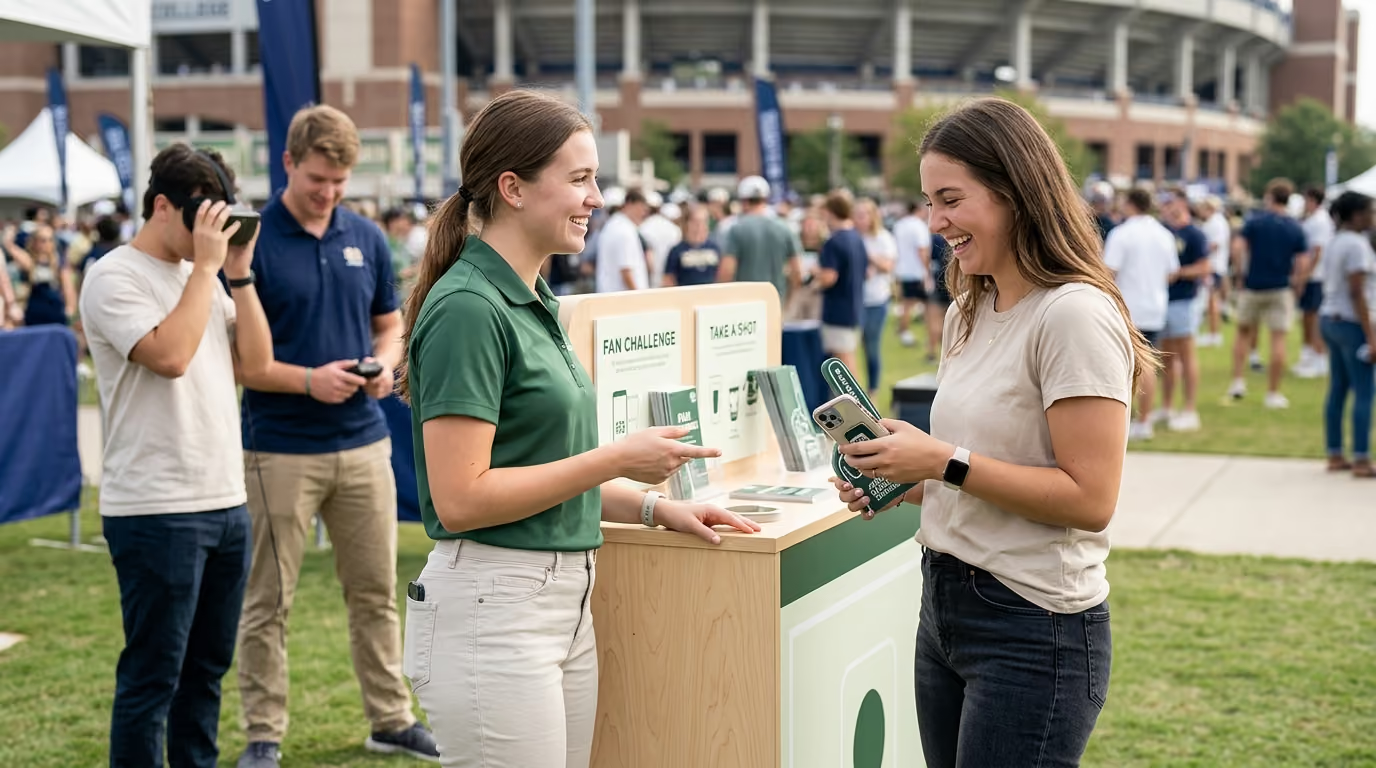
College sports experiential marketing turns the intense passion of campus athletics into verified consumer trial, brand affinity, and retail pipeline. This guide outlines the operational frameworks required to manage multi-tiered rights, design high-converting on-site activations, deploy student ambassadors, and measure commercial impact with precision.
Six hours before kickoff, forty thousand alumni, students, and local fans pack into the perimeter parking lots surrounding a major university stadium. Pop-up tents overlap in every direction, generators roar over brass bands, and thousands of attendees move in unpredictable waves toward stadium gates. A consumer goods brand sets up a custom sampling footprint in what was supposed to be a prime pedestrian corridor. Within thirty minutes, campus parking marshals redirect foot traffic toward a different gate, cutting off visitor flow. Meanwhile, a local beverage distributor sets up an unpermitted pop-up twenty yards away, handing out cold cans and confusing brand visibility.
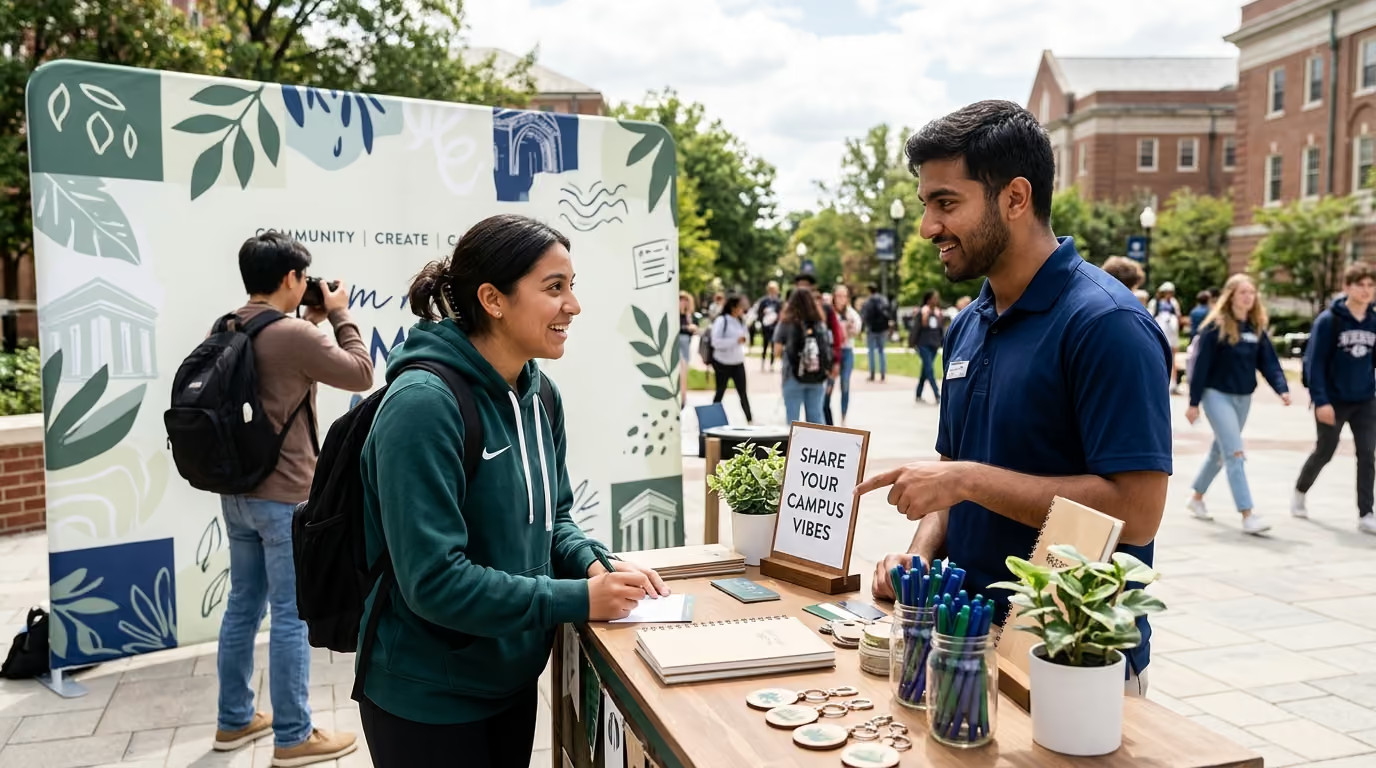
Across campus on the central student quad, an untrained student brand ambassador team struggles to assemble a canopy in high winds while trying to decipher university sound ordinances. The Wi-Fi drops completely as mobile cell towers saturate under fifty thousand simultaneous connections, crippling the brand's digital survey app. Security staff approach to inspect municipal vendor permits that were routed to the athletic department rather than the university facilities office. By halftime, thousands of samples have been distributed, but zero verified consumer opt-ins or clear sales conversions have been recorded.
This chaotic operational environment is typical for brands that treat collegiate sports like standard consumer events. Live sports properties on campus involve complex political, legal, and operational friction points. Winning on gameday requires rigorous logistical planning, disciplined staffing, and clear strategic alignment across multiple institutional entities.
Navigating the legal perimeters of college athletics requires understanding the distinction between official sponsorship rights, lawful proximity marketing, and unlawful association. College athletics is not a single unified commercial property. Instead, it is a fragmented ecosystem comprising national governing bodies, athletic conferences, individual university administrations, multimedia rights holders, and local stadium authorities.
Ambush marketing research defines the practice as a strategic effort to capture the commercial attention and goodwill generated by a property without holding an official contract. Academic research on athletic sponsorships indicates that unlawful ambushing occurs when an unauthorized company associates its brand with a sports event in a manner that creates consumer confusion regarding its official status. Marketers must categorize their college sports campaigns into three distinct operating tiers before securing footprint space or producing assets.
A rights-cleared program operates under executed contracts with the relevant property owner. This may be the athletic department, a multimedia rights agency, or the collegiate conference. These agreements explicitly define which marks, logos, physical zones, media channels, and player or team references your brand may use.
According to regulatory documentation from the NCAA, a direct license is mandatory to use the NCAA name or official championship marks on products, promotional items, or advertising collateral. Furthermore, the NCAA maintains specific commercial logo rules that differ between Division I, Division II, and Division III programs. Securing rights with an athletic conference does not automatically grant promotional rights to an individual university venue or campus quad. Every mark, phrase, and logo must be inventoried against property-specific licensing terms.
Lawful contextual marketing allows brands to engage consumers within a collegiate town or off-campus perimeter without purchasing official intellectual property rights. This strategy focuses on the broader cultural moment of gameday rather than claiming a formal institutional partnership.
To execute lawful contextual activations, brands must adhere to strict creative and operational guardrails:
The primary operational risk of activating near collegiate venues is creating consumer confusion. If a reasonable fan believes your activation is sanctioned, sponsored, or presented by the university when no license exists, your brand faces significant legal exposure and operational shutdown.
A thorough review of your promotional strategy must evaluate physical location, staff uniform wording, digital ad geo-fencing copy, and sampling collateral. Proximity alone does not constitute trademark infringement. The legal line is crossed when the creative execution implies an official relationship that does not exist.
Securing physical space for a college sports activation requires peeling back several distinct jurisdictional layers. Operating within a stadium is entirely different from activating on a campus plaza, which is distinct from securing a footprint in a downtown commercial entertainment district.
Footprints inside the stadium concourse or directly on the athletic field offer maximum visibility and high consumer density. A peer-reviewed study on college basketball sponsorship published in the Journal of Applied Sport Management found that conference sponsors frequently face strict limits on activation space inside member-school sports venues. Even when a brand holds conference-wide sponsorship rights, individual institutional venues maintain distinct local vendor contracts, facility policies, and physical constraints.
Physical access within stadiums also involves rigid commercial zoning rules. In recent years, NCAA rule adjustments permitted commercial sponsor advertisements directly on football fields during regular-season games in all three divisions, including 50-yard-line placements and flanking sideline markers. However, field-level signage does not automatically grant experiential activation rights on concourses or entry gates. Brands activating inside venues must clear fire-marshal egress plans, utility hookups, union labor jurisdictions, and exclusive concessionaire agreements.
On-campus spaces, such as central quads, fraternity lawns, and university tailgating fields, are typically governed by university real estate, student affairs, and campus safety departments rather than athletic marketing teams. Securing an experiential permit in these locations requires submitting detailed certificates of insurance, structural engineering specs for staging, and comprehensive waste-management plans.
When integrating a comprehensive brand activation strategy, our team coordinates with campus facilities weeks in advance to map electrical load capabilities, vehicle weight restrictions on turf, and pedestrian choke points. Campus activations must also comply with student-body solicitation rules. Many universities restrict direct product sales on campus while permitting complimentary sampling and experiential engagement.
When campus access is constrained, brands frequently activate along off-campus commercial strips, downtown fan corridors, or transit centers leading to the stadium. These environments fall under municipal jurisdiction. They require street-use permits, sidewalk-occupancy clearances, sound amplification licenses, and local health department approvals for food or beverage sampling.
Municipal activations provide greater creative freedom and avoid restrictive collegiate intellectual property clauses. However, they lack the built-in security and crowd flow management provided by campus grounds. Brands must provide their own power, security perimeter, sanitation, and crowd-control barriers.
Merely showing up with a logo and a generic tent does not drive meaningful consumer action. Effective collegiate sports activations must align with the cultural rituals of the specific fanbase and provide tangible utility to attendees.
Academic research underscores that perceived sponsor fit significantly impacts campaign effectiveness. A 2024 academic study examining university affiliates and athletic event sponsorships found that brand cohesiveness directly shaped fan attitudes toward sponsors, with perceived fit acting as a decisive mediating mechanism. When consumers perceive a logical, natural connection between the brand and the athletic institution, their receptivity to promotional messaging increases.
Sponsor fit is not limited to sports equipment or hydration brands. A consumer packaged goods brand can establish strong perceived fit by solving immediate gameday challenges:
Sponsorship research conducted with spectators at Historically Black Colleges and Universities demonstrated that university identification, brand trust, and consumer gratitude strongly correlate with positive purchase intentions and word-of-mouth advocacy. When an activation is designed to genuinely serve the fan community rather than disrupt it, attendees experience gratitude that directly impacts brand sentiment.
In a comprehensive field marketing playbook, experiential moments should be structured around shared cultural traditions. Tailgating rituals, fight songs, and local school history should inform the visual and interactive design of the activation. When fans feel that a brand understands and respects their institutional traditions, engagement metrics and brand recall rise substantially.
Sponsorship research examining NCAA Division I basketball tournaments surveyed over 3,100 spectators across regular-season campus venues and neutral-site conference tournaments. The researchers found that sponsor recognition improved significantly at neutral-site tournament venues compared to standard campus venues. Crucially, the study established that high fan affinity for the conference directly correlated with an increased intention to buy the sponsor's products.
However, brand recognition alone does not equal marketing success. A consumer may recognize a logo across a stadium ribbon board without ever intending to purchase the product. Experiential marketing bridges the gap between passive recognition and commercial action. By combining sensory product trial with interpersonal engagement, physical activations convert general fan enthusiasm into verifiable pipeline.
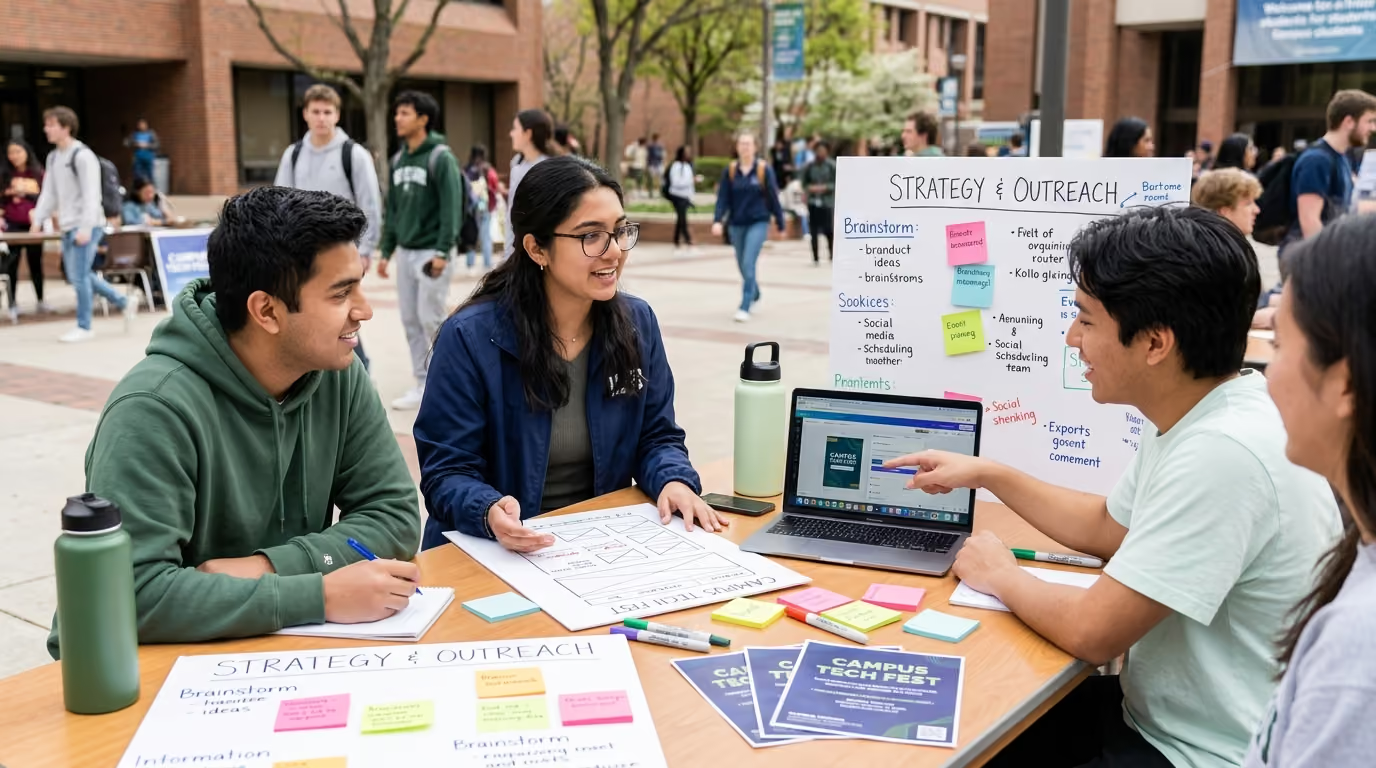
Executing a flawless collegiate sports activation requires disciplined, step-by-step operational management across the planning, staging, execution, and breakdown phases.
Field execution quality depends entirely on the people representing your brand. In collegiate marketing, brands often struggle to balance the authentic peer-to-peer connection of student ambassadors with the operational discipline of professional event crews.
Student brand ambassadors bring unmatched credibility and direct access to campus social networks. They understand the nuances of campus culture, unspoken social codes, and active student communication channels. When engaging student peers, ambassadors communicate without the corporate polish that can alienate collegiate demographics.
However, relying solely on student ambassadors introduces operational risks. Students face conflicting academic schedules, fluctuating exam periods, and limited experience in managing complex physical activations. Furthermore, published academic literature currently shows an evidence gap regarding exact staffing ratios and verified conversion lift from student ambassadors versus professional teams. Marketers should treat student ambassador deployment as a structured operational program requiring rigorous recruitment, standardized training, and direct professional supervision.
To maximize operational reliability and authentic engagement, leading brands deploy a hybrid staffing structure. Our experience executing high-volume experiential tours shows that pairing seasoned professional leads with campus-native student ambassadors produces the highest conversion rates and cleanest operational execution.
When designing your event staffing and workforce planning, you must build detailed contingency staffing models. College gameday environments are volatile. Having a 20 percent staffing reserve ensures your footprint operates at full capacity even if student staff face sudden academic or transport conflicts.
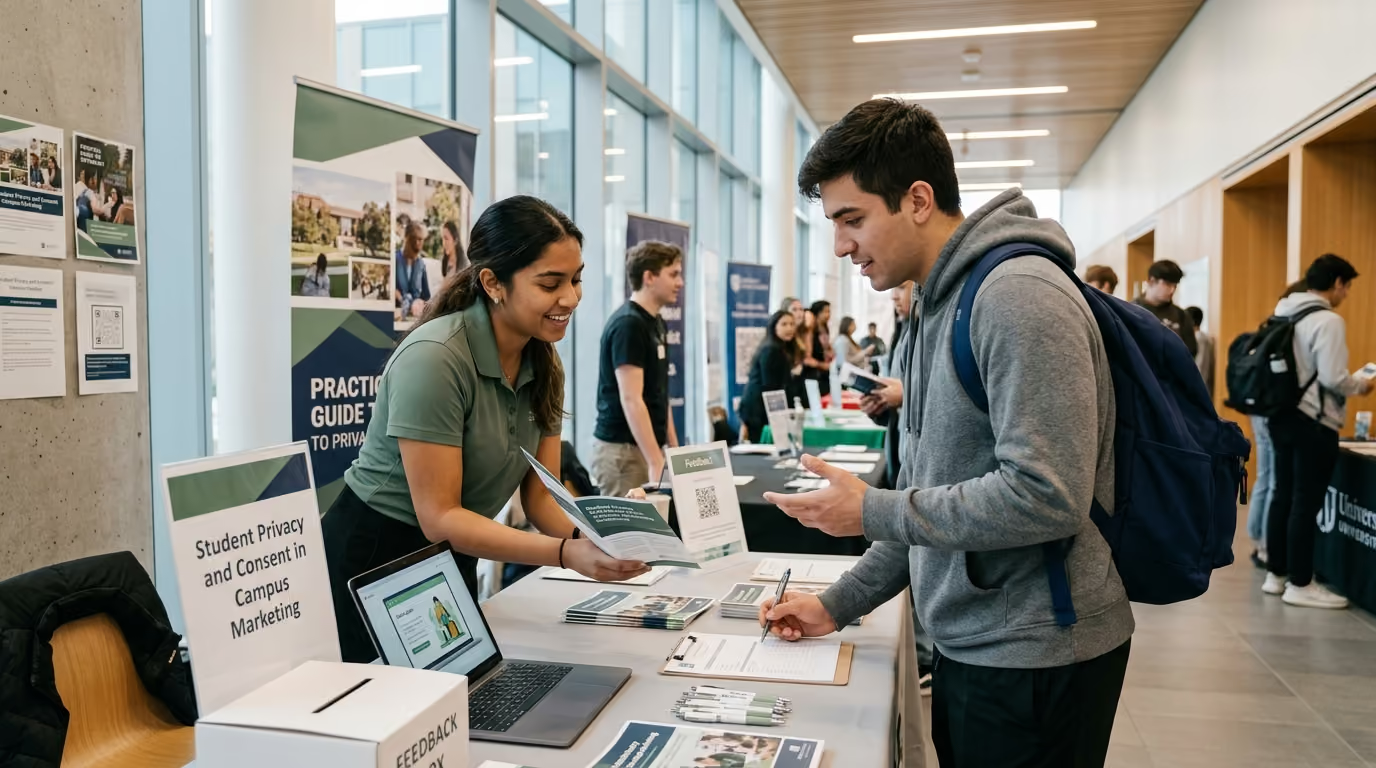
Every member of the field team, whether student or professional, must undergo rigorous training prior to gameday. Training modules must cover:
Experiential marketing campaigns in college sports must be held to clear financial and behavioral performance standards. Trade industry reports surveying college football viewers indicate that unaided recall for leading sports sponsors often reaches substantial levels. However, general awareness does not demonstrate true campaign incrementality. Marketers must evaluate performance across a comprehensive multi-stage funnel.
Spelling out Return on Investment on first use establishes a clear standard for reporting. Calculating true Return on Investment requires isolating campaign costs against incremental revenue generated through retail sales, digital customer lifetime value, and qualified pipeline conversion.
A robust field marketing measurement plan tracks both leading operational indicators during the activation and lagging commercial outcomes post-event.
With increased consumer privacy regulations and declining digital advertising targeting accuracy, live activations serve as premier engines for capturing first-party customer information. Implementing first-party data capture at live events requires minimizing friction.
Rather than deploying long digital surveys, use interactive trivia games, instant-win sweepstakes, or exclusive team-themed digital content unlocks. Every captured record must immediately trigger an automated, personalized follow-up workflow containing a trackable offer code. This connects physical gameday excitement directly to downstream e-commerce or retail transactions.
To demonstrate that sales lift was caused by your experiential program rather than general gameday demand, implement matched-market testing. Compare retail sales velocity in the collegiate market where your activation occurred against a control market with similar athletic demographics where no physical activation took place. Tracking the delta between these markets provides clear, defensible evidence of experiential Return on Investment to executive leadership.
A national sparkling energy beverage brand sought to drive retail velocity and build brand affinity across four major Southeastern Conference college markets during the autumn football season. The brand faced heavy competition from entrenched legacy energy drinks that held massive on-campus pouring rights and stadium signage.
Because the competitor held exclusive in-stadium athletic sponsorship rights, the brand could not place logos on the field or sample inside the gates. Our team designed an off-campus, lawful contextual activation strategy focused on high-traffic student pedestrian corridors and commercial retail strips adjacent to the campuses.
The campaign activated across four consecutive home-game weekends. To manage local permitting hurdles, the team partnered directly with local commercial property owners along key transit routes, securing private-property promotional permits that bypassed restrictive university pouring rights.
The student brand ambassadors engaged their campus networks through social channels 48 hours prior to gameday, announcing the sampling location and highlighting complimentary product availability. On gameday, the team distributed full-can samples at optimal serving temperatures, maintaining cold-chain compliance using dedicated mobile refrigeration units.
Ambassadors invited fans to participate in a high-speed reaction-time reflex game. Completing the game required scanning a QR code that delivered an immediate digital coupon to the consumer's mobile wallet. The coupon offered a complimentary four-pack at major grocery retailers located within three miles of campus.
By focusing on consumer utility, flawless cold-chain logistics, and frictionless digital integration, the brand achieved dominant visibility and verifiable retail sell-through without infringing upon exclusive stadium sponsorship rights.
Executing experiential activations in collegiate environments presents unique pitfalls. Avoiding these common missteps preserves marketing budgets, protects brand reputation, and maximizes commercial results.
Marketing teams often secure approval from a university student organization or academic department, assuming it grants permission to activate near the stadium. Athletic departments, collegiate licensing bodies, and facility concessionaires operate as separate commercial entities with independent contracts. Always verify that your site permits originate from the specific entity that controls the ground beneath your footprint.
Recruiting student ambassadors and handing them boxes of product without on-site leadership leads to operational failure. Without direct operational oversight, sample distribution rates decline, data collection stops, and message consistency degrades. Student ambassadors thrive when paired with professional field managers who handle logistical friction and enforce performance standards.
Gameday crowds move quickly. Designing an interactive experience that requires ten minutes of participation or asking consumers to fill out ten-field registration forms creates massive queue congestion and high drop-off rates. Keep experiential interactions under ninety seconds and limit digital registration to two or three core fields.
Autumn collegiate sports encompass extreme weather shifts, from oppressive southern heat to freezing northern blizzards and severe high-wind storms. Deploying standard pop-up canopies without proper 100-pound commercial ballast weights per leg creates severe safety hazards. Every activation must maintain documented wind thresholds, structural tie-down guidelines, and immediate lightning shelter plans.
Distributing thousands of samples is wasted spend if the consumer cannot purchase the product locally the following day. Experiential activations must be tightly synchronized with retail sales teams. Ensure regional grocery, convenience, and mass retailers receive increased inventory shipments two weeks prior to the event, supported by dedicated point-of-sale displays.
Revisit this operating guide whenever your brand initiates a new collegiate marketing campaign, secures rights to a regional athletic property, launches an on-campus student ambassador program, or prepares annual sports marketing budgets. Mastering the operational disciplines of rights management, venue logistics, student engagement, and rigorous performance measurement ensures that your college sports activations consistently deliver measurable commercial growth.

30 Years Experiential & Retail Activation Partner for CPG & Beverage Brands | Multi-Market Demos, Roadshows & Costco/Club Programs That Actually Sell