Robbie Thain
Founder, CEO

We Are Collider launched ROXi, an AI tool predicting experiential event ROI before launch. Learn how pre-event forecasting changes budget approvals and logistics.
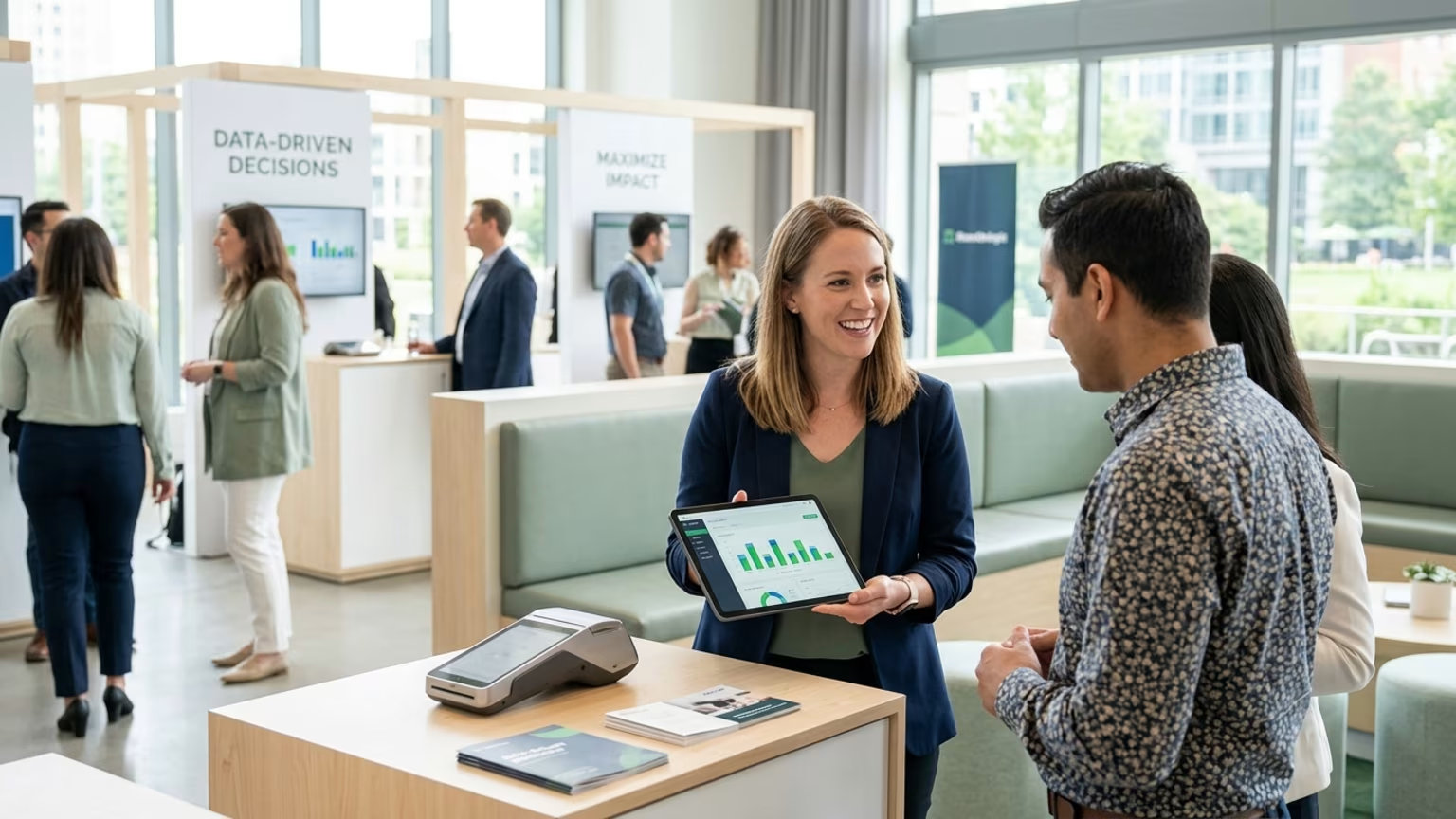
A marketing director holds a budget request for a national sampling tour. She knows the creative concept is strong, but the finance team needs proof it will drive pipeline before approving the capital. The evidence she requires does not exist yet.
On August 25, 2026, brand experience agency We Are Collider introduced a potential solution by launching ROXi. Micebook reports that ROXi is a proprietary AI tool designed to predict the potential Return on Investment of a brand experience before the event takes place. The launch attempts to solve a systemic problem in marketing operations by forecasting outcomes before production dollars are spent.
ROXi evaluates proposed activations using a specific set of operational inputs. According to Micebook, planners input expected attendee numbers, total budget, and paid media investment into the platform. They also factor in influencer attendance and campaign type. The tool processes these variables to generate an overall Return on Investment score alongside a breakdown of potential reach.
The system relies on a blend of proprietary information and broader industry data. We Are Collider states that the tool was trained using its own case-study data and behavioral-science research. Furthermore, ROXi uses retrieval-augmented generation to gather industry benchmarks for comparable campaigns. This provides marketing teams with a data-driven forecast rather than relying entirely on creative enthusiasm.
The agency developed the platform through its in-house innovation lab, Arq. Charlotte Bunyan led the lab development, while We Are Collider managing director Tracy Sorgiovanni conceived the tool. The agency became part of The Strata Group in June 2026. This acquisition placed them alongside agencies such as Strata, Wonderland, and On. Other group members include Sherbet, Trinity, and Element. Its client roster currently includes Amazon Games, John Lewis, and Red Bull.
However, the public launch details leave several measurement variables open to interpretation. The initial coverage does not provide a public accuracy rate, validation study, or independently audited comparison between the predictions and actual event outcomes. A model trained primarily on one agency’s past work may be highly useful for comparable campaigns, but its forecasts could be less reliable for unfamiliar markets. This means the output functions best as a planning signal rather than an absolute guarantee of revenue.
Consumer packaged goods brands face intense pressure to justify physical marketing spend. Micebook cites a Bizzabo report finding that 70 percent of event organizers and brand marketers struggle to measure and demonstrate Return on Investment effectively. Traditional metrics like footfall, content shares, and earned media value are universally reported after the activation concludes. That timing creates a severe disconnect when field marketing managers need to secure funding months in advance.
We have been connecting brands with people through live experiences, retail programs, and national activations since 1995. Over three decades, we have built a track record of creating meaningful brand moments across the country. In our experience, budget approvals stall when teams cannot clearly articulate how a physical footprint translates into measurable retail sales. Predictive modeling introduces a decision-support layer between the initial creative idea and the final production budget.
For a beverage or snack brand, this shift in planning methodology is critical. An activation often carries multiple conflicting objectives, ranging from product trial and lead generation to retail support and content creation. When teams can establish key performance indicators before launch, they stop guessing about the downstream impact. The focus moves away from aesthetic choices and directly toward conversion metrics.
The ability to model expected outcomes transforms experiential marketing from an art form into an accountable business function. This is particularly relevant for high-volume deployments like national sampling tours or large-scale retail demonstrations. When a brand manager can present a data-backed reach estimate, they can secure the internal support necessary to execute aggressive market expansion. Pre-event forecasting ultimately builds trust between the creative marketers designing the experience and the finance leaders funding it.
The introduction of predictive scoring forces a structural change in how field marketing campaigns are built. Teams can now treat pre-event planning as an active scenario comparison rather than a static presentation. A brand director could use ROXi to compare a baseline concept against a reach-optimized version with higher paid media spend. They could also test a conversion-optimized version that relies on heavier influencer participation.
This capability directly impacts downstream logistics, specifically regarding municipal permits and footprint flow. If a forecast model shows that adding localized paid media significantly boosts predicted attendance, the operational plan must adjust immediately. Larger crowds require different permitting strategies, expanded venue footprints, and entirely new crowd control measures. A sudden increase in expected attendance completely changes how trade show footprint flow must be designed to avoid bottlenecks.
Furthermore, staffing ratios must scale proportionally to meet the forecasted audience demand. Storage, shipping, and inventory management suddenly require tighter alignment to handle the anticipated surge in product trial. It also changes the conversation with retail partners and regional distributors. When a brand can present a data-backed estimate of local foot traffic, retailers are more likely to support the campaign with endcap displays.
Flawless field execution requires aligning these physical realities with the initial digital forecast. To achieve brand experiences at scale, operators must connect their predictive models directly to their supply chain capabilities.
While AI can generate a precise numerical score, actual event performance relies heavily on human execution. Real-world results are consistently influenced by staffing quality, venue traffic patterns, and sudden weather changes. Furthermore, product availability and retail distribution gaps can completely derail a well-planned activation. None of these physical execution variables are publicly listed as inputs for the ROXi tool.
This highlights a critical blind spot in purely digital forecasting models. Reach and attendee metrics do not automatically equate to behavioral change or tangible product sales. A strong planning process must connect the predictive forecast to event-specific conversion measures. These measures might include sample distributions, completed demonstrations, QR code scans, or post-event sales lift.
Marketing teams should use pre-event tools to test their assumptions before committing to expensive fabrication costs. Understanding how interactive technology reshapes live brand experiences is crucial for modern planning. However, they must also maintain rigorous physical execution standards on the ground. A high predicted score means nothing if the brand ambassadors fail to engage consumers properly.
The demand for pre-event accountability is growing across the experiential industry. Tracy Sorgiovanni, We Are Collider managing director, noted that integrated tools capable of providing hard data to support and predict experiential Return on Investment are in short supply. She added that ROXi would give the agency and its clients a serious competitive edge.
Her statement highlights the commercial reality facing modern marketing departments today. Procurement teams and finance leaders need evidence before they authorize a campaign, not just a post-event recap deck. While an AI forecast is an estimate rather than a guarantee, it provides a structured framework for defending capital investments against tighter budgets.
As the industry shifts toward predictive analytics, the days of securing funding based solely on creative concepts are ending. The integration of artificial intelligence into the planning phase sets a new standard for budget justification. Marketing leaders must critically evaluate their own internal approval processes. How will your team justify next quarter's field marketing budget without a data-backed forecast connecting planned logistics to measurable revenue?
Trade show coordinators and brand managers carry the heavy burden of turning abstract event forecasts into flawless physical execution, but that stress disappears when a specialized operator handles the logistics. We eliminate the difficulty measuring real ROI from live events by managing your Storage & Logistics. We store your sampling product and event gear, then ship, track and coordinate delivery nationwide so every activation stays on schedule.

30 Years Experiential & Retail Activation Partner for CPG & Beverage Brands | Multi-Market Demos, Roadshows & Costco/Club Programs That Actually Sell