Robbie Thain
Founder, CEO

Target announced its Inside Out campaign, featuring Bagspotting pop-ups in Boston and Chicago. Discover how multi-city activations impact field operations.
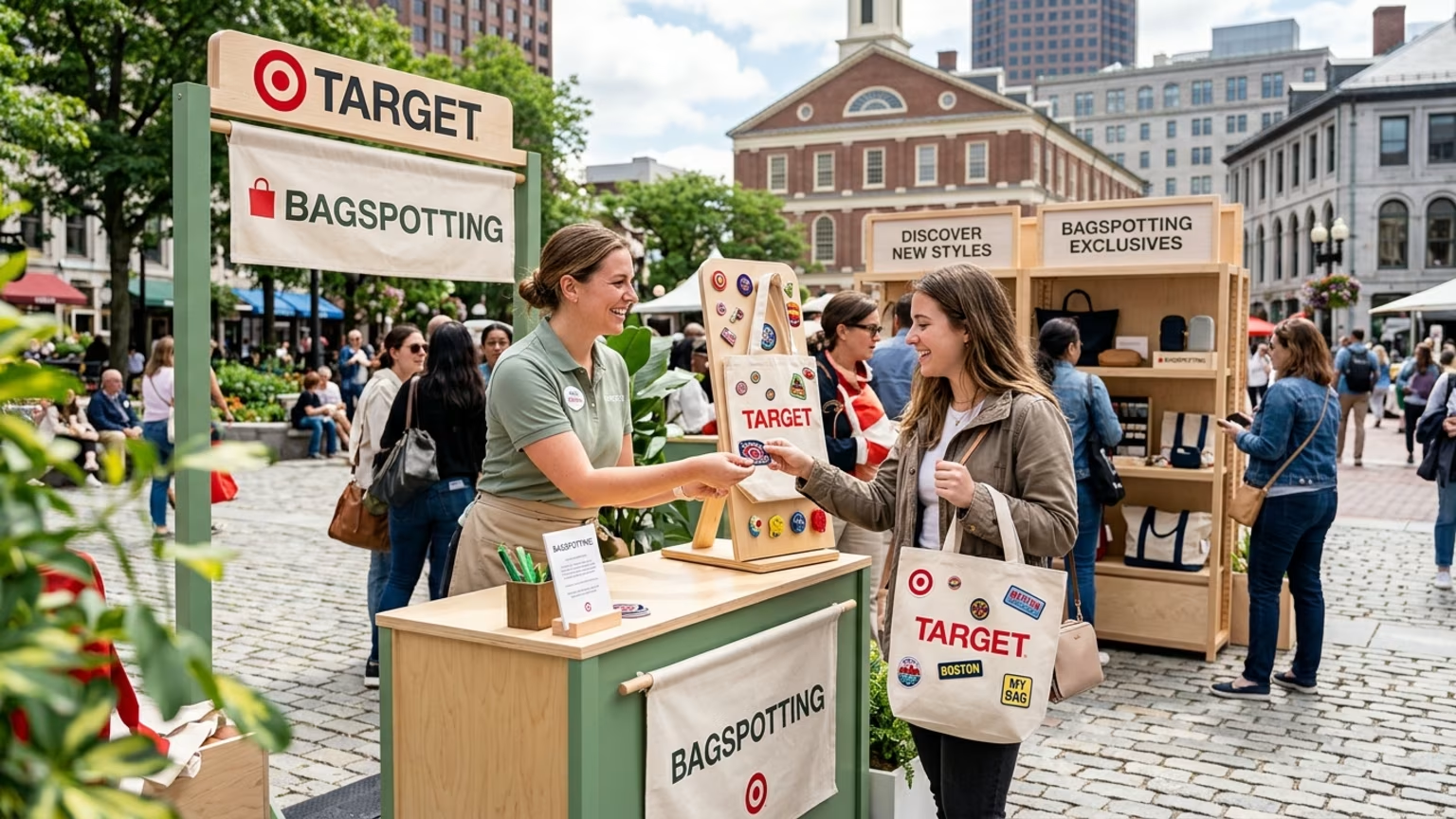
On September 22, 2026, Target announced the launch of Inside Out, a new national brand campaign centered on guests and the retailer’s iconic red shopping bag. The brand built this initiative on the creative premise that the products people bring home can express their personalities, interests, and sources of joy. The campaign will extend well beyond traditional advertising channels by featuring a mix of creator partnerships, guest activations, and physical experiential moments. Target scheduled localized pop-ups called Bagspotting to appear later in September in Boston and Chicago.
The Bagspotting activation relies on a specific physical participation mechanic. The events are designed specifically for people carrying their own Target bags. Participants will face playful street-style challenges and encounter surprise moments as they engage with the pop-ups. Marketing Daily reported that the Boston and Chicago events will include man-on-the-street challenges and gift-card giveaways.
Target also plans to distribute reusable bags for a limited time across five cities and two college campuses. However, the official announcement did not identify those exact locations or explain the distribution mechanics. The broader rollout of Inside Out will include television, streaming, digital, social, and audio placements. It will also feature unexpected moments in New York City alongside creator storytelling segments called Red Bag Stories.
Target previously connected this campaign to Target by Design, a two-day immersive presentation. That event took place at New York City’s New Museum during New York Fashion Week. The presentation included three environments focused on the company’s design history, the shopping experience, and the red bag as a creative canvas. Guests at the New Museum were invited to customize bags of their own to take home.
The retailer engaged multiple marketing agencies to execute this integrated strategy. Marketing Daily reported that Mythology created the campaign and Day One handled the social media components.
Building a multi-city activation around a recognizable physical object is a highly effective strategy for retail momentum. The red bag serves as a unifying device that links digital advertising directly to live consumer behavior. However, generating public visibility without a plan for measurable business impact is a risky approach. Target has not publicly specified the exact Bagspotting dates, venues, or expected attendance figures in its official announcement.
The brand has also not released any campaign results, conversion rates, sales lift, or return-on-investment figures for the Inside Out initiative. When CPG and beverage brands attempt similar street-level campaigns, they must prioritize structured pipeline creation over mere crowd size. In our experience, we specialize in creating retail demos, product sampling programs, and roadshows that bring brands face to face with their audiences. Each program is designed to drive trial, build consumer relationships, and accelerate retail velocity across multiple locations.
When shoppers recognize a familiar visual cue on the street, they approach the activation with built-in context. This established trust reduces the friction of cold interactions during field marketing campaigns. Our structured approach transforms initial product trial into sustained consumer confidence and retail performance. If a brand replicates this strategy, the physical item must clearly lead the participant toward a measurable purchase behavior.
You must connect physical product trials to digital retargeting success to prove the value of your field investments. If a physical activation generates foot traffic but fails to capture usable consumer intent data, the execution is incomplete. High-visibility activations require an operational framework that converts attention into measurable retail performance. We converted a vintage Ultra Van into a mobile VIP beauty lounge for Refinery29 and Smashbox at Coachella.
The activation generated more than 260,000 vehicle impressions, hosted more than 1,200 VIP guests, and reached a seven-figure social audience. Achieving those metrics required strict alignment between the physical footprint and the data capture strategy. If a brand wants to plan pop-ups people actually visit, the field team must execute flawless lead capture protocols.
Deploying unscripted street challenges across major metropolitan markets triggers a massive domino effect on field operations. Because Target has not disclosed specific venues, the operational pressure on local staffing and permitting is immense. Public activations involving surprise giveaways and gift cards naturally attract sudden, unpredictable crowds. Managing these crowds requires strict adherence to city permit regulations, rapid deployment strategies, and dynamic crowd control measures.
When unexpected crowds gather for surprise giveaways, field teams face immediate operational pressure. Brand ambassadors must maintain public safety while attempting to capture usable consumer data in a chaotic environment. Every location requires clear escalation procedures and localized vendor approvals before the first participant arrives. Navigating complex event logistics safely is non-negotiable for large-scale urban campaigns.
When a pop-up relies on spontaneous participation, field managers must train brand ambassadors to handle rapid fluctuations in foot traffic safely. Coordinating these logistics across multiple states demands a rigorous field playbook. We ran the Little Debbie Share a Smile Tour as a 21-market mobile activation using a branded truck, trailer, and Cupcake Smart Cars. Across the tour, we distributed 224,534 cupcakes and generated more than 2.4 million brand impressions.
We also captured 9,500 photos and 340 videos while earning coverage from three local television stations. Managing that scale required us to build an operating system for repeatable campaigns to keep every market stop on schedule. Without a centralized logistical framework, multi-city events quickly devolve into disjointed, unmeasurable stunts.
The distribution of reusable bags across two college campuses presents another distinct operational hurdle. Campus activations involve unique compliance rules, specific vendor approvals, and tightly controlled access points. Field teams cannot simply arrive on a university campus and begin distributing merchandise without advanced clearance. Every single physical touchpoint must align with a centralized inventory management system.
The core objective of this campaign is to place guests at the center of the brand narrative. Scott Swartz, Target’s vice president of creative, explained the strategy behind utilizing a familiar retail prop. “We’re putting guests at the center and using something as familiar as the Target bag to tell those stories in a fresh, joyful way,” he said. This approach shifts the focus from simple product advertising to active, joyful consumer participation.
Marketing Daily reported that the campaign includes two 30-second spots and multiple 15-second versions running across various broadcast and digital channels. The media plan incorporates television, streaming media, digital platforms, social networks, and audio channels. The entire initiative is set to RAYE’s song “Joy,” according to the retailer's official campaign feature. This unified audio and visual strategy ensures that the physical bag serves as the anchor across all media formats.
As marketers watch this campaign unfold, they must critically evaluate their own experiential playbooks. When you deploy a multi-city field marketing campaign, do you have the operational infrastructure required to translate street-level participation into measurable retail sales? Returning to the image of shoppers navigating the streets of Boston and Chicago, a red shopping bag certainly captures attention. The ultimate success of the activation, however, depends on turning that brief public interaction into a documented, repeatable purchase.
When unscripted street challenges and multi-city pop-ups strain a brand's logistical capacity, marketers struggle to maintain consistent execution. To solve the challenges of navigating complex event logistics, permits, and staffing, Makai designs the operational framework required to protect your investment. Through our Costco Roadshows capability, we manage end to end Costco roadshows that bring brands to shoppers through live demos, real conversations, and measurable sales impact. Request a proposal

30 Years Experiential & Retail Activation Partner for CPG & Beverage Brands | Multi-Market Demos, Roadshows & Costco/Club Programs That Actually Sell