Robbie Thain
Founder, CEO

Summer Fancy Food Show 2026 is June 28 to 30 in New York. Use this plan to win buyer meetings, run a tighter booth, and turn tasting into next steps.
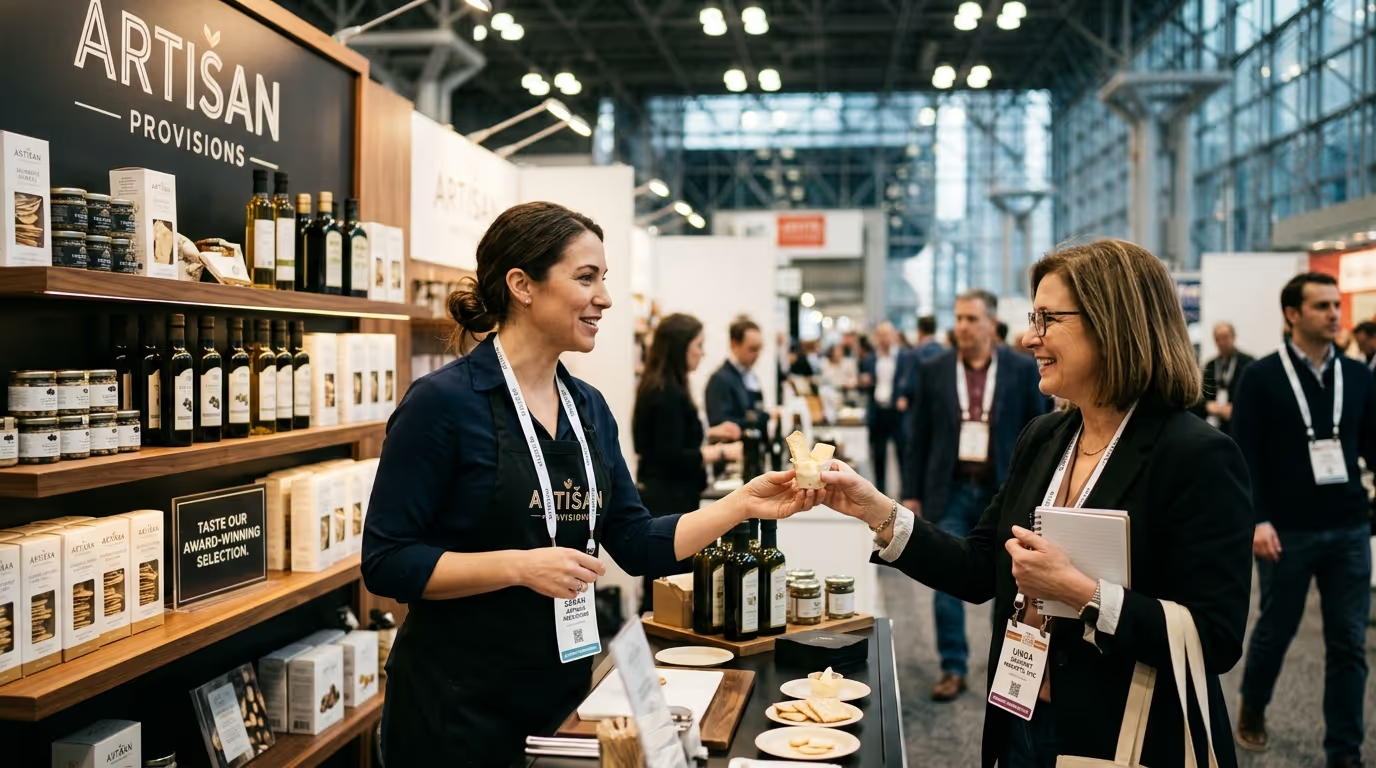
The Summer Fancy Food Show 2026 is one of the biggest specialty food buying events in North America. It brings premium food and beverage brands into one place with buyers, distributors, brokers, importers, foodservice teams, and press, all moving fast and looking for what is new.
That makes it a strong show for discovery, but it also makes it crowded. If your booth tries to say too much, the buyer walks on. If your tasting slows down, the aisle keeps moving. If your team captures names without clear next steps, the post-show pipeline gets weak fast.
This guide is built for brands that want more than booth traffic. It is about how to use the Summer Fancy Food Show 2026 to create serious buyer conversations, stronger tasting moments, cleaner lead capture, and follow up that actually turns into distribution.
If you want support with booth planning, staffing, show flow, and reporting, start with trade show experiences and experiential marketing.
The show runs June 28 to 30, 2026.
It takes place at the Jacob K. Javits Convention Center in New York City.
Sunday and Monday run from 10 a.m. to 5 p.m. Tuesday runs from 10 a.m. to 3 p.m. Buyer badges get early access starting at 9:30 a.m. each day.
The organizer positions it for makers, buyers, distributors, brokers, restaurateurs, investors, press, and other specialty food professionals. It is a strong match for premium food and beverage brands that need retail and wholesale connections.
The show site promotes more than 8,000 buyers, 2,500 booths, 340,000 square feet, 40 plus categories, and 24 international pavilions. That means strong opportunity, but also strong competition for attention.
It is built around specialty discovery. Buyers come expecting premium products, trend-driven ideas, and new brands worth a closer look.
Pick one. For most brands it should be qualified buyer meetings, distributor conversations, or next-step actions like line reviews, sample requests, or pricing follow up.
The Summer Fancy Food Show is not a casual tasting event. Buyers are there to cover ground, compare brands, and make short-list decisions. That means your booth has to do two jobs at once. It has to feel premium enough for the category, and it has to work like a fast business funnel.
The good news is that buyers are in discovery mode already. The organizer leans hard into product discovery, trendspotting, startup zones, pavilions, and buyer tools. That means the audience is open. The hard part is that hundreds of nearby brands are trying to earn the same stop.
If your product needs story, quality cues, or sensory proof, this show can be especially strong. That applies to brands in food, beverage, organic, and packaged goods. A great bite or sip, paired with the right business talk, can move faster here than a long deck sent after the show.
Do not open with your full catalog. Open with one strong reason the buyer should care.
Your booth, tasting, and talk track should all support that same story. If the booth says one thing, the sample says another, and the sales sheet says something else, the buyer leaves confused.
A specialty food booth should not feel like a crowded shelf. It should make the product easy to try and the business discussion easy to start.
Use a simple flow.
The show’s own exhibitor rules matter here. Demos need to stay inside your booth space, not spill into the aisle. That means line control, tasting layout, and crowd flow need to be planned before you arrive, not fixed in the moment.
At a show like this, tasting is not just a nice extra. It is the fastest way to prove the product. But tasting alone is not enough.
Every tasting should answer one business question.
Keep the tasting portion small and fast. Let the first sentence explain what the buyer is tasting and why it matters. Then move into one short qualifying question. For example, “Do you buy more for specialty grocery or foodservice?” or “Are you looking for everyday shelf items or limited standout products?”
The show gives buyers early access at 9:30 a.m. and offers a hosted buyer program for retail, foodservice, distributor, and importer channels. That is a good sign. It means qualified people are not just wandering in. Many are coming in with a plan.
So should you.
Do not rely only on aisle traffic. Build a pre-show meeting list and outreach plan. Start with current customers, top target accounts, distributor prospects, and buyers already active in your category.
If your team needs a stronger meeting structure, pair this show with the thinking in trade show strategy.
The Summer Fancy Food Show is not just rows of booths. The organizer is pushing spaces like Fancy Bodega, Debut District, Good Food Mercantile, country and state pavilions, and main stage programming. That tells you what kind of energy buyers are expecting.
Think about how your booth fits that mindset.
The goal is to feel worthy of discovery, not noisy for the sake of it.
A lot of specialty brands send great people to the show, then make them do everything at once. That slows the booth and hurts lead quality.
Use clear roles.
If you are a small team, one person may cover two roles in quiet moments. But during peak traffic, the roles need to split. That is how you protect both taste quality and business quality.
For a clean way to size your team, see trade show staffing.
The fastest way to waste a great show is to come home with a badge scan list and no context.
Use a two-step capture system.
Useful tags for this show include:
This is the same discipline behind trade show lead capture. Better follow up starts with better tags.
A lot of trade shows feel productive on the floor and weak after the flight home. That usually means the follow up system was not built early enough.
Before the first show day starts, set the post-show rules.
If your team has to invent the process after the show, you will lose momentum.
Do not judge this show by booth traffic alone. Judge it by the quality of the pipeline it creates.
If you want a clean structure for this, use experiential marketing reporting as your base.
If you are a CMO, founder, sales lead, or brand lead, ask these questions before approving the spend.
If those answers are clear, the booth becomes a real business tool. If those answers are fuzzy, the show becomes expensive brand theater.
If the Summer Fancy Food Show 2026 is on your calendar and you want a booth plan that turns tasting into stronger distribution conversations, Makai can help with strategy, staffing, show flow, and reporting. Start with Request a proposal. If you are planning broader field work around New York, see where we work and coverage for New York.

30 Years Experiential & Retail Activation Partner for CPG & Beverage Brands | Multi-Market Demos, Roadshows & Costco/Club Programs That Actually Sell