Robbie Thain
Founder, CEO

Learn how specialty food brands use sourcing transparency and origin storytelling to drive measurable retail trial, boost sales, and improve in-store ROI.

Brand narratives are frequently treated as digital theater, yet they act as the most efficient mechanism for driving physical product trial in crowded grocery aisles. This guide details how marketing operators translate sourcing transparency into high-converting retail activations that multiply regional sell-through.
The food industry wastes millions annually on origin videos that never survive contact with the actual retail floor. Marketers spend months agonizing over the emotional arc of their founder mission in a pitch deck. Then they hand a folding table and a cooler of product to an undertrained brand ambassador who mumbles through a generic sampling script.
The result is a total disconnect between the premium price tag and the cheap customer experience. Retail buyers face a sea of specialty food founders claiming authentic roots. Buyers look for distinct positioning paired with proof of immediate pull-through. When the story stays trapped in digital silos, physical trials drop and category performance flatlines.
Over thirty years of national execution experience has taught us that hope is not a strategy. We have executed over 1000 campaigns across all 50 states, bringing brands to life in every major U.S. market. A passionate founder with a new flavor profile is a great start. Attracting buyers requires a distinct mission and clear provenance delivered flawlessly in the real world.
According to SmartBrief, retail buyers prioritize velocity over mere narrative. A good story helps a buyer justify the initial listing. That story must be paired with hard data from live demos or club channels to secure long term shelf space.
Storytelling operates as a commercial engine that directly influences discovery and price realization. Consumers actively seek foods with a story, particularly items highlighting regional cuisines and authentic preparation methods. Puratos research notes that narratives about local goods shape consumer perception of quality and value. Shoppers willingly pay higher prices when they understand the precise origin of an ingredient.
A recent food marketing trends report from Imagine.art identifies sourcing transparency as a highly durable positioning strategy. This transparency builds deep trust and creates true differentiation in saturated categories. Marketers must treat their brand narrative as a tactical operating system for packaging and retail demonstrations. You must translate abstract brand values into physical cues at the exact point of decision.
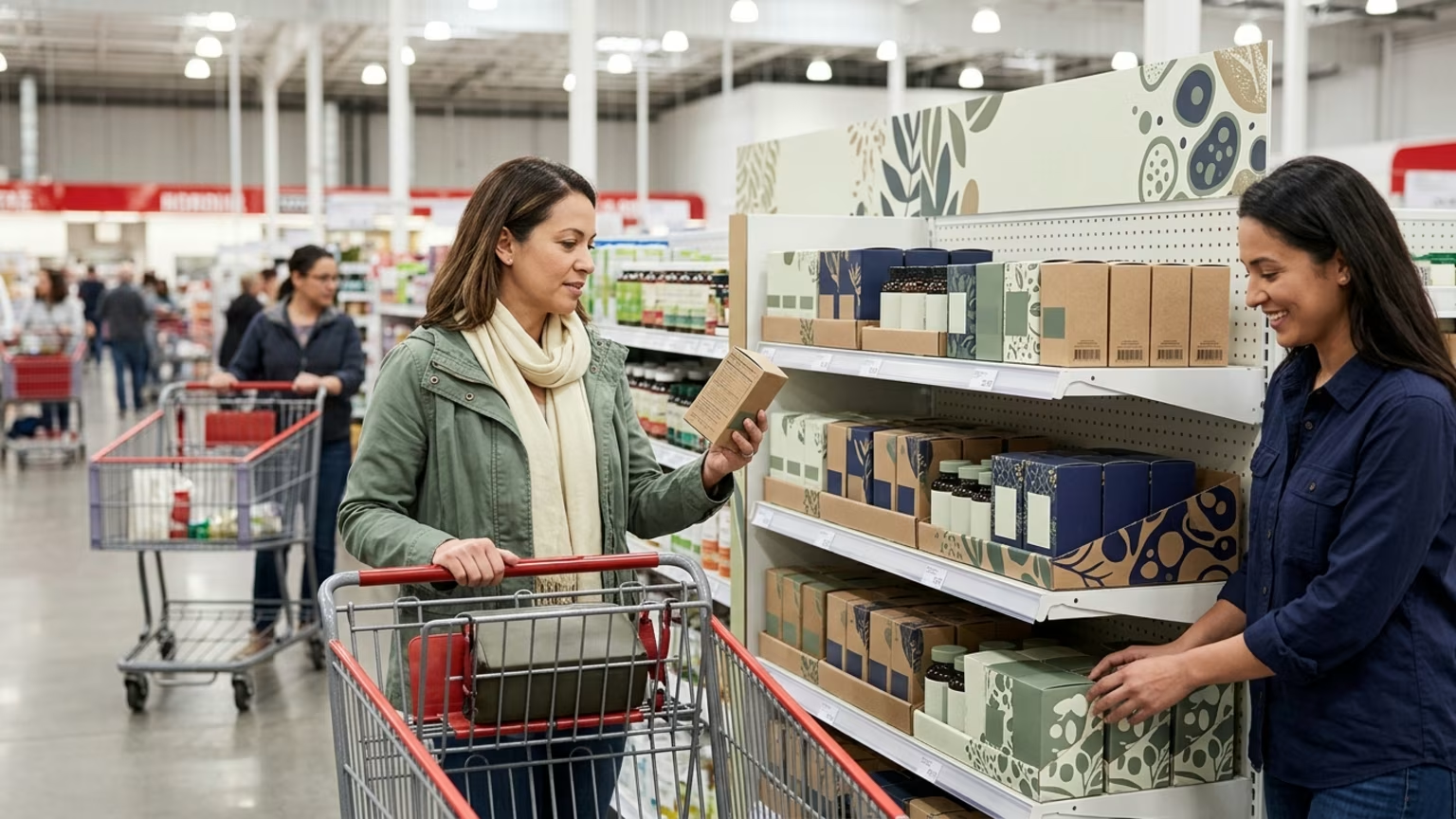
Visual identity systems must convey this story consistently across every shopper touchpoint. Structural packaging choices instantly telegraph origin and quality cues where attention is fiercely limited. We know that brands investing in human-centered in-store experiences see much stronger conversion rates. Storytelling is an efficiency tool for trial and not a replacement for clear product benefits.
Attest research concludes that brands that tell more tend to sell more. Structured storytelling increases memorability and purchase consideration far better than feature-led messaging. A strong identity system conveys the mission in a compelling way that impacts long-term loyalty. Consistency beats intensity when communicating this narrative to the modern shopper.
The risk of generic authenticity is real in today's grocery aisles. Brands relying on empty phrases like crafted with love fail to stand out. You need precise naming conventions for farms, regions, and processing methods. This precision reframes commodity items into premium lifestyle choices.
Converting a lofty mission statement into a trial-driving system requires operator-grade discipline. Field teams need a structured playbook to communicate provenance efficiently during busy events. A cohesive plan prevents the narrative from degrading into confusing buzzwords. This operational approach turns casual browsers into committed buyers.
Start by boiling your story down into a few components that field teams can execute physically. Detail the exact founder identity and specific regional origin cues. Define the core tension your product solves and provide the proof of quality ingredients. This narrative must fit neatly on a shelf talker or a thirty-second demo script.
Build a rapid aisle pitch that hits origin, benefit, and usage occasion before the shopper walks away. Provide a one-page guide detailing responses for common pricing objections or ingredient questions. Align your staffing partners to execute the exact same narrative consistently across every region. Our methodologies for multi-city food brand demos rely entirely on this rigorous alignment.
Use narrative to define when and how your product fits into a daily routine. Position the item as a weeknight cooking shortcut or a specialized post-workout ritual. In-store setups should pair the story with physical cues like recipe cards or bundle displays. These displays must reflect real usage occasions rather than generic product sampling.
Create branded demo carts that mirror the primary story cues from your packaging. Use header cards that shoppers can digest in a single second. Make sure typography and textures match the origin narrative perfectly. Avoid overloading the front panel with competing claims that dilute the core message.
Place QR codes on demo materials that link directly to a short origin video. Connect shoppers to a practical recipe guide that helps them imagine the product in their own kitchen. Make the physical sample the gateway to a deeper brand relationship. For brands planning their next expansion, you can book a strategy call with our team to map out this exact flow.
Marketing operators must prove that live brand experiences lead to sales lift and retailer confidence. A beautiful narrative means nothing without demonstrable Return on Investment. Tracking the right data separates successful trade marketing managers from those who merely run expensive sampling booths. You need cold financial evidence to justify your physical activations.
Compare scripted story-driven samplings directly against standard product-fact demonstrations. Record the immediate uplift in units sold per hour during these tests. Track direct opt-ins to your customer relationship management platform at the sampling table. This measures the immediate persuasiveness of the spoken narrative.
Monitor whether shoppers buy multiple flavors when exposed to the full brand story. Observe if they pair the item with complementary goods based on your usage occasion suggestions. A strong story often drives incremental purchases across the brand portfolio. These lag metrics prove that the educational component of the demo actually works.
Run full story merchandising in a test set of high-traffic store locations. Compare the rate of sale against a control group running standard planograms. This comparison isolates the financial impact of your storytelling materials. Teams can track these specific points using a dedicated retail demo and event checklist to maintain rigorous field standards.
Record short shopper interviews at the table to capture exact phrases and emotional responses. Feed these direct quotes into your sell-in decks to prove that the messaging resonates in the real world. Buyers respond to consumer enthusiasm backed by hard sales data. Qualitative feedback bridges the gap between raw numbers and brand sentiment.
Tie your storytelling content directly to retailer media networks or digital coupon programs. Track redemption rates and drive-to-store metrics at local event locations. This unifies your digital advertising spend with your live experiential presence.
Legacy CPG brands and emerging challengers face the exact same shelf-level friction. When our team activated campaigns for brands like Dole, Popchips, and Pulmuone, we moved beyond basic product handouts. We focused on the precise moments that bridge heritage with immediate consumer utility.
One specialty food brand wanted to break into a saturated retail market with a premium pricing model. They needed to communicate their slow-fermentation process and local farm partnerships to a skeptical audience. We designed a mobile tasting station that physically mirrored their origin story. The setup featured raw material displays and detailed regional maps.
Field ambassadors delivered a tight script focusing on craft methods and the founders' community initiatives. The campaign produced measurable gains in retail sell-through and immediate trial conversion. The activation proved that authenticity scales rapidly when it is backed by operational excellence. The physical manifestation of the supply chain built immediate trust with shoppers.
Shoppers engaged with the material samples and tasting notes at the point of decision. The brand repurposed short video clips captured at the event for their digital channels. This integrated approach amplified the core narrative across both physical and digital environments. The resulting data gave their sales team the proof needed to secure national distribution.
The aisles are loud, and attention is scarce. A good story grounds the product in reality, turning a fleeting taste into a lasting memory. In the end, consumers do not just buy ingredients; they buy the meaning behind the meal.

30 Years Experiential & Retail Activation Partner for CPG & Beverage Brands | Multi-Market Demos, Roadshows & Costco/Club Programs That Actually Sell