Robbie Thain
Founder, CEO

Learn how to select the right experiential format, from pop-ups and roadshows to in-store demos. Align your activation strategy with measurable commercial outcomes.

In 2026, market data revealed a definitive shift toward physical marketing investments. PQ Media forecast a 10.3% growth in global experiential spending for the year. This follows an estimated $138.94 billion spent globally in 2025. The United States accounted for roughly 46% of that total, according to industry reporting.
This surge signals a major strategic pivot for marketing leaders across all major product categories. Brands are actively reallocating funds to secure physical attention in crowded markets. Marketers must deploy these increased budgets with precision to avoid logistical disasters. A larger budget cannot fix a fundamentally flawed format choice.
Brands are heavily funding physical touchpoints to create market differentiation. A separate estimate from Mordor Intelligence projects the immersive marketing services market to reach $11.28 billion by 2031. This accelerated growth increases the importance of format discipline for every marketing operator. Marketers can no longer treat a street team and a mobile tour as interchangeable tactics.
Each activation type reaches a different audience and requires a specific operating model. A format that works for a high traffic retail hub will likely fail at a B2B trade show. Every format introduces distinct cost drivers and logistical demands. The underlying change is that physical marketing requires operator grade discipline to succeed.
At Makai, we believe that format selection must begin with the commercial job. We have been connecting brands with people through live experiences, retail programs, and national activations since 1995. Over three decades, we have built a track record of creating meaningful brand moments across the country. Our experience proves that relying on passive presentations is an operational error.
Increased budgets mean increased pressure to prove Return on Investment beyond vanity traffic. Freeman research indicates that attendees place immense value on hands on demonstrations and practical takeaways. Brands must deploy the smallest viable format capable of proving its operating model before expanding. True field success requires moving past generic badge scans to secure qualified pipeline.
Selecting an activation format creates an immediate ripple effect across field operations. A multi city tour multiplies the number of logistical failure points compared to a single location event. Every choice dictates venue sourcing, staffing levels, data capture methods, and reporting standards. Marketing leaders must cost the fully loaded operating model before approving any field deployment. This includes production, travel, insurance, permits, retailer fees, and follow up labor.
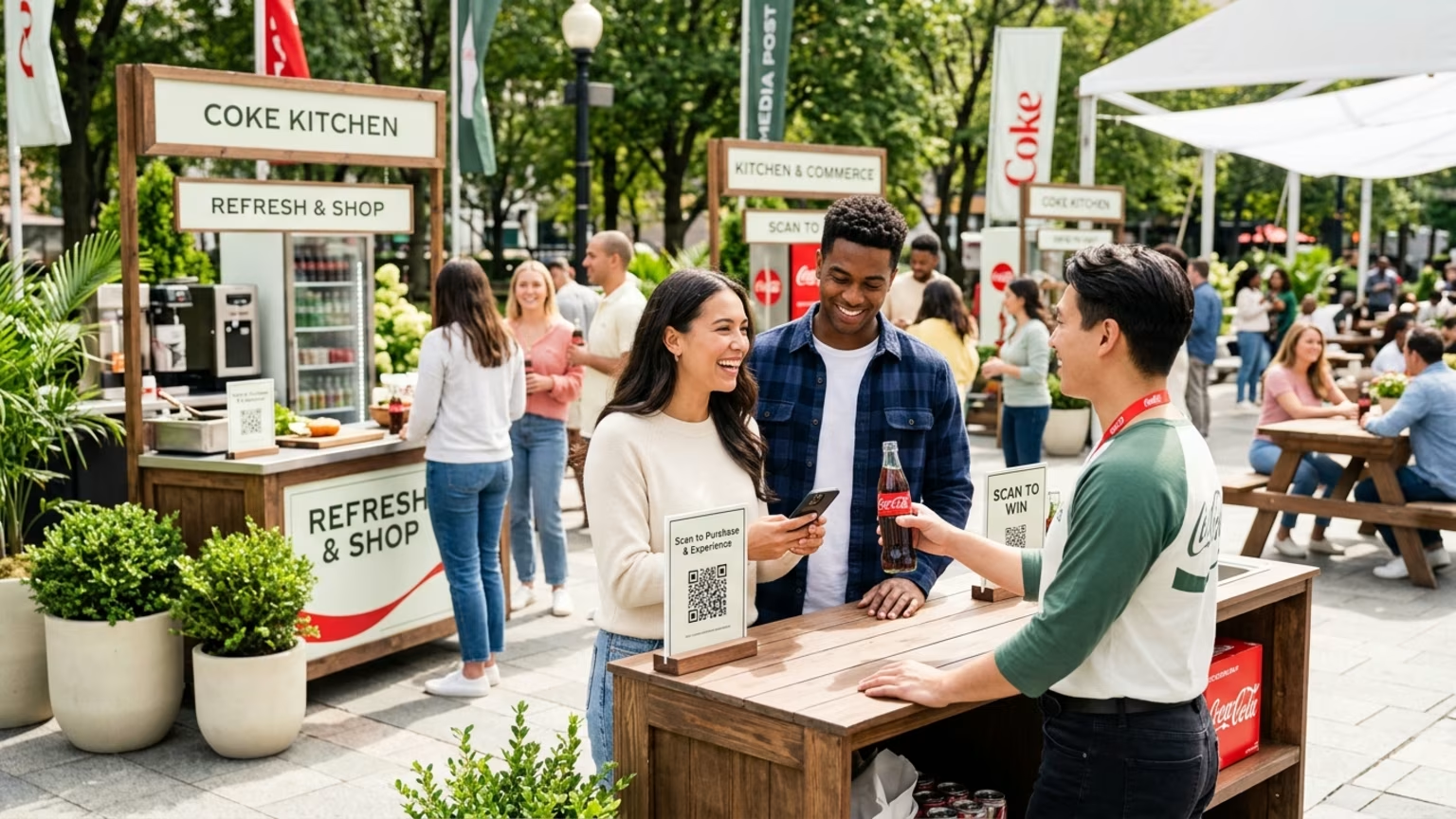
A pop up creates a controlled physical world for product launches or direct consumer interaction. CMO Magazine planning ranges put a single market pop up at roughly $15,000 to $40,000 for a few days. This format requires intensive site selection, queue management, and daily reporting to function correctly. A brand should choose this format when they need deep engagement in a highly curated environment.
Brands should choose a pop up when they need a completely controlled environment. This format allows marketers to construct a memorable physical world. It serves well as a launch moment that combines trial, content creation, and data capture. However, marketers should not choose it merely because the architectural concept looks impressive. The business case must specify the required number of meaningful interactions to justify the fixed costs.
Geographic distribution requires moving a complex brand experience across multiple cities. CMO Magazine estimates a multi city tour at approximately $500,000 to $2 million. Logistics and consistency become central risks when managing crew travel and market specific permits. Brands should utilize this format when a national launch demands scale and repeatable physical execution.
The initial pilot test should validate route economics and staffing productivity before a nationwide rollout. This testing phase allows field teams to refine maintenance protocols and local permissions. Moving too quickly into national scale guarantees fragmented execution. Securing local permits requires significant advance planning for every scheduled market.
Retail demos drive immediate product trial at the actual point of sale. Demo Wizard estimates that a single in store demo may cost $150 to $500. This depends heavily on ambassador pay, sampling costs, and retailer fees. Execution quality and food safety compliance are critical operational demands for field teams.
Demo Wizard cites Nielsen and POPAI benchmarks reporting 25% to 30% same day CPG sales lifts for trained demos. Operating in retail spaces requires a strict collaboration playbook for in-store activations to secure manager approval. Brands should select this format when the product is available for immediate purchase. Tasting or touching the product can effectively remove consumer uncertainty.
Trade shows demand an operational footprint entirely focused on qualified business leads. Success relies heavily on booth staffing and aggressive pre show meeting schedules. World Financial Review reports that only 23% of B2B exhibitors have a formal trade show measurement process. This data cites CEIR research to highlight a major gap in commercial follow up.
A badge scan holds no value without a structured CRM workflow. The desired outcome is a qualified meeting or a confirmed distributor relationship. The program must begin long before the doors open and end with strict lead scoring rules. A highly structured operating model ensures that field data reaches the sales team quickly.
Street teams build local awareness through flexible contact points and rapid sampling. They demand moderate operational oversight depending on local location permissions and weather planning. Brands should deploy this tactic when they need traffic driving support at a lower level of production complexity. It serves as a strong mechanism for simple product education.
However, a street team is a poor substitute for a technical product demonstration. If the product requires privacy or expert configuration, a controlled venue is strictly necessary. Field staff must be trained to handle basic objections while distributing samples efficiently. Understanding shopper psychology helps ambassadors engage pedestrians without causing friction.
Partner activations borrow trust and audience access from another established organization. The operational trade off is that a brand often surrenders some control over messaging and data ownership. Brands should choose this path when a partner provides cultural relevance or distribution that cannot be built efficiently alone. The contract must specify audience definitions and brand safety rules before execution.
Make the partner accountable for measurable deliverables rather than relying on estimated impressions. Sharing physical space means sharing the reputational risk if logistics fail. Conducting a rapid activation debrief helps both teams fix errors early. Clear reporting lines must be established to track partner sourced leads.
Proving the success of any format requires capturing structured field data instead of guessing. Ulala recommends a two track measurement model that keeps hard revenue separate from softer brand metrics. Combining these into a single metric can obscure operational weaknesses. AnyRoad describes brand lift as the difference between exposed and matched control groups on measures like awareness. Brands must establish these reporting layers long before the activation begins.
Using tools like QR codes, coupon codes, and retailer POS data allows teams to track true conversion. Post event surveys should be integrated into the initial workflow rather than added after the recap is due. Measuring baseline brand health before deploying a national street team provides a clear comparison metric. The measurement architecture is just as critical as the physical build.
Marketing operators need a practical model to evaluate format candidates objectively. We recommend scoring each potential format on a standard scale based on objective fit and audience access. Consider the required interaction depth before finalizing the budget. If a product requires technical explanation, a street team will fail to provide sufficient education.
Assess conversion proximity to ensure the audience is actually near a purchase decision or retail shelf. Evaluate operational feasibility by assessing if the field team can execute the concept reliably. Review measurement confidence to confirm that results can be compared with a baseline. A high score in total cost efficiency requires looking past the initial build estimate.
Weigh these criteria according to the specific commercial assignment. A new beverage launch might prioritize trial and same day sales. A technology product launch would prioritize qualified meetings and pipeline generation. Format selection must remain strictly tied to the desired business outcome.
Are your current activation formats truly aligned with your commercial objectives, or is your budget funding vanity traffic instead of measurable pipeline?
Selecting an activation format based on vanity metrics guarantees a structural failure for any physical campaign. Makai prevents this outcome by deploying our Expo / Trade Shows capability to plan and manage trade show spaces that attract attention, start conversations, and convert visitors into customers. We eliminate the risk of low quality leads from crowded trade shows for CPG marketers managing national campaigns. Request a proposal

30 Years Experiential & Retail Activation Partner for CPG & Beverage Brands | Multi-Market Demos, Roadshows & Costco/Club Programs That Actually Sell