Robbie Thain
Founder, CEO

Discover why Mobilo Card’s analysis of 26 event lead-generation platforms urges trade show teams to connect CRM routing with instant capture for better outcomes.
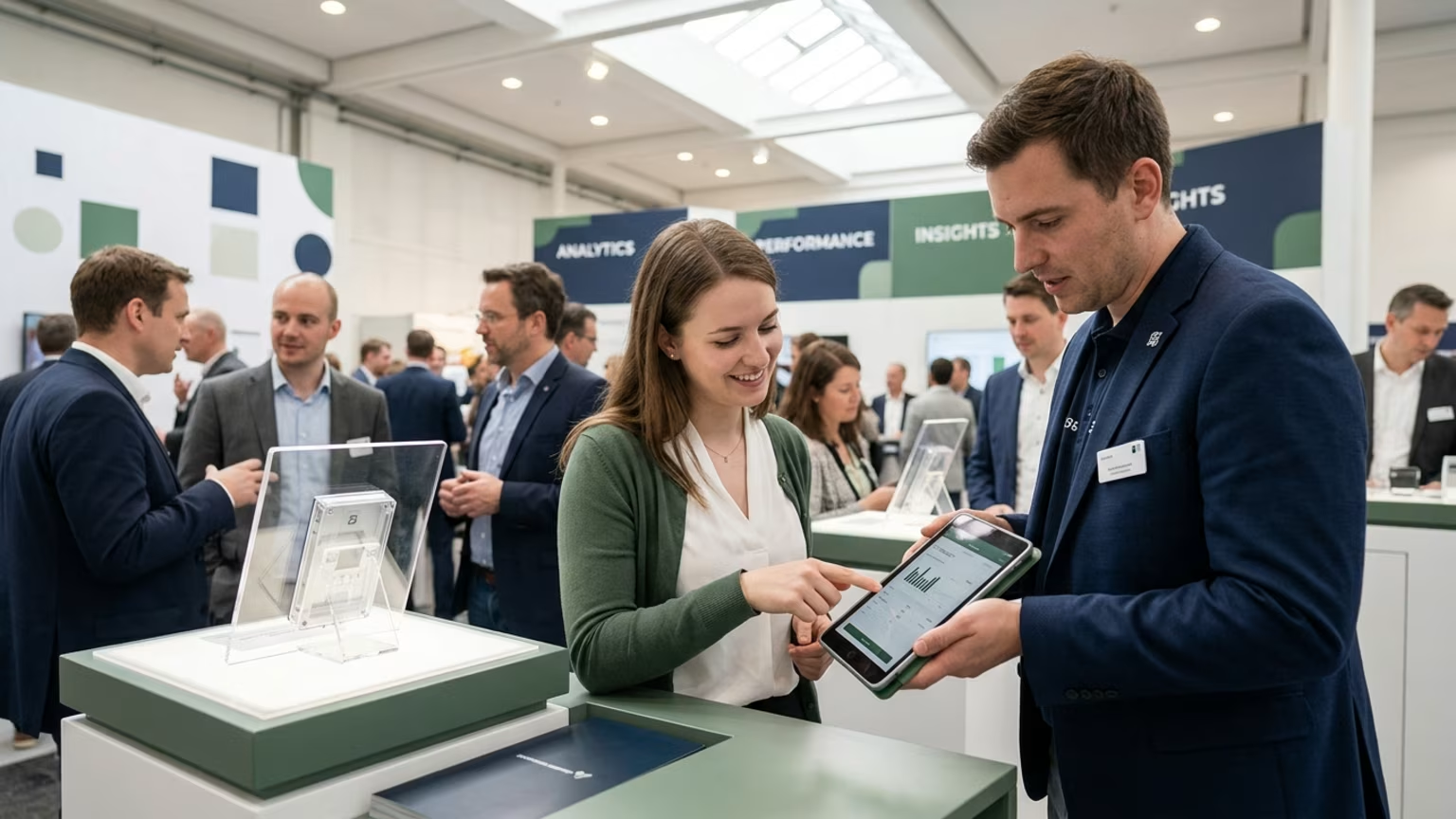
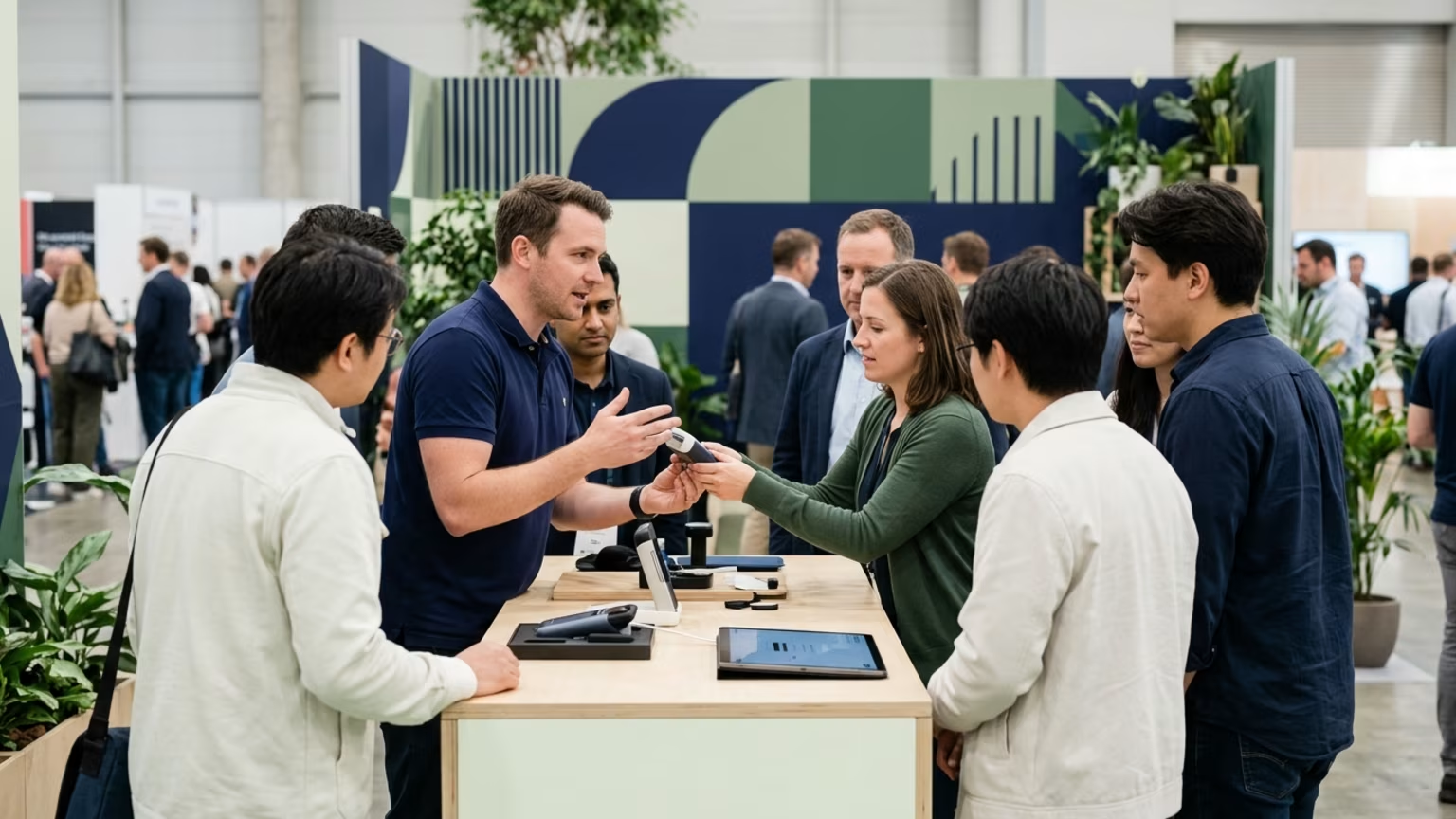
The scanner beeps confirm another attendee walked past the booth. A representative hands over a promotional pen and moves to the next person. Marketing leaders often watch this rapid exchange and assume they are building pipeline. Measuring event success by badge scan volume is a highly efficient way to burn through a massive budget with nothing to show for it. If those scans do not route immediately to a sales system with clear context, you are merely funding an expensive digital collection agency. Your giant interactive booth is bleeding you dry if your follow up process relies on manual data entry a week later. Brands spend months perfecting lighting and signage. They forget that the only metric that pays the bills is a qualified retail meeting booked after the show.
This failure point is where the anxiety for chief marketing officers begins. A brand spends six figures to secure premium floor space and construct a visually stunning footprint. Yet the sales team receives a chaotic spreadsheet weeks later. Representatives then struggle to reconstruct conversations from memory while trying to contact prospects who have already moved on. According to an article titled “26 Best Event Lead Generation Software Tools for 2026” by Mobilo Card, 80% of trade show leads never receive follow up.
Mobilo also states that leads can go cold within 24 to 48 hours after the original conversation. Furthermore, Mobilo claims that 90% of new contacts never enter the CRM after an event. That massive leak destroys the value of the physical interaction. The same article cites Never Drop’s 2024 industry data, attributing an estimated annual loss of $21,000 per sales representative to inefficient event lead capture and follow up. When the capture strategy fails, the entire field marketing investment collapses into unmeasurable brand theater.
The article suggests that companies following up within 24 hours are 60% more likely to qualify leads. However, this claim is not supported by a clearly identified public study in the text. Despite the lack of an independent citation, the operational warning remains clear. If your event staff cannot route a lead immediately, your competitor will likely secure the deal first.
While the visible page lists 29 entries rather than the 26 advertised, the core editorial test Mobilo applies is highly relevant. The analysis evaluates event software by asking whether the platform eliminates the manual handoff between contact collection and CRM entry. Simply collecting a name and email address is useless if the system requires a human to type those details into a database later. Mobilo distinguishes between collection and capture directly. Collection means obtaining basic information, while capture means creating an enriched record with context that can enter a follow up workflow.
At Makai, we know that genuine human connection is the foundation of any great activation. However, creating warm experiences requires brutal operational discipline behind the scenes. You need a structured technology stack that captures the nuances of a live conversation without breaking the natural flow. Mobilo recommends a layered event stack that combines badge retrieval for high volume traffic with NFC exchange for personal conversations.
This approach ensures that a representative can capture a contact and note specific product interest simultaneously. The system should then handle automated CRM routing so the record is assigned instantly. Mobilo notes that its platform connects to CRM systems through 6,000 Zapier integrations. It also offers pricing for its own plans of $3 per month for Pro, $4 per member per month for Teams, and $5 per member per month for Business when billed annually.
When evaluating event prep timelines and seamless transitions for trade shows, offline reliability is non negotiable. The convention center internet connection will inevitably fail when the floor is busiest. Mobilo specifically recommends testing any tool by completing a workflow with airplane mode enabled before the event begins. A robust system must store the data locally and synchronize automatically once connectivity returns. Relying on venue Wi Fi is a rookie mistake that seasoned field operators never make.
The broader economic picture makes this discipline even more critical. The Events Industry Council developed a 2026 study with Oxford Economics that outlines the scale of these live environments. The study estimates that business events generated $3.1 trillion in total business sales and supported 24.2 million jobs worldwide in 2025. It estimates that trade show activity alone supported $444 billion in business sales and contributed $256 billion to global GDP.
Adam Sacks of Tourism Economics noted that business events support economic activity while enabling necessary industry relationships. Amy Calvert, president and CEO of the Events Industry Council, described the report as evidence of the role events play in economic growth and workforce development. The stakes are simply too high to rely on fragmented manual processes.
Marketing teams must shift their focus from tracking foot traffic to tracking tangible commercial outcomes. The EIC study reports that trade shows attracted 318 million participants and generated $179 billion in direct spending in 2025. That volume of participation proves the enduring value of physical spaces. Survey respondents in the same EIC study calculated that events generated $11 in incremental revenue for every $1 invested in attending or exhibiting.
However, that Return on Investment is not a universal guarantee. Brands only achieve those numbers by capturing the right context at the moment of interaction. The EIC study found that 70% of respondents considered face to face relationship building among the event outcomes that would be most difficult to replace. A simple badge scan does not record the details of a relationship. True event strategy maps every interaction to a specific commercial step.
You need contextual capture to know if the attendee wanted a product trial or a retailer meeting. The article names platforms like Cvent LeadCapture and Salesforce Event Connect. It also evaluates HubSpot Marketing Hub alongside specialized tools like iCapture and B2Brain. LinkedIn Sales Navigator, ON24, and Mobilo Card round out the diverse list.
Mobilo describes tools like Clay as capable of pulling more than 150 Luma or Eventbrite attendees, validating email addresses, and pushing the resulting data to a CRM in under two minutes. Pre event prospecting allows your team to define target accounts before the show even opens. This allows field staff to identify priority attendees and turn trade show chaos into measurable revenue.
Respondents in the EIC study reported that 28% of revenue would be lost without participation in in person events. They also attributed 22% of new customer acquisition to participation in those events. To secure that acquisition, your measurement systems must connect directly to sales systems. By establishing ROI frameworks from events to retail sell through, you hold the physical activation accountable to real business growth.
Event technology should never serve as a substitute for a defined operational strategy. Buying a software license will not fix a broken internal process. Marketers must demand rigorous execution and strict data governance over flashy floor aesthetics. The most successful trade show programs are the ones that treat post event follow up as the primary objective rather than an afterthought. An experiential campaign is only as strong as its ability to convert a brief smile into a signed contract.
Integrating advanced lead capture software across a massive trade show floor requires intense coordination long before the doors open. Makai solves the challenge of navigating complex event logistics, permits, and staffing by assuming full operational control. We deploy our Brand Activations capability to create high energy activations that turn awareness into participation and drive measurable consumer response.

30 Years Experiential & Retail Activation Partner for CPG & Beverage Brands | Multi-Market Demos, Roadshows & Costco/Club Programs That Actually Sell