Robbie Thain
Founder, CEO

Train your booth staff to engage media targets and retail buyers. Learn how tracking links and dedicated pages drive measurable marketing Return on Investment.

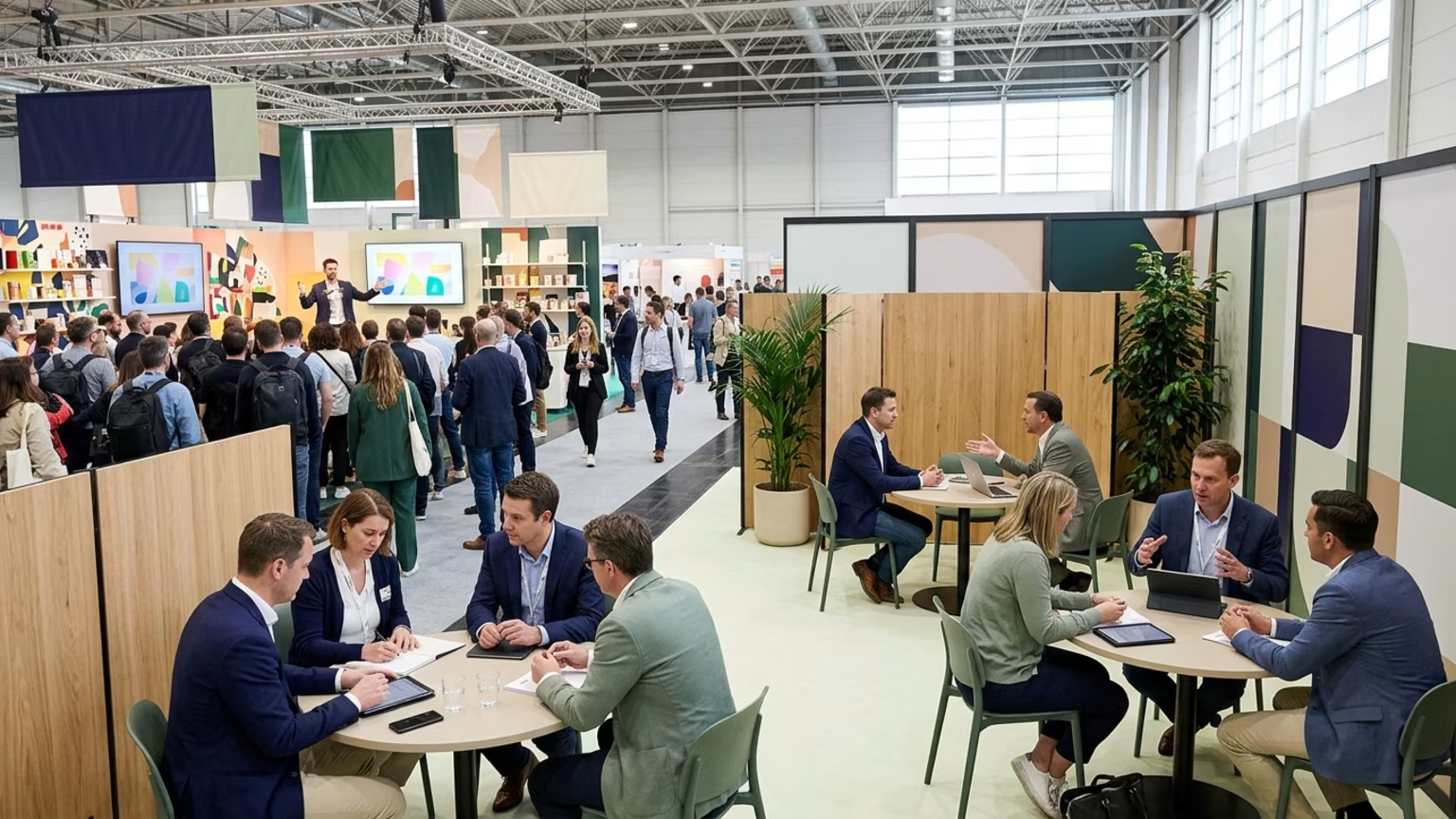
The aisle is packed with hundreds of badge-wearing attendees. Your lead ambassador is busy scanning QR codes. A reporter from a major industry publication walks right past the booth. Another massive opportunity for earned media vanishes into the crowd.
Trade show booths must function as media hubs to capture buyer attention and valuable press coverage. Equipping your staff with targeted training and tracking tools turns fleeting interactions into measurable earned media backlinks and long-term marketing Return on Investment.
Most trade show activations prioritize foot traffic over targeted engagement. Booths look incredibly busy with attendees taking samples. Teams scan hundreds of badges an hour with minimal qualification. High traffic often produces fog instead of real evidence of success.
Staff members are usually trained to pitch products to retail buyers. They are rarely trained to identify journalists. A reporter from a major publication might receive the standard sales pitch. They do not get the specialized attention they require.
There is no dedicated media kit available on the spot. There is no custom tracking link to capture their attention. This fragmented execution turns a potential PR win into a wasted interaction. The brand misses out on high-authority backlinks.
The marketing team struggles to prove the event generated real Return on Investment. You cannot measure success by the amount of free merchandise given away. Brands need a system that captures attention. They need a system that converts that attention into measurable media coverage.
A chaotic environment dilutes brand messaging quickly. Exhibitors spend thousands of dollars designing beautiful spaces. Yet they forget to create a distinct journey for the press. Journalists arrive looking for a unique story and leave with a generic tote bag.
Untrained teams undermine participation rates despite strong concepts. They risk turning a brilliant booth design into a beautiful disaster. Fragmented delivery confuses the audience. It completely alienates busy journalists who need fast information.
When you fail to separate media targets from general attendees, your Return on Investment suffers. The cost per lead skyrockets. The event looks successful on social media but fails to generate pipeline. This is a massive failure of operational discipline.
The solution requires treating media targets with the same precision as retail buyers. We specialize in creating retail demos, product sampling programs, and roadshows that bring brands face to face with their audiences. Each program is designed to drive trial, build consumer relationships, and accelerate retail velocity across multiple locations. We apply this exact discipline to media relations.
Interactive experiences create memory and prompt attendees to invest emotional energy. Passive displays only build basic awareness. According to recent experiential design reports, execution separates a strong concept from a strong result. Your strategy must align the activation mechanic with a clear media lead capture process.
A dual-track approach means your staff can pivot instantly on the floor. They know exactly what to do when a buyer wants pricing data. They know exactly where to send a journalist who needs high-resolution assets. This system relies on dedicated landing pages and explicit follow-up sequences.
At recent retail expos, tech brands advanced trade show tactics with tech-supported personalization. You can borrow these strategies for CPG activations. Modular pop-ups and roaming carts can extend your reach beyond the static footprint. This transforms passive booth visits into active brand participation for every audience type.
A strategic approach requires meticulous planning before the doors open. Research shows that interactive setups drive better memory recall than passive signage. You must integrate digital tracking into the physical experience. This bridges the gap between a live event and a digital campaign.
Technology integration is a non-negotiable standard today. QR codes can unlock special content for verified reporters. Augmented reality features can demonstrate product capabilities without taking up physical space. These elements create a premium experience for VIP guests.
CMOs and Field Marketing Directors face intense pressure to prove sales lift. They must justify the massive expense of booth space and travel. A media relations strategy provides a secondary pipeline of value. It justifies the budget even if direct sales take months to close.
Brand trust requires third-party validation. Earned media gives your brand that validation at scale. By turning your booth into a press generator, you multiply the impact of your physical presence. This is the mindset of a true field marketing operator.
Turning an activation into a media engine requires systematic training and precise tools. Marketing leaders must equip their teams with defined assets to handle press inquiries. Here is the exact playbook to capture earned media at your next event.
Event prep must include these exact steps to avoid poor execution. Brands focusing on digital press outreach see significantly better marketing Return on Investment. Properly trained teams will stop handing out generic flyers. They will start building real industry authority.
You can use this checklist for managing major organic food expos to stand out and book real meetings. A prepared team acts with confidence. They never miss a chance to pitch a visiting writer. The entire booth operates like a high-performing PR machine.
You must create a fast feedback loop during the event. Schedule daily debriefs with your field team to review media interactions. Adjust your pitch based on which journalists showed the most interest. This agility separates amateur setups from professional operations.
High attendance numbers do not equal business success. CMOs need hard data to justify experiential budgets. You must track defined lead and lag metrics. This proves that your media strategy actually worked.
Lead metrics indicate immediate engagement on the floor. Track the number of media badges scanned by your team. Monitor the scan rate of your custom media QR codes. Measure the dwell time of journalists interacting with your setups.
These numbers tell you if your initial hook was effective. They show if your staff successfully identified press targets. Lag metrics prove the long-term Return on Investment. Measure the number of earned media backlinks generated within thirty days.
Track the domain authority of the referring domains. Monitor the direct referral traffic from those published articles. This is the ideal framework for attaching physical event metrics to real sales pipeline. These figures give your executive team confidence in the field marketing program.
Many marketing teams fail with measurement. They report on total booth visitors and call it a win. True operators track the conversion rate of exact audience segments. You need to know how many media scans turned into published articles.
You must measure the cost per acquired backlink. Compare this metric against your standard digital PR campaigns. Live events often produce higher-quality links when executed correctly. This data gives you the confidence to increase your field marketing budget.
You can analyze the geographical reach of your earned media. If a local reporter covers your activation, you gain regional awareness. If a national publication links to your site, you boost your overall domain authority. Both outcomes have a distinct dollar value.
Consider a recent CPG brand activating at a major food expo. They knew traditional sampling would attract massive consumer crowds. They needed coverage in retail trade publications to support a launch. The brand layered a targeted media strategy over their activation.
They deployed roaming carts away from their main booth. The staff directed reporters to a hidden AR experience. This tech-supported approach captured attention in a crowded hall. It provided a quiet moment for a meaningful brand interaction.
The results proved the value of the dual-track system. The brand tracked direct engagement through unique QR codes. The rapid follow-up sequence resulted in five high-authority backlinks. The campaign paid for itself in earned media value.
Another great example comes from the automotive sector. A brand launched a new vehicle at an industry expo. They trained a specialized team to handle press inquiries exclusively. The main staff handled consumer test drives.
The press team used custom tracking links embedded in digital press kits. They gamified the experience by challenging reporters to complete a quiz. This drove deeper product knowledge and higher engagement. The resulting coverage was exceptionally detailed.
This approach is highly effective for dominating competitive exhibition floors in crowded markets. It turns brief interactions into measurable pipeline. You can replicate this model for any industry vertical. Precision always outperforms chaos on the trade show floor.
Book a strategy call with our team to align your next experiential campaign around a measurable media playbook. Build a dedicated press landing page with a custom tracking link today to start capturing high-value press coverage at your next event.

30 Years Experiential & Retail Activation Partner for CPG & Beverage Brands | Multi-Market Demos, Roadshows & Costco/Club Programs That Actually Sell