Robbie Thain
Founder, CEO

Learn how GEN Korean BBQ used rigorous supermarket demo data and targeted experiential marketing to secure 40 direct Costco freezer aisle placements.
The regional buying office is quiet and completely immune to flashy marketing decks. Brand managers sit across from category buyers and attempt to justify shelf space with vague promises of social media reach. They hand over beautiful sell sheets that contain zero hard evidence of real consumer demand. The buyer stares back and politely declines the pitch.
Securing premium shelf space at major warehouse clubs requires undeniable sales data rather than promotional theater. This guide breaks down how a rigid sampling strategy can bypass traditional buyer prerequisites and secure massive retail purchase orders.
Most brands approach retail expansion with backward priorities and massive blind spots. They spend heavily on scattered trade shows and generic field marketing to build arbitrary brand awareness. The actual outcome is usually a chaotic blur of low quality leads, inconsistent brand messaging, and buyer meetings that end in rejection. Retailers want proof of demand. Marketers show up with unsupported claims.
Field marketing teams often treat product sampling as a mere awareness exercise. They deploy poorly trained ambassadors who hand out expensive inventory without initiating meaningful conversations. The brand pays for booth space, travel, and logistics without capturing a single actionable data point. This operational sloppiness makes it impossible to calculate a true Return on Investment for the campaign.
Brands mistakenly believe that a pretty booth and free giveaways will automatically generate pipeline. They send junior staff to run trade show floors with zero instructions on how to qualify leads. These untrained representatives waste thousands of dollars in premium samples on people who will never buy the product. The resulting event report is just a collection of nice photographs and empty engagement metrics.
This systemic failure creates a massive disconnect between marketing spend and actual retail growth. The Chief Marketing Officer demands verifiable return on ad spend. The field team only provides vanity numbers. When it comes time to renegotiate shelf space, the brand has no ammunition to fight off hungry competitors.
Buyers at massive retail chains face immense pressure to optimize every square inch of shelf space. They cannot afford to take risks on unproven consumer packaged goods. A new product must prove it can turn quickly before a buyer will authorize a regional rollout. If your field marketing does not generate this hard proof, your retail pitch will fail completely.
Warehouse clubs are particularly ruthless environments for unproven brands. A standard supermarket might carry forty thousand different products. A warehouse club carries a fraction of that number. Earning one of those rare spots requires an overwhelming display of operational competence and local demand. Brands that rely on hope and colorful packaging will never survive the vendor review process.
Winning a cautious buyer requires a systematic shift from promotional theater to measurable commerce. You need a verifiable framework that proves your product moves off the shelf before you ask for warehouse space. This means building a rigorous demand dossier based on controlled field tests. You must capture hard metrics from live environments to eliminate the financial risk for the buyer.
A solid proof of demand stack relies on structured data collection at the local level. Brands must treat every local supermarket demonstration as a rigid scientific test. You train your field teams to execute a precise script and track every single interaction. This extreme discipline allows you to establish a reliable baseline for consumer interest and purchase intent.
Smart marketers layer multiple signals of consumer interest to build an overwhelming case. They combine live event metrics with secondary indicators like regional gift card performance or direct consumer sales. This multi layered approach proves that your demand is legitimate and highly repeatable. You can start winning retailer buy in with data when you stop relying on vanity metrics.
Creating this dossier requires a deep understanding of what category managers actually care about. They do not care about your brand purpose or your clever packaging design. They care about supply chain reliability, high margin velocity, and localized consumer traction. Your field data must speak directly to these three critical buyer anxieties.
You must integrate your digital presence into this physical proof stack. Show the buyer how your local sampling events drive targeted online searches and regional social media spikes. When digital engagement mirrors physical sell through data, the buyer sees a highly coordinated marketing machine.
Your demand dossier must include flawless operational documentation. Buyers will inspect your food safety audits, your basic buying agreements, and your supply chain logistics. Providing a complete package of sales data and compliance paperwork removes every possible objection. The buyer simply has to say yes to a proven revenue generator.
Success in the field requires military grade discipline and strict adherence to a proven playbook. You must follow a sequential process to translate fleeting live interactions into massive purchase orders. Field teams must operate with absolute precision to capture the data that buyers demand.
Field activations are entirely useless if you cannot track their immediate and long term financial impact. You need specific numbers to justify your event spend to senior leadership and corporate boards. Measuring the right variables separates serious marketing operators from amateur brand enthusiasts.
Lead metrics tell you if your live activation is actually working in real time. Focus heavily on units moved per demo hour and the immediate conversion rate of sampled shoppers. Track the exact number of qualified conversations your field staff initiates on a daily basis. These immediate numbers allow you to adjust your pitch and staffing models on the fly.
Do not ignore the qualitative feedback gathered during these physical retail activations. Field staff should document common shopper objections and exact phrasing used by enthusiastic buyers. This qualitative data helps your creative team refine product packaging and update future marketing copy.
Lag metrics prove that your experiential campaign created lasting consumer habits in the target region. Monitor the sustained retail sell through in the weeks following your initial field events. Watch your regional market penetration and the frequency of buyer reorders carefully. These lagging indicators validate the live retail advantage over passive shelf presence in competitive markets.
A strong reporting infrastructure ties these metrics directly to your bottom line revenue. Your field marketing software should capture daily recaps, inventory levels, and consumer objections in one central location. This rigorous reporting turns a simple product sampling event into an indispensable market research tool.
When you present these metrics to leadership, frame them entirely around risk reduction and revenue generation. Show how every dollar spent on controlled sampling directly resulted in a measurable increase in regional baseline sales. This financial clarity transforms field marketing from a bloated cost center into an untouchable growth engine.
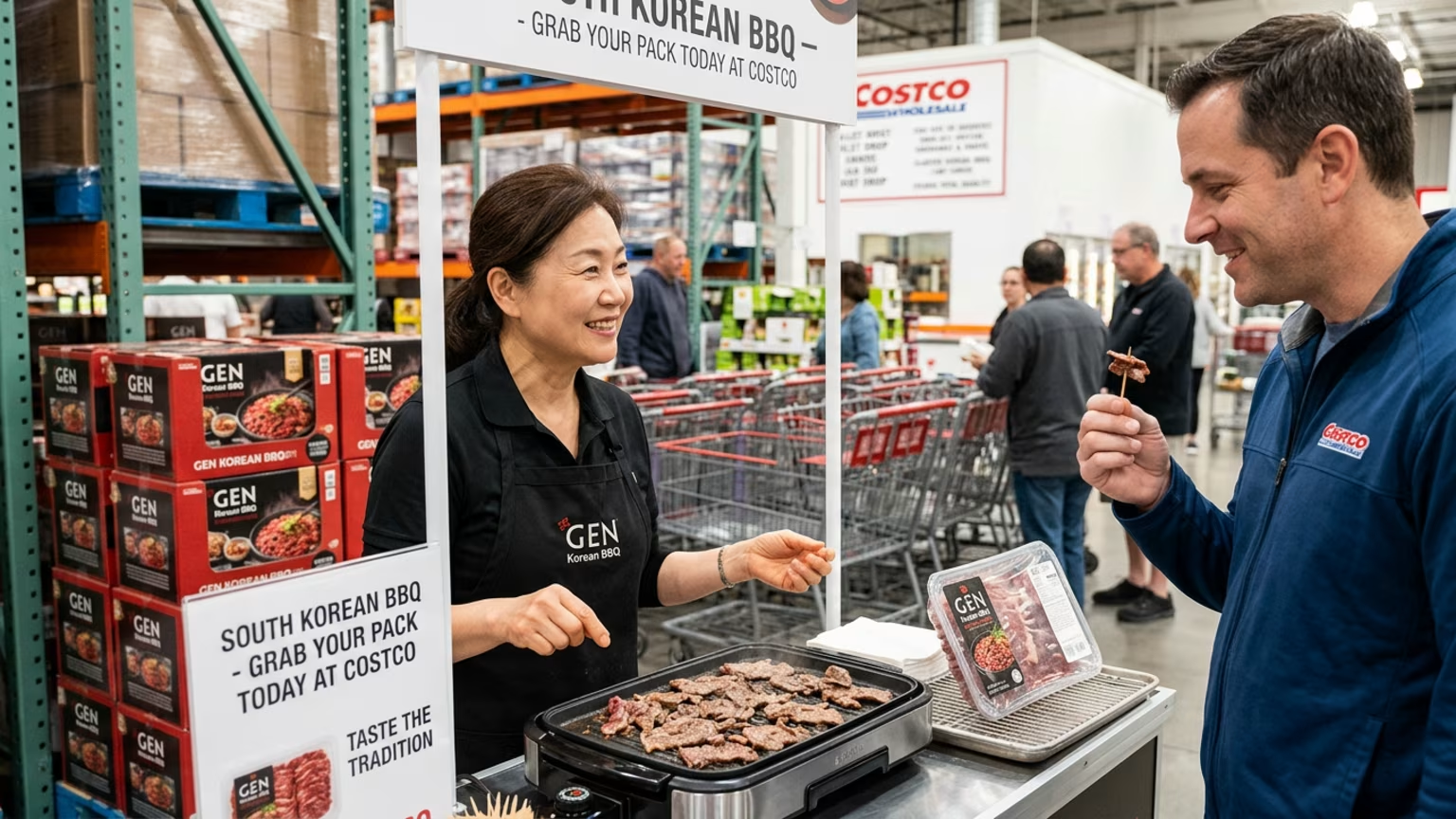
Let us look at a concrete example of this rigorous strategy in live action. GEN Korean BBQ recently secured its first direct regional purchase order for forty major warehouse locations. The brand earned lucrative placements for their ready to cook marinated meats in the frozen aisle. They completely bypassed the standard regional roadshow requirement entirely based on their localized data.
The company achieved this massive win by arriving with an undeniable stack of experiential proof. They executed over one hundred supermarket demonstrations prior to pitching the regional buyer. During these highly controlled local tests, the brand recorded phenomenal sell through rates. Field teams consistently moved one hundred to three hundred units per four hour event.
By running these initial tests in standard grocery environments, GEN isolated the true appeal of their product. They refined their messaging and perfected the physical cooking demonstration before attempting to enter the warehouse club channel. This calculated patience prevented them from burning a massive opportunity with a poorly planned retail pitch.
This exceptional demo velocity gave the regional buying team absolute confidence in the physical product. The brand paired this live event data with strong gift card sales across ninety one national warehouse locations. The combination of established venue presence and raw sampling power made the buyer decision incredibly simple. This data driven approach fueled their major activations in California and their rapid expansion into Hawaii.
The brand completed all necessary vendor requirements well before the pitch. They finalized extensive food safety audits and basic buying agreements early in the process. This operational maturity proved to the retailer that the brand could handle high volume distribution smoothly. The buying committee saw a fully formed revenue machine rather than a speculative product launch.
Costco recognized that GEN possessed both the consumer demand and the backend infrastructure to succeed immediately. The retailer issued the purchase order without forcing the brand to prove itself through a probationary roadshow period. This rare exception highlights the immense power of arriving at the negotiating table with irrefutable localized data.
The brand is now planning aggressive launch activations to maintain this incredible sales momentum. They are using experiential tactics not to win the space, but to dominate the category and accelerate immediate product movement. They understand that winning shelf space is only the very first step in a long retail war.
You must continue driving trial at the point of sale to protect your newly acquired retail footprint. If your brand needs to replicate this level of rigorous field execution, it is time to book a strategy call. Our teams know exactly how to turn fleeting consumer interactions into permanent retail dominance.

30 Years Experiential & Retail Activation Partner for CPG & Beverage Brands | Multi-Market Demos, Roadshows & Costco/Club Programs That Actually Sell