Robbie Thain
Founder, CEO

Learn how AI compresses category review cycles from weeks to days. See how experiential marketing teams run rapid retail experiments to prove real pipeline.
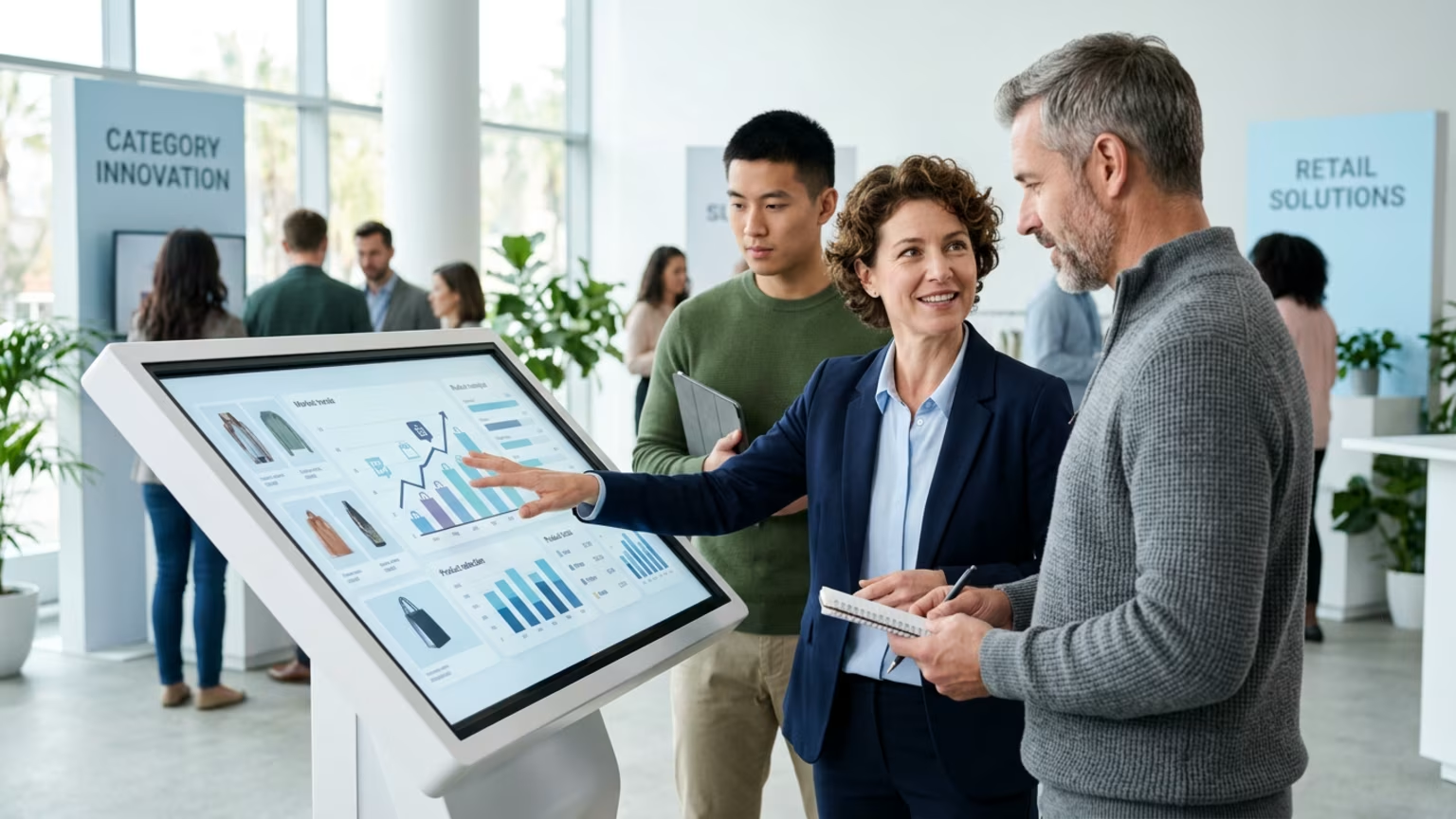
Shelf space and placement can explain 20 to 40 percent of sales variance in many consumer packaged goods categories. By compressing category review cycles from weeks to days, new artificial intelligence platforms allow experiential teams to run rapid retail experiments and prove the Return on Investment of their physical activations.
You launch a massive new snack line at a major industry trade show to attract retail buyer interest. The trade show floor is a chaotic mix of flashing lights, loud announcements, and buyers rushing to secure early product allocations. Your experiential team spends months designing the perfect booth flow to capture attention and scan badges. The real challenge begins when the show ends and you try to translate that live event momentum into physical store execution.
Retailers historically rely on slow category reviews that take weeks to process. By the time your new product hits the shelf, the excitement from the live launch is completely dead. Out of stock events or poor placement can quickly kill your retail rollout before it even gains traction. Marketing leaders end up frustrated when they cannot connect their expensive live event data to actual store level performance.
This creates a painful gap between headquarters planning and reality in the field. Your brand might have a beautiful planogram designed by the merchandising team. Yet that plan often falls apart on the retail floor from inconsistent staffing and fragmented logistics. Without a rapid way to test physical product placement, trade show success rarely translates into immediate retail wins.
Brands spend millions designing interactive trade show booths to generate buyer interest. The sales team collects thousands of leads and promises massive retail support to their distribution partners. Then the reality of field logistics sets in. The promotional materials arrive late to the warehouse.
The temporary staff lacks proper training. The retailer changes the planogram at the last minute. This fragmented execution destroys the Return on Investment of the initial event. To succeed, brands must merge their creative activations with operational discipline.
To fix this broken handoff, brands must close the loop between live product launches and store level execution. SymphonyAI recently announced its connected decision engine platform to address this exact gap. According to reports from MarTech Series, this software compresses category review cycles from weeks to days. It is already proven across hundreds of global product deployments.
SymphonyAI built this tool to close the gap between planning and physical reality. The software draws on deep learning to analyze localized shopping behaviors. It processes massive amounts of point of sale data to recommend the exact product mix for each store. This level of granularity was previously impossible without hiring legions of data scientists. Now, field teams can access these insights through a single dashboard.
The system unifies demand forecasting with in store analytics to power rapid decision making. Instead of waiting for a quarterly review, field marketing teams can track store specific layouts and adjust secondary displays rapidly. This continuous optimization acts as an acceleration engine for your retail strategy. You can design a physical activation, deploy it, and measure its impact on sell through almost immediately.
Historically, consumer packaged goods companies ran quarterly category reviews driven by manual analyses. These legacy processes were heavily constrained by human bandwidth and slow data aggregation. Platforms like SymphonyAI enable continuous category optimization. New data rapidly flows into the model to refresh plans in real time. This means shorter test cycles for in aisle merchandising and secondary displays.
This speed allows brands to adopt a new playbook for real world conversion that actually drives pipeline. Retail AI practitioners note that the main benefit is embedding intelligence directly into the assortment workflow. Teams can iterate in days instead of quarters to align store layouts with live shopper behavior. Faster testing eliminates the guesswork from your experiential budget.
Your retail merchandising no longer needs to operate in a vacuum separate from your event team. By linking space planning tools with live sales data, you create a feedback loop that benefits both departments. This alignment means your brand ambassadors are always promoting the right product in the right location.
When your field team is operating on an accelerated timeline, you need a precise system to test and measure results. Fast technology still requires flawless physical execution to work properly. Use this framework to align your live events with AI powered category insights.
Whether you are managing massive convention appearances or planning sampling at scale, speed is your biggest advantage. Shorter test cycles allow you to pivot mid campaign if a configuration underperforms. You never have to wait for a seasonal reset to fix a broken retail display.
To defend your experiential budgets, you must speak the language of measurable revenue. This means tracking specific indicators that show your physical activations actually moved the needle. Lead metrics provide the early signals you need to adjust your campaigns in real time. These initial data points prove that your physical operations are functioning correctly.
Your core lead metrics include store compliance rates, trial conversion during live sampling, and the speed of display installation. Store compliance rates tell you if the retailer actually implemented the agreed upon shelf space. Trial conversion measures how many shoppers sampled the product and immediately made a purchase. Installation speed tracks how fast your logistics team transitions from a live event to a retail endcap.
These early signals tell you if the field execution matches the digital plan. Without these lead metrics, you are flying blind until the end of the quarter. Field managers can use this data to correct poor store setups before the weekend rush begins. This proactive approach saves thousands of dollars in wasted promotional material.
Lag metrics focus on the ultimate financial outcome of your activation. You must measure category sales lift, rate of sale changes, and the reduction of out of stock events. Category sales lift proves to the retailer that your campaign grew the entire aisle, not just your specific brand. Tracking the rate of sale confirms that your new product maintains momentum after the brand ambassadors leave the store.
Reducing out of stock events is perhaps the most critical lag metric for any physical campaign. Even a small out of stock rate can materially erode sales lift during a highly promoted launch. AI platforms help predict these inventory shortages before they occur. Your experiential team can then coordinate with store managers to restock shelves prior to peak weekend traffic.
When you bring this data to retail buyers, you prove that your experiential campaigns drive mutual growth. This evidence based approach secures better placement for your next rollout. Integrating smart systems is the best way to turn trade show chaos into measurable revenue. You transition from selling brand awareness to selling guaranteed retail performance.
You must carefully weigh the power dynamics inherent in category management. Retailers ultimately control the shelf space and make the final decisions regarding layout. Your brand cannot unilaterally force a new planogram just on the advice of an algorithm. Instead, you must use these insights to build a collaborative business case. Show the retailer how your optimized assortment and live sampling events will grow their entire category.
This rigorous focus on metrics completely changes the conversation with your Chief Financial Officer. Experiential marketing is often viewed as a cost center that produces fluffy brand theater. Armed with clear data on assortment performance, you can reposition your field events as a direct revenue driver. Every dollar spent on physical activations becomes a calculated investment in market share.
We see the power of combining tight logistics with emotional resonance every day. Real world testing is the best way to refine a product launch before committing to a massive national rollout. Our teams rely on strict data feedback to adjust live sampling strategies on the fly. This approach guarantees that every activation generates measurable pipeline for our partners.
One of our clients, a Brand Manager in the alcohol beverage space, shared their experience regarding our field execution. They noted that working with Makai completely transformed their strategy. The activation blew past all our KPIs and created a lasting emotional connection with our customers. They achieved simply outstanding work by treating rapid feedback as a core operational standard.
When you merge optimized shelf placement with well trained brand ambassadors, you create an unstoppable retail presence. Shoppers get to experience the product firsthand. At the same time, the brand collects critical sales data. If you are ready to implement these fast feedback loops into your next campaign, book a strategy call with our team. We can help you build an activation that converts excitement into measurable revenue.
A trade show floor will always be a noisy, high pressure environment with buyers rushing to secure the best new products. With modern tools compressing the review cycle, that booth momentum no longer has to die when you wait for a quarterly reset. By treating assortment optimization as a speed advantage, you can turn a successful launch event into proven retail dominance.

30 Years Experiential & Retail Activation Partner for CPG & Beverage Brands | Multi-Market Demos, Roadshows & Costco/Club Programs That Actually Sell