Robbie Thain
Founder, CEO

Analyze how brands manage crowd flow and field operations at the 2026 US Open. Compare high-volume utility with controlled access experiential strategies.
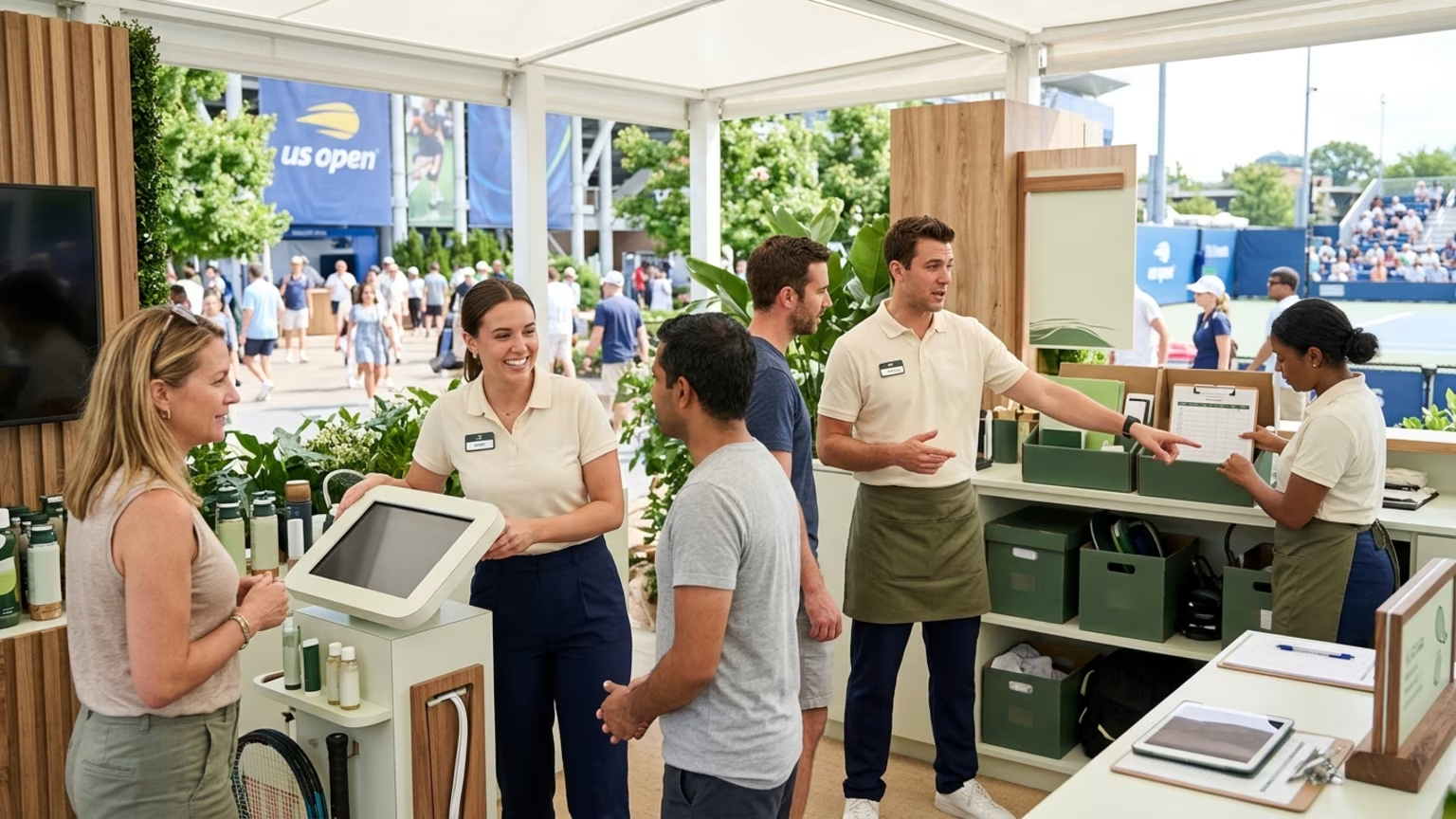
A field coordinator checks her clipboard while thousands of fans stream past a cooling station outside Arthur Ashe Stadium. Activating at the 2026 US Open forces brands to choose between serving a massive crowd or creating intimate moments. Marketers face a sharp operational divide when capturing attention during the record 22-day tournament. The choice comes down to mass utility across distributed touchpoints versus highly controlled niche experiences.
The first approach focuses on mass throughput and solving immediate consumer friction points. Event Marketer describes the 2026 US Open as a record 22-day tournament running from August 23 through September 13. This extended window gives sponsors access to a massive audience. Forbes reports total three-week attendance of 1,144,562, including 239,307 visitors during Fan Week.
To reach this volume, brands build distributed utility stations rather than single promotional booths. Dove combined content capture, fan interviews, and a cooling and beauty touch-up space under its 2026 US Open platform. This multi-touchpoint model requires distinct workstreams for content production, talent management, and guest service. Logistical constraints center on constant product replenishment and queue management for thousands of daily visitors.
Similarly, IHG Hotels & Resorts introduced the Racquet Cruiser to solve a post-event mobility problem. Event Marketer reports that IHG’s Racquet Cruiser combined transportation with hospitality services and dropped fans at two central Manhattan IHG properties. The free premium coach bus operates during first-round matches to help fans get home after late sessions. This moving experience requires intense coordination among transportation providers, hotel teams, and event staff.
High-volume environments also require rigorous planning for product sampling activations and retail fulfillment. Tag-Walk reports that Ralph Lauren planned to dress 800 people across the US Open, including 215 officials and 300 ball crew members. The brand managed overlapping experiences across retail customization and hospitality suites. Meanwhile, Yahoo Sports reported that more than 700,000 Honey Deuces were served the prior year and that the 2026 cocktail was priced at $20 in selected venues.
The alternative approach ignores mass throughput in favor of targeted participation and controlled access. This tactic often moves the experience away from the busiest tournament pathways. Brands prioritize community building, education, or deep affinity over raw impression counts. The execution footprint requires strict registration management and qualified staff rather than sheer volume handlers.
According to Event Marketer, eos’s clinics brought 100 women of color together for instruction, open play and product interaction. This operating model requires participant management, equipment coordination, and extended time for meaningful interaction. It is a completely different operational reality from a high-volume public tent. Brands must overhaul event staffing and training to ensure specialized ambassadors can facilitate deep conversations.
Brands also take this controlled approach off the main grounds entirely. evian used the tournament to connect its 200th anniversary and 40th year as a US Open sponsor with activations on the grounds and at Brooklyn’s DUMBO Archway. This off-site strategy requires separate venue production, local permitting, and independent transportation logistics. Event Marketer reports that Dove funded food and beverage at 10 women-owned sports bars for its Women’s Finals watch-party program.
Each off-site extension must operate with complete independence rather than functioning as an afterthought. Locations require specific operating briefs, inventory plans, and escalation protocols tailored to their unique footprints. Transporting materials between the main venue and an off-site activation introduces severe logistical risks if not properly managed. Brands must ensure that supply chains remain uninterrupted across all participating venues.
High-volume utility wins unconditionally when a brand needs to capture dense foot traffic and generate mass trial. This tactic dominates when the 239,307 Fan Week visitors are looking for rapid engagement before the main competition begins. Brands with broad consumer appeal thrive by solving practical problems for these large crowds. The approach is ideal for consumer packaged goods companies seeking rapid physical product distribution.
This tactic is also the clear choice when the primary goal is capturing immediate consumer relief. Dove's cooling stations and IHG's transportation service succeed because they address heat and fatigue directly. When a sponsorship relies on removing friction for tired or uncomfortable fans, mass utility is unmatched. The resulting brand sentiment is heavily tied to this immediate physical comfort.
Measuring behavior rather than just visible busyness is a mandatory requirement for high-volume spaces. A crowded footprint may indicate strong awareness, but it does not confirm that visitors understood the proposition or opted into follow-up communications. Useful measures include qualified engagements, queue completion rates, and average dwell time by experience type. Teams must distinguish sheer foot traffic from actual commercial value.
Brands scaling this type of high-volume utility often face extreme staffing pressures. We run experiential and engagement programs coast to coast with local crews, smart logistics, and permit expertise that let us launch fast and maintain quality consistency in every region, from major metros to smaller markets. Our nationwide infrastructure enables us to activate brands wherever their audiences are located. This operational control is necessary when managing mass throughput.
Controlled access dominates when a brand requires high-quality media capture, virality needs, or massive crowd aggregation around specific cultural moments. A focused clinic or an exclusive off-site launch generates rich narrative content that a crowded sampling booth cannot provide. This tactic is necessary when creating premium brand launches that rely on influencer participation. The intimate scale ensures that every guest receives a flawless brand interaction.
This approach also wins when a sponsor wants to engage specific demographic segments deliberately. The eos activation succeeded by creating a safe, dedicated space for networking and education. When the objective is changing brand perception rather than just driving volume, controlled access is required. It allows marketers to dictate the pace of the experience entirely.
Furthermore, off-site controlled events capture city-based fans who may not hold tournament tickets. Moving the activation to Brooklyn allowed evian to create a cultural destination outside the tennis center. This strategy dominates when a brand wants to leverage the cultural relevance of a major sports property without fighting for space inside the venue. Advanced software is often needed for streamlining onsite event logistics across these dispersed city footprints.
The operational verdict comes down to matching staffing structures with consumer dwell time. Over-investing in mass throughput while ignoring targeted community building leaves valuable brand equity on the table. Under-resourcing high-volume utility spaces will rapidly turn a premium sponsorship into a chaotic guest experience. Brands must assign distinct operating teams to manage fast transit paths and deep engagement zones separately.
Relying on a single staffing model across all locations guarantees failure. Supervisors need specific escalation protocols for supply chain interruptions during peak weekend sessions. Successful activations require mapping audience speed, touchpoint ownership, and service capacity long before the event begins. Return on Investment relies on defining measurable pathways from the event floor to long-term consumer retention.
Field leaders must build their staffing plans by function rather than just filling a footprint with generalists. Your single actionable takeaway for today is to audit your upcoming event calendar and assign dedicated queue-management personnel for every expected crowd surge.
Choosing between mass throughput and controlled participation during a massive sporting event strains internal resources, which is where Makai assumes full execution control. Makai solves scattered attention and poor booth flow by deploying its Engagement Marketing capability. The team turns audiences into participants with live and digital experiences that invite people to try, share, and act.

30 Years Experiential & Retail Activation Partner for CPG & Beverage Brands | Multi-Market Demos, Roadshows & Costco/Club Programs That Actually Sell